
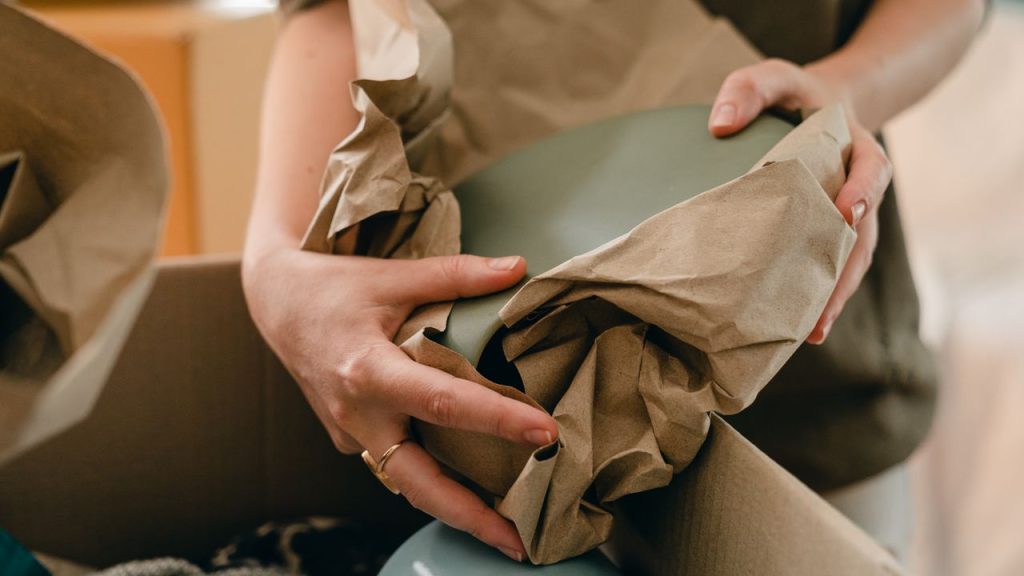
Knowing how to pack crockery for moving comes down to one principle: eliminate movement. A plate wrapped individually and packed tight will survive almost anything; the same plate loosely wrapped in a half-empty box will crack before the van has left the street. Wrap every piece separately, stand plates on their edge, and fill every gap so nothing can shift – get those three things right and your crockery will arrive in one piece.
This guide covers everything: the materials you need, step-by-step techniques for plates, bowls, and mugs, how to choose the right boxes, and what to do on moving day itself.
What You’ll Need to Pack Crockery for Moving
Before you wrap a single plate, gather your materials. Having everything to hand makes the process faster and far less likely to end in disaster.
Essential materials:
Crockery packing paper – unprinted white packing paper or newsprint is the workhorse of crockery packing. It sits flush against the surface of each piece, preventing chips and scratches. Avoid printed newspaper directly against china – the ink transfers.
Bubble wrap – best used as a second layer over packing paper, or as a protective bundle wrap around groups of plates. Don’t use it as the first layer against fine china; it can leave pressure marks on delicate glazes.
Tissue paper – a soft, acid-free first layer for fine china, bone china, or anything with a decorative finish. Particularly useful for heirloom pieces.
Double-walled boxes – significantly stronger than standard single-walled boxes. Crockery is heavy; a single-walled box can buckle under the weight before you’ve even loaded the van.
Cell divider boxes – cardboard inserts that slot together to create individual compartments. The single most effective tool for mugs and cups.
Strong packing tape – reinforce the bottom seams of every box with at least two strips before loading anything.
Marker pen and FRAGILE labels – every box needs to be clearly marked on multiple sides.
Scissors – for cutting paper and tape to size.
Optional but helpful:
Foam pouches or foam sheets (a reusable, paper-free alternative)
Crumpled paper or packing peanuts for void fill
A thick sheet of cardboard to act as a dividing layer between stacked rows
The Best Way to Pack Crockery for Moving – Step by Step
The best way to pack crockery for moving is methodical and unhurried. Rushing is how plates get broken. Here is the full process for a standard set of dinner plates – the same logic applies to side plates, serving dishes, and any other flat crockery. For a dedicated guide to dinner plates, side plates and bowls packed together, see how to pack plates and bowls for moving.
Step 1: Prepare and reinforce the box
Tape the base of the box firmly – two strips across the centre seam and one strip along each side join. Add a generous layer of crumpled packing paper to the base, at least 5–8 cm deep. This cushioning layer is your first line of defence against impact.
Step 2: Wrap each plate individually
Lay a sheet of packing paper flat on a table. Place the plate face-down at one corner of the paper. Fold the paper up and over the plate, then roll diagonally, tucking the edges in as you go. Secure with a small piece of tape. Every plate gets its own wrap – never bundle two plates in the same sheet.
For fine china or bone china, wrap in acid-free tissue paper first, then in packing paper as an outer layer.
Step 3: Group plates into bundles
Once individually wrapped, group three or four plates together and wrap the bundle in a second sheet of packing paper or a layer of bubble wrap. This bundle wrap adds a further layer of protection and keeps the group stable in the box.
Step 4: Stand plates on their edge – the “records not pancakes” rule
This is the single most important rule when packing crockery for a move. Stand plates vertically on their edge, like records in a crate – never flat. When plates are stacked horizontally, every bump in the road transfers through the entire pile, and the bottom plate takes all the weight. On their edge, the load is distributed along the strongest axis of the plate.
Step 5: Fill every gap
Once the plate bundles are standing upright in the box, fill any remaining space with crumpled packing paper, foam, or soft clothing. Nothing should move when you gently shake the box. If you can hear or feel anything shifting, add more padding.
Step 6: Add a top cushioning layer, then seal and label
Place a final layer of crumpled paper or bubble wrap on top before closing the box. Tape it securely. Write FRAGILE, CROCKERY, and THIS WAY UP on at least three sides – not just the top. A label only visible from above is effectively no label at all once the box is in a stack.
How to Wrap Crockery for Moving
The wrapping technique varies slightly depending on the piece. Here is how to handle each type, and how to choose the right material.
The Diagonal Roll Method for Plates
Place the plate face-down at one corner of a large sheet of packing paper. Roll it diagonally across the sheet, tucking the paper edges in as you go – the same motion as wrapping a burrito. The diagonal roll ensures full coverage with minimal wasted paper and creates a neat, secure package that holds its shape.
Bowls: Wrap Before Nesting
Bowls can be nested inside each other, but only after each one has been individually wrapped. Bowl rim against bowl surface – without paper between them – is how chips happen. Wrap the first bowl, nest the next wrapped bowl inside it, and continue. Three or four nested wrapped bowls can then be wrapped as a bundle before going into the box.
Mugs: Handle-First Wrapping
Mugs need special attention because the handle is the most vulnerable point. Start by wrapping the handle with a separate strip of packing paper or bubble wrap, securing it with tape. Then place the mug at the corner of a full sheet of paper and roll diagonally, tucking the paper around the body and base. The handle gets its own dedicated layer before the full wrap goes on.
Crockery Packing Paper vs Bubble Wrap vs Tissue Paper
| Material | Best for | Notes |
|---|---|---|
| Crockery packing paper | All crockery, first layer | Clean, no ink transfer, sits flush to surface |
| Bubble wrap | Second layer, bundle wrapping | Can leave marks if used directly on delicate glazes |
| Tissue paper | Fine china, bone china, decorated pieces | Acid-free, non-reactive, gentle on delicate finishes |
The professional approach – used by removal crews trained to the standards of the British Association of Removers – is to combine materials: packing paper as the first layer in direct contact with the crockery, bubble wrap as an outer layer for additional impact protection.
How to Pack Bowls for Moving
Bowls are more forgiving than plates but still need careful handling. The nesting technique saves space without sacrificing protection – as long as you follow the paper-between-every-layer rule.
The nesting method:
Wrap the largest bowl individually in packing paper.
Wrap the next bowl, then nest it inside the first wrapped bowl.
Continue wrapping and nesting, working from largest to smallest.
Once you have a stack of three or four nested wrapped bowls, wrap the entire bundle in a further sheet of paper or bubble wrap.
Place the bundle in the box – on its edge if the bowl shape allows, or upright if the stack is stable.
Small bowls inside larger ones: Small bowls can sit inside larger ones, but stuff the gap between them with crumpled packing paper to prevent any movement. A small bowl rattling inside a larger one will chip the rim of both.
Padding between layers: If you need to stack two rows of bowls in one box, place a firm sheet of cardboard between the rows – never let one row sit directly on top of another without a rigid dividing layer.
How to Pack Mugs and Cups for Moving
Mugs are surprisingly resilient – but the handle is not. A mug dropped on its handle will almost always lose it. The goal is to protect the handle first, then the body.
Handle protection: Wrap the handle separately before wrapping the whole mug. A strip of bubble wrap around the handle, secured with tape, gives it its own dedicated cushioning layer.
Upright vs upside-down: Pack mugs upright, base-down. The base is the strongest point; the rim is the most vulnerable. Packing mugs upside-down puts pressure on the rim during transit.
Cell dividers: If you have a cell divider box, use it for mugs. Each mug sits in its own compartment, completely isolated from its neighbours. This is the single most effective way to prevent handle-to-body contact between mugs in transit. Cell boxes are widely available from UK removal suppliers and are worth the small additional cost for a full set of mugs.
Without cell dividers: Wrap each mug individually, pack them upright in a small box, and fill every gap with crumpled paper. Keep the box light – a box of mugs gets heavy quickly.
Choosing the Right Crockery Packing Boxes
The box you choose matters almost as much as how you wrap each piece. Using the wrong box – too large, too thin, or too flimsy – undoes even the best wrapping technique.
Dish Pack Boxes
Dish pack boxes (also called china cartons) are the specialist choice for crockery. They are typically double-walled, with a taller internal height that accommodates plates standing on their edge. If you are moving a full dinner service, these are the boxes to use.
Double-Walled Boxes
Double-walled cardboard boxes are the minimum standard for packing crockery for moving. The extra layer of corrugated cardboard makes them significantly more resistant to crushing and impact than standard single-walled boxes. UK suppliers including Kite Packaging, Davpack, and Boxworks all stock double-walled options specifically designed for crockery and china.
Cell Divider Boxes
Cell divider boxes – with cardboard inserts that create individual compartments – are the best packing boxes for crockery when it comes to mugs, cups, and anything with a handle or fragile protrusion. They prevent any item-to-item contact during transit.
A Note on Box Size
Use small or medium boxes for crockery – never large ones. Crockery is heavy. A large box packed with plates will quickly become too heavy to lift safely, and a heavy box is far more likely to be dropped or set down hard. A good rule of thumb: if you cannot lift the box comfortably with one hand supporting the base, it is too heavy.
Can EcoGreen Movers Help?
If you would rather not source boxes yourself, EcoGreen Movers can supply packing boxes as part of their moving service – including dish pack and double-walled boxes specifically suited to crockery and china. It is one less thing to organise in the run-up to moving day.
How to Pack Crockery for Moving House – Room by Room
When packing crockery for moving house, the order in which you pack matters as much as the technique.
Start with the Kitchen
The kitchen is usually the last room you want to lose access to, so pack it in stages:
Pack first: Serving dishes, platters, seasonal items, and anything you use rarely. These can be boxed weeks before moving day.
Pack second: The bulk of your everyday crockery – dinner plates, side plates, bowls – a few days before the move.
Pack last: The mugs, cups, and one or two plates and bowls you will use right up until moving morning. Keep these in a clearly labelled “open first” box.
Everyday Crockery vs Fine China
Separate your everyday crockery from your fine china. Fine china – bone china, porcelain, decorated sets – needs more wrapping material, more careful handling, and its own dedicated box. Mixing a bone china dinner plate with a robust stoneware bowl in the same bundle is a recipe for chips.
Fine china packing tips:
Always wrap in acid-free tissue paper as the first layer.
Use double-walled boxes only – never single-walled.
Label the box FRAGILE – FINE CHINA so it receives extra care during loading and unloading.
How to Pack Dinnerware for Moving as a Complete Set
When packing a full dinner service, work systematically: dinner plates together, side plates together, bowls together, serving dishes together. Keeping like with like makes unpacking faster and reduces the risk of mismatched bundles ending up in the wrong box.
How Much Crockery Packing Paper Do You Need?
A question that is easy to underestimate. Running out of packing paper mid-pack leads to shortcuts – and shortcuts lead to breakages.
Here is a practical estimate based on household size:
| Household size | Crockery items (approx.) | Packing paper needed |
|---|---|---|
| 1–2 people | 20–30 pieces | 1 roll (approx. 50 sheets) |
| 3–4 people | 40–60 pieces | 2 rolls (approx. 100 sheets) |
| 5+ people or full dinner service | 60–100+ pieces | 3–4 rolls |
| Fine china or collector’s sets | Variable | Add 1 extra roll for double-wrapping |
Practical tips:
Buy one more roll than you think you need. It costs very little and the peace of mind is worth it.
Crumpled paper for void fill uses more sheets than you expect – factor this in.
Tissue paper is sold separately; allow one sheet per piece of fine china, plus extras for stuffing gaps.
Common Mistakes That Lead to Breakages
Even careful movers make these errors. Knowing what to avoid is as important as knowing the right technique.
1. Stacking plates flat The most common mistake. Flat stacking transfers every bump through the entire pile, and the bottom plate takes all the weight. Always stand plates on their edge.
2. Overfilling boxes A box that is too heavy is more likely to be dropped, set down hard, or have other items stacked on top of it. Keep crockery boxes to a weight you can lift comfortably.
3. Not labelling FRAGILE on multiple sides A FRAGILE label only on the top of a box is invisible once the box is in a stack. Label all four sides and the top.
4. Using single-wall boxes Single-walled boxes are not strong enough for crockery. They buckle under the weight and offer minimal impact protection. Always use double-walled boxes for crockery.
5. Leaving gaps in the box Any empty space allows crockery to shift during transit. Fill every gap with crumpled paper, foam, or soft clothing until nothing moves when you shake the box.
6. Wrapping multiple pieces in the same sheet Wrapping two plates together in one sheet of paper is one of the most common causes of chips. Every piece needs its own individual wrap.
7. Mixing crockery with heavy non-fragile items Books, appliances, and tools in the same box as crockery will find the weakest point. Keep crockery in dedicated boxes with other fragile items of similar weight.
8. Packing crockery in large boxes Large boxes encourage overpacking. Stick to small or medium boxes for all crockery.
What to Do on Moving Day
Good packing is only half the job. How your crockery boxes are handled on moving day is equally important.
Labelling and Organisation
Write the destination room on every box alongside FRAGILE and THIS WAY UP. This tells whoever is unloading exactly where each box goes – and how to handle it.
Use a colour-coding system if you have many boxes: a coloured sticker per room speeds up unloading and reduces the risk of boxes being mishandled.
Number your boxes and keep a simple inventory. If a box goes missing, you will know immediately.
Loading Order in the Van
Heavy boxes go in first, at the bottom – but crockery boxes are the exception. Crockery boxes should be loaded last and positioned near the van doors, not buried under furniture.
Never stack heavy items on top of crockery boxes. Even a box of books placed briefly on top of a crockery box can cause damage.
Keep crockery boxes upright at all times. A box tipped on its side – even briefly – can allow well-wrapped plates to shift and crack.
Wedge boxes firmly so they cannot slide during transit. Use furniture blankets or soft items to fill gaps between boxes in the van.
On Arrival
Unload crockery boxes first and carry them directly to the kitchen.
Place them on a flat surface and unpack as soon as possible – do not leave them in a stack.
Inspect each piece as you unwrap it. Set aside anything chipped or cracked; a chipped plate is a safety hazard and should not be used.
Thinking About Professional Help?
If you would rather leave the fragile stuff to people who do this every day, EcoGreen Movers has completed over 400 moves across the UK and handles crockery and fragile items with the kind of care that comes from genuine experience. Fully insured, eco-conscious, and with a track record of customer satisfaction that speaks for itself – it is the kind of reassurance that makes moving day feel a lot less daunting.
Frequently Asked Questions
What is the best way to pack crockery for moving?
The best way to pack crockery for moving is to wrap every piece individually in packing paper, stand plates on their edge (never flat), and fill every gap in the box so nothing can move. Use double-walled boxes, reinforce the base with tape, and label every box FRAGILE and THIS WAY UP on multiple sides. These steps, taken together, are the most reliable way to prevent breakage.
What is the difference between crockery packing paper and bubble wrap – which should I use?
Use crockery packing paper as the first layer in direct contact with each piece – it sits flush to the surface, prevents ink transfer, and stops chips. Use bubble wrap as a second outer layer around bundles of wrapped plates, or to line the inside of boxes. Bubble wrap used directly against fine china or decorated glazes can leave pressure marks. For the best protection, combine both.
How do I pack plates for moving without them breaking?
Wrap each plate individually in packing paper, then stand them vertically on their edge in a small or medium double-walled box – like records in a crate, never flat. Cushion the base of the box with crumpled paper, fill every gap so nothing can shift, and label the box FRAGILE on all sides. This is the single most effective method for how to pack plates for moving without breakage.
What are the best packing boxes for crockery in the UK?
The best packing boxes for crockery are double-walled dish pack boxes or china cartons. These are specifically designed for heavy, fragile kitchen items and are significantly stronger than standard single-walled boxes. For mugs and cups, cell divider boxes – with individual cardboard compartments – are the gold standard. UK suppliers including Kite Packaging, Davpack, and Boxworks all stock suitable options.
How do I wrap crockery for moving – is there a specific technique?
Yes. For plates, use the diagonal roll method: place the plate face-down at one corner of a large sheet of packing paper and roll diagonally, tucking the edges in as you go. For mugs, wrap the handle separately first with a strip of bubble wrap, then wrap the whole mug in a full sheet. For bowls, wrap each individually before nesting them inside each other with paper between every layer.
How do I pack dinnerware for moving as a complete set?
Work systematically: pack dinner plates together, side plates together, bowls together, and serving dishes together. Keep everyday stoneware separate from fine china or bone china – the latter needs tissue paper as a first layer and double-walled boxes only. Label each box with its contents and destination room. Pack the pieces you use daily last, in a clearly marked “open first” box.
How do I pack crockery for moving house if I have fine china?
Fine china needs extra care. Wrap each piece in acid-free tissue paper first, then in packing paper, then in bubble wrap as an outer layer. Use double-walled boxes only – never single-walled. Keep fine china in its own dedicated boxes, separate from everyday crockery, and label them FRAGILE – FINE CHINA. A mid-range dinner set costs £45–£150 to replace; a fine china service can cost considerably more – the extra wrapping is always worth it.
What boxes should I use for crockery – does the box type really matter?
Yes – significantly. A single-walled box is not strong enough for crockery. It will buckle under the weight and offer minimal impact protection. Always use double-walled boxes as a minimum. For a full dinner service or fine china, use specialist dish pack boxes (china cartons). For mugs and cups, add cell divider inserts to prevent item-to-item contact. And always use small or medium boxes – never large ones, which encourage overpacking and become dangerously heavy.
Useful Sources
British Association of Removers – Fragile and Non-Fragile Packing Training – The UK removal industry’s professional training standard for packing fragile items, including crockery and glassware.
The Van Man Co – How to Pack Plates and Fragile Items for Moving Day – Detailed UK guide covering the “records not pancakes” rule and wrapping techniques for plates, bowls, and mugs.
Bournes Moves – How to Pack Plates and Bowls When Moving House – Step-by-step video guide from a long-established UK removal company.
The Independent – Mirrors and Crockery Most Likely to Be Damaged During Moves – UK survey data showing crockery accounts for 20% of all items damaged during house moves.
Big Brown Box – How to Pack Crockery Safely for Moving House – Practical UK packing guide from a specialist removal supplies retailer.
Kite Packaging – Removals Boxes – UK supplier of double-walled boxes and specialist removals packaging, with 73 double-wall sizes in stock.