
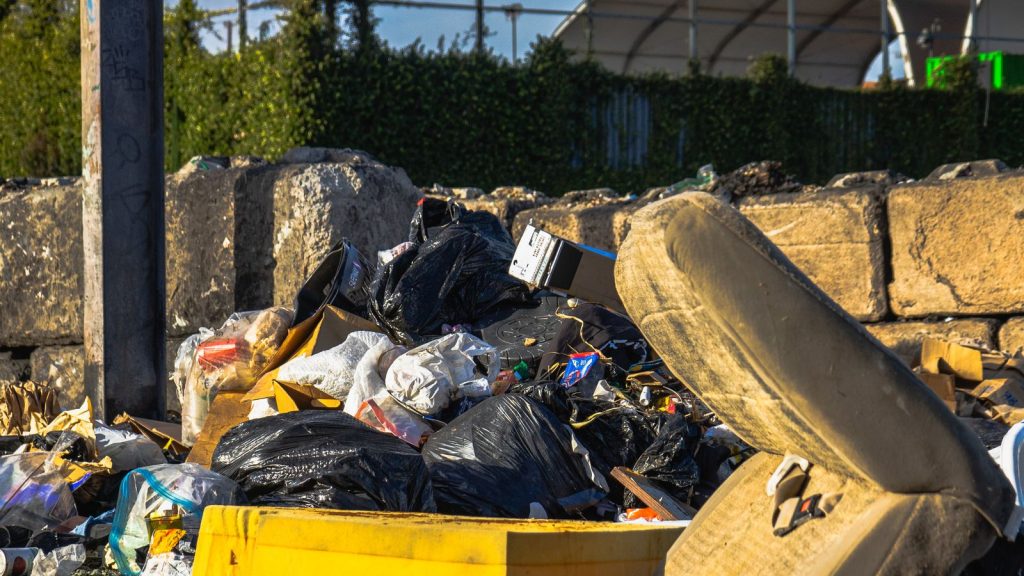
A mattress will not fit in a wheelie bin, and propping one against the side of it is not a grey area. The government’s household waste guidance names old mattresses specifically as the kind of waste that needs a route of its own, and leaving one at the kerb without a booked collection is fly-tipping.
The better news is that five legitimate routes exist and the most common one is free. What separates them is not really price. It is how much lifting you personally end up doing, which is the part most disposal guides skate over. Whether you own a vehicle, and whether the mattress is currently upstairs, will shape this decision more than any advertised fee.
Summary: Taking a mattress to a household waste recycling centre (HWRC) yourself is free in most areas. A council bulky waste collection costs a fee your council publishes, and you must get the mattress to your boundary yourself. If you pay anyone else to take it, check them on the Environment Agency public register first: under the householder duty of care you can be fined if your mattress is later dumped.

The five routes, and who does the lifting
| Route | What you pay | Wait | Who carries it | The catch |
|---|---|---|---|---|
| Recycling centre, under your own steam | Free in most areas | Same day | You | Needs a vehicle it fits in, plus a booked slot or van permit at many sites |
| Council bulky waste collection | A fee your council publishes | Days to weeks | You, as far as the boundary | Crews will not step inside the property |
| Retailer take-back with a new mattress | A recycling charge on the order | Arrives with the replacement | The delivery team | Has to be booked at the point of order, not on the doorstep |
| Charity collection | Free | Varies | The charity | Needs an intact fire label, and most charities still say no |
| Licensed private collection | The dearest route by a distance | Same or next day | Them, from any room | You must check the carrier registration yourself |
Fees are worth looking up rather than guessing at, because they are set locally and the spread across the country is wide. Search your council’s name alongside “bulky waste” and the current charge will be published on their site. Plenty of councils also reduce or waive the fee for residents on means-tested benefits, which is a question worth asking outright rather than assuming the headline rate applies to everyone.
The liability rule that catches people out
Under the householder duty of care, occupiers of a domestic property must take all reasonable measures to pass household waste only to an authorised person. An authorised person means your council, a business holding a valid waste carrier registration, or a site with the right environmental permit. Failing that duty is a criminal offence, and the penalty lands on you rather than on the person who did the dumping. See the Defra waste duty of care code of practice, section 5.
Two separate penalties get muddled together constantly, including by people who ought to know better, so it is worth pulling them apart. Dumping waste yourself is fly-tipping, and the maximum fixed penalty notice for that rose to £1,000 in July 2023. Handing your waste to an unregistered collector who then dumps it is a duty of care breach, a different offence with a lower ceiling of £600. Councils set their own level within a £150 to £600 band. Refuse to pay either and the matter can go to court, where the fine is unlimited. The House of Commons Library briefing on fly-tipping sets out both regimes.
The practical shape of this is depressingly ordinary. Someone pays cash to a van that answered a local advert, the mattress surfaces in a lay-by a fortnight later, a delivery label or an old envelope inside the load points back to an address, and the householder opens a letter they were not expecting. Guarding against that takes about a minute.
- Search the register. The Environment Agency publishes waste carrier registrations for England, with equivalent registers held by the Scottish Environment Protection Agency and Natural Resources Wales. Upper tier registration numbers begin with the letters CBDU.
- Ask for the number outright. Anyone legitimate reels it off. Hesitation tells you what you need to know.
- Keep whatever paperwork you get. Householders are not legally required to hold a waste transfer note, but a receipt naming a registered business is exactly the evidence that closes an investigation early.
- Photograph the van. Registration, livery, company name. Ten seconds of effort that links a dumped load back to an operator rather than to you.
- Treat free removal with suspicion. An offer to take a mattress away for nothing, with no charity behind it and no registration on display, is not generosity.
None of which makes private collection a bad choice. A registered operator carrying a double down from a first-floor bedroom is worth real money to plenty of households, particularly anyone moving alone or nursing a bad back. The instruction is simply to check the registration rather than the price.
Why charities usually say no
Charities that supply second-hand furniture are doing so in the course of business, which puts them inside the Furniture and Furnishings (Fire) (Safety) Regulations 1988. Used goods must meet the same standard as new. For a mattress, the label to look for cites BS 7177, the ignition resistance standard for mattresses, divans and bed bases. Anything that cannot be verified from its label has to go to a recycling centre instead of a shop floor, per Business Companion, the Chartered Trading Standards Institute guidance service.
So check for the label before you make a single phone call. On a mattress it is normally sewn into a side seam or the underside. No label means no charity can take it, however pristine it looks, because they would be breaking the law by reselling it. Note that this is a different tag from the “carelessness causes fire” permanent label found on sofas and armchairs, which mattresses and bed bases are exempt from.
Hygiene does the rest of the work. Even with a valid label, a great many charities decline used mattresses outright as a matter of policy. The ones running dedicated furniture operations are your best prospect, and some collect free of charge, which is comfortably the happiest ending available. Ring ahead and describe the thing honestly, age and marks included. A crew that drives over and refuses it has lost a morning and so have you.
Selling privately is worth a try for something genuinely good, though temper your expectations. The second-hand market for mattresses is thin, and a listing nobody answers just postpones the problem by a fortnight. Anything damp, mouldy or infested closes every reuse route at once and will be turned away at a recycling centre too, since sites cannot handle it safely. That one needs a professional collection where it can be bagged properly.

What actually happens to it after collection
Mattress recycling in the UK has improved sharply. The National Bed Federation (NBF) found that 56 percent of mattresses were sent for recycling in 2023, more than double the 25 percent estimated for 2021. Material actually recovered, which the NBF calls real recycling, rose from 14 percent in 2020 to 33 percent. The trade body’s own target is 75 percent diverted from landfill by 2028, and it warns that target is still some way off. Figures from the NBF fifth End of Life Mattress Report.
Sit with those two numbers for a second, because the gap between them is the whole story. Being sent for recycling and being recycled are not the same event. A mattress that reaches a specialist reprocessor gets taken apart properly: steel springs go back to steel, polyurethane foam turns into carpet underlay and insulation, textiles become industrial wiping cloths. A mattress that reaches a general waste transfer station does not.
Which is why the route you pick matters past the price tag. Ask directly what happens to it. Councils publish their arrangements, and a decent private operator will tell you plainly whether they use a mattress recycler or a transfer station. Two firms quoting almost identical figures can send your mattress to entirely different fates, and the only way to know is to ask.
Keep it dry in the meantime, too. A mattress left out overnight in the rain drinks in a startling amount of water, becomes far heavier to shift, and can be rejected at the gate for being saturated. If it is going out for a booked collection, put it out that morning rather than three days early, and bag it if you have one.
Cost against effort for a real move
Comparing these routes on money alone flatters the cheap ones, because each hides a different quantity of work and a different set of assumptions about your staircase. Here they are with the forgotten costs added back in.
| Route | Direct cost | Hidden cost | Realistic effort | Suits |
|---|---|---|---|---|
| Own car or borrowed van to the recycling centre | Free in most areas | Fuel or van hire, and a second pair of hands | Half a morning | Anyone with access to a big enough vehicle |
| Council collection | Published local fee | Carrying it to the boundary | Twenty minutes, then a wait | Ground-floor homes that are not in a hurry |
| Retailer take-back | Recycling charge on the order | Only exists if you are buying new | None | Anyone replacing the mattress anyway |
| Licensed private collection | Highest | None beyond checking the registration | Answering the door | Upstairs flats, no vehicle, short notice |
| Add it to a removals job | Varies | Must be agreed in advance | None | Households already booking a move |
Two things follow from that. Retailer take-back is the most overlooked option on the list, purely because it has to be arranged at the moment you order the replacement rather than the moment it turns up. Ten minutes of forethought at checkout makes the entire problem vanish, and it is usually the cheapest paid route going.
The council route, meanwhile, looks like the sensible middle ground and often is. It also quietly assumes you can wrestle a double mattress out to your boundary without help, because the crew will not come in and get it. For a first-floor flat, or anyone living alone, the saving against a private collection can evaporate the moment you try.
When to keep it rather than dispose of it
If the mattress is unstained, comfortable and not yet showing sag, moving it is almost always cheaper than replacing it. Disposal plus a new mattress is a three-figure decision at the very least, and removals firms carry mattresses as routine work. Bear in mind that reuse is the step above recycling in the waste hierarchy set out in the waste duty of care code of practice, so keeping a serviceable mattress is the better environmental outcome as well as the cheaper one.
Disposal guides tend to open with the assumption that you have already decided to get rid of it. Mid-move, that decision is frequently still live, and the honest arithmetic favours keeping a decent mattress rather more often than people expect.
The real counter-argument is access, not condition. A super king that will not turn the corner of a narrow Victorian staircase is a mattress you cannot use, and discovering that at four o’clock on moving day is an expensive way to learn it. Measure the stairwell and any tight turns at the new place before you commit.
If it is coming, protect it. A mattress bag costs a few pounds and stops the thing arriving damp and grey after a trip across a wet driveway. Any competent removals firm will supply one or bring one along.
And if it is not coming, sort it out before the van arrives rather than after. A mattress abandoned in an empty property becomes the new owner’s headache or a dilapidations line on your deposit, and our guide to decluttering before a move covers where everything else ought to go.
How EcoGreen Movers handles it
Tell us at the quoting stage if a mattress is not coming with you. EcoGreen Movers works to a fixed quote based on what is actually moving, so an item taken off the inventory changes the price rather than being discovered on the day, and we can point you at the disposal route that suits the property.
We run residential moves across the UK, including London, Manchester and Edinburgh, with mattress bags supplied for anything that is travelling. The move comes at three levels, Standard for loading and unloading, Standard Plus with bed frames dismantled and rebuilt, and Premium with the packing included, and we also handle disposal and clearance so an old mattress can leave in the same visit rather than waiting weeks for a council slot. Boxes are sold on their own, and storage is available where a bed has nowhere to go yet. Get in touch for a quote.
Frequently asked questions
Can a mattress go in a wheelie bin?
No. It will not fit, and leaving one beside the bin counts as fly-tipping, which carries a fixed penalty notice of up to £1,000 and an unlimited fine on conviction. Defra’s household waste guidance treats mattresses as waste requiring a separate route, whether that is a recycling centre, a booked bulky collection or a registered carrier.
Is the recycling centre free for mattresses?
Free for residents at most household waste recycling centres, though a minority of areas have introduced a charge to fund separate mattress recycling. Many sites also want proof of address, a pre-booked slot, or a permit if you are arriving in a van, so check your council’s page before setting off.
Will a charity take a used mattress?
Often not. Many decline on hygiene grounds regardless of condition, and any charity reselling one is legally required to verify it meets the Furniture and Furnishings (Fire) (Safety) Regulations 1988, which for a mattress means an intact label citing BS 7177. Charities running furniture operations are the likeliest yes, and some collect free.
Am I liable if a collector dumps it?
You can be. The householder duty of care requires you to hand waste only to an authorised person, and a breach carries a fixed penalty notice of up to £600, with councils setting their own level between £150 and £600. Checking the carrier on the Environment Agency register and keeping a receipt is the defence.
Can a mattress actually be recycled?
Yes, and increasingly it is. National Bed Federation research put 56 percent of UK mattresses as sent for recycling in 2023, with 33 percent of material genuinely recovered. Springs return to steel production, foam becomes underlay or insulation, textiles become industrial cloths. Whether yours joins that figure depends on the route you choose.
In summary: check the registration, not just the price
Buying a replacement? Arrange take-back when you place the order and the problem solves itself for a modest recycling charge. Otherwise the recycling centre is free in most areas, and a council collection costs a published local fee provided you can get the mattress as far as your boundary.
Whoever ends up taking it, confirm they hold a valid waste carrier registration and hang on to the receipt. A bargain collection that finishes in a lay-by turns into your fixed penalty, and that is a far more expensive result than any of the legitimate routes on this page.