
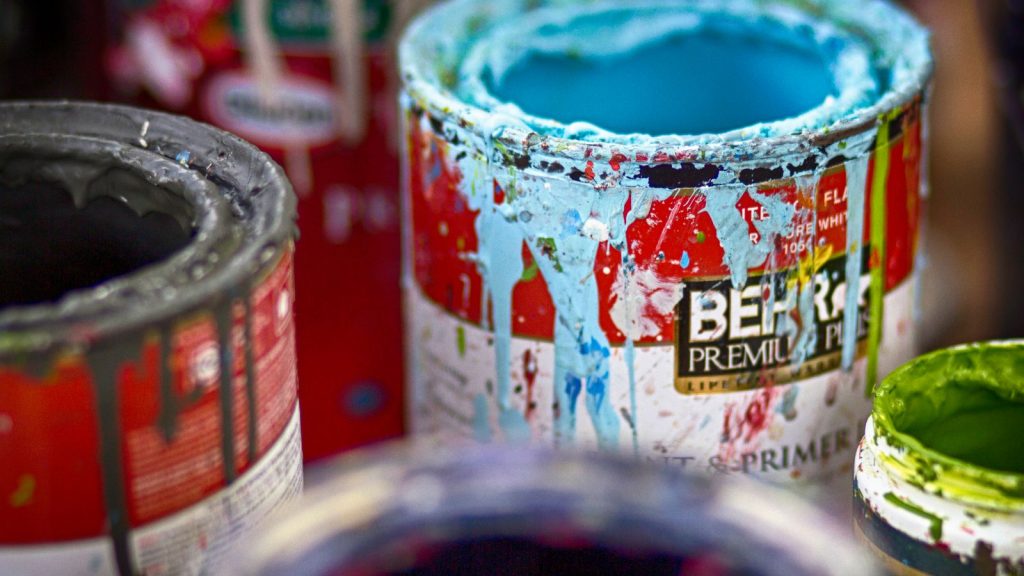
Every move turns up paint. Half tins under the stairs, a gloss from a door frame done six years ago, emulsion the previous owner left in the garage and never mentioned. Two separate rules govern all of it, and almost everybody blurs them into one.
Rule one applies to every tin regardless of type: liquid waste is banned from landfill, so no council will take liquid paint in a bin and no recycling centre will accept it in that state. Rule two applies only to some tins: solvent-based paint, thinners and white spirit are classified as hazardous waste and need handling as such. Water-based emulsion is not hazardous. It simply has to stop being liquid.
That distinction is the whole article, really. Get it right and most of what a household finds during a clear-out costs nothing to deal with and needs no special trip.
Summary: Donate usable paint through a reuse scheme such as Community RePaint. Harden leftover water-based paint by stirring in sawdust, sand or soil with the lid off, then bin it once it is solid and pierced through to confirm. Take solvent-based paint, thinners and white spirit to a household waste recycling centre (HWRC) as hazardous waste. Never pour paint down any drain. See Recycle Now’s paint guidance, run by the WRAP charity.

Matching the method to what is in the tin
| What you have | Correct route | Can it go in a bin? | Watch out for |
|---|---|---|---|
| Usable water-based paint, tin over half full | Community RePaint or a local reuse scheme | No, donate it | Must be genuinely usable, not separated or years old |
| Leftover water-based paint, small amount | Harden, then general waste | Yes, once fully solid | Tacky is not solid. Wait longer |
| Gloss, undercoat, varnish, wood stain | Hazardous bay at an HWRC, or a licensed carrier | No, never | Do not dry these at home and bin them |
| White spirit, thinners, brush cleaner | Hazardous bay at an HWRC | No | Classified hazardous in its own right |
| Empty, dry metal tin | Scrap metal at an HWRC, sometimes kerbside | Often yes | A thin dried coating is fine, foundries burn it off |
| Empty plastic paint tub | HWRC, kerbside in some areas | Varies | Less consistently accepted than metal |
Sort the tins into those two families before you start anything else. Emulsion, masonry paint and water-based gloss are the straightforward group. Traditional oil-based gloss, primer, undercoat, varnish and wood stain are the hazardous group. Read the tin if you are unsure: anything that tells you to clean brushes with white spirit rather than water belongs in the second pile.
Hardening a tin properly
Stir an absorbent material into water-based paint until no free liquid remains, then leave the lid off somewhere ventilated and out of reach of children and animals. Recycle Now recommends a proprietary paint hardener, or sawdust, sand or soil. Before you take it anywhere, pierce the dried surface to confirm it has set the whole way through rather than skinning over a wet middle. Guidance from Recycle Now.
That piercing step is the one people skip, and it is the reason tins get turned away. A skin forms early and looks convincing. Underneath, a half-full tin of emulsion can still be entirely wet a week later, which is why the surface test tells you nothing and the poke test tells you everything.
Sawdust is free if you have any. Builder’s sand, dry soil and cheap cat litter all do the same job, and commercial hardener sachets from DIY and trade suppliers work faster if you are facing more than a few tins. How long it takes depends on how much paint is in there, so plan around the volume rather than the clock.
For a scraping at the bottom of a tin, skip the absorbent altogether. Brush it out thinly onto scrap cardboard, let it dry, then the cardboard goes in general waste and the tin goes in metal recycling. Faster, and it produces less waste on the way through.
Do all of this at the start of packing rather than the end. Drying time is trivial when you have six weeks and impossible when the van is due at eight. Paint belongs in the first weekend of sorting, alongside everything else covered in our guide to decluttering before a move.
One safety note. Solvents and water evaporating off an open tin produce fumes, so work in a garage with the door up, a shed, or outside under cover. Not the kitchen, and not anywhere anyone sleeps.
Donating what is still good
Reuse sits above recycling and disposal in the waste hierarchy, which UK waste law requires to be applied in order. Community RePaint is the established UK network for this, collecting usable leftover paint and passing it to charities, community groups, schools and households on low incomes. Recycle Now names it as the route for unwanted but usable paint on its paint page.
Schemes set their own criteria, and knowing the common ones saves a pointless drive. Expect the tin to need to be at least half full, water-based, still usable, and sealed well enough to travel without leaking. Label it with the colour, brand and finish while you are at it, because an anonymous white tin is far harder to rehome than a named one.
- Skip anything very old. Paint that has separated, gone lumpy or turned sour is not a donation, it is a disposal job you are handing to a volunteer.
- Rule out anything frozen. Emulsion that spent a winter in an unheated garage is usually finished even when it looks fine in the tin.
- Stir before you judge. Settling and separation on standing are normal and reversible. Lumps through the body of the paint, a skin all the way down, or a sour smell are not.
- Check opening times. Many schemes operate out of a recycling centre or community site with limited days, and some want you to book.
- Look for a reuse cabinet. Several councils keep donated water-based paint in a marked cabinet at the recycling centre for anyone to take free.
Before any of that, try the direct route. Neighbours, community groups, scout huts and anyone mid-decorating will take a decent tin of emulsion off your hands the same afternoon, which beats every formal scheme on speed.

Using a recycling centre without wasting a trip
Household waste recycling centres route paint through a separate hazardous or chemical bay rather than general recycling, and many restrict quantity, require pre-booking, or accept hazardous waste only on set days. Find your nearest service by postcode on the GOV.UK hazardous waste disposal finder for England and Wales. Scotland is covered by the Scottish Environment Protection Agency and Northern Ireland by the Department of Agriculture, Environment and Rural Affairs.
Limits vary enormously between councils, and they are real. Some cap the number of items per visit, some cap the litres per household per month, some cap the size of an individual container, and a fair number want a form completed and confirmed before you turn up. Turning up unannounced with a boot full of chemicals is how people get sent home again.
Bring tins upright in a crate, lids on, ideally in their original containers with the labels still legible. Sites frequently refuse hazardous waste that has been decanted into something unmarked, because staff cannot identify what they are being handed.
One useful quirk of the rules: hazardous waste coming out of a domestic household does not need a consignment note, unlike the same substance from a business. That exemption is set out in the Defra waste duty of care code of practice. Clearing your own garage is paperwork-free. Clearing one as a trade means the full regime applies to you.
If you are a decorator, or clearing a property with serious quantities, a recycling centre is the wrong destination entirely. Sites are set up for household volumes and will decline trade waste. A licensed hazardous waste contractor is the route, and they will quote on what you actually have.
The other garage items with the same problem
Paint is rarely alone. The same clear-out usually surfaces white spirit, brush cleaner, weedkiller, engine oil, brake fluid, aerosols and stale fuel. All are hazardous waste, and none of them can lawfully travel in a removals van. Classification rules for each are set out in the GOV.UK waste classification guidance.
Round them up in one go rather than finding them one at a time over three weekends. Most recycling centres cover chemicals, oils, solvents and batteries in the same hazardous area, so a single well-planned trip usually clears the lot.
- White spirit and brush cleaner. Hazardous, never poured away. Let the residue settle out, decant the clear solvent to reuse, and hand the sludge in.
- Engine oil and brake fluid. Most sites run a dedicated oil bank. Do not mix oil types in one container, as it makes the whole lot harder to process.
- Aerosols. Genuinely empty ones usually go with metals. Part-full ones count as hazardous and must never be punctured or crushed.
- Garden chemicals. Hazardous, and several older products have been withdrawn from sale since you bought them, which changes nothing about your duty to dispose of them properly.
- Petrol and diesel in cans. Ring first. Many sites restrict the quantity or want advance notice.
- Gas canisters and camping gas. Commonly refused outright. Take these back to the supplier or a specialist.
Mention the garage to your removals company when you get the quote, not on the day. Hazardous goods are excluded from what a removals firm may carry, so a crew that discovers a jerrycan behind the lawnmower at nine in the morning will quite rightly leave it exactly where it is.
The drain rule and why it is enforced
Of every disposal shortcut in this article, one carries real criminal exposure and it remains stubbornly common. Here is what each version actually does.
| Method | Legal position | What actually happens | Consequence |
|---|---|---|---|
| Down a household sink or toilet | Prohibited | Solids build up along the pipe run | Blockages you pay to clear, plus load on treatment works |
| Down an outside drain or gully | Criminal offence | Surface drains commonly run straight to a watercourse | Prosecution, unlimited fine on conviction, clean-up costs |
| Poured onto soil or a garden | Criminal offence | Contaminates ground and can reach groundwater | The same enforcement exposure |
| Liquid paint into a wheelie bin | Not permitted | Liquid waste is banned from landfill | Bin refused and collection missed |
| Liquid paint into a skip | Not permitted without agreement | Contaminates the entire skip load | Operator surcharge, or refusal to collect |
The outside drain is the one that gets people prosecuted, and the reason is a piece of plumbing most households have never thought about. Foul drains go to a treatment works. Surface water drains, the ones in driveways and gardens, very often discharge to a river or stream with no treatment whatsoever. Rinsing a roller tray over a garden gully is therefore not a shortcut to the sewer, it is a direct discharge into a watercourse, which is why regulators take it as seriously as they do.
The skip trap catches house-clearers specifically. A skip is licensed for the waste type you agreed with the operator, and a part-full tin tipped in can contaminate the whole load. Ask before you book, and put only bone-dry empty tins in.
Brushes and rollers are the forgotten source. For water-based paint, rinse into a bucket, let the solids drop out, pour the clear water away and harden what is left in the bottom. Brushes used with solvent-based paint need white spirit, which is hazardous waste itself and follows the same route as the gloss it came off.
When to keep it rather than get rid of it
Keep a small labelled quantity of every colour currently on your walls, and leave a labelled tin behind for the buyer if you are selling. Touch-up paint is close to impossible to match afterwards, and retaining a usable product sits at the top of the waste hierarchy that UK waste law requires holders to apply, as set out in the waste duty of care code of practice.
Disposal guides rarely make this point, but the best outcome here is frequently not disposal at all. A jam jar of each shade, labelled with the room, the brand, the colour name and the finish, occupies almost no space and saves a full repaint the first time a radiator gets clipped by a chair.
Selling up? Ask the buyer through the agent whether they want the tins before you go anywhere near the sawdust. Plenty will, especially for a colour they plan to live with. What is not fair is abandoning a stack of unlabelled tins in the garage without asking, which just moves the job onto somebody else.
If you do keep paint, keep it somewhere warm. A UK winter in an unheated garage frequently freezes emulsion and separates it past saving, so an internal cupboard or a loft is the better bet. Seal the lid down firmly and stand the tin upside down for a moment to form a seal at the rim, which slows skinning.
Do be honest about quantity, though. Three tins of the same white is not a touch-up supply, it is a storage problem you have agreed to have again in five years. Keep one. Donate or harden the others.
How EcoGreen Movers handles what is left
Removals firms cannot carry hazardous goods, and paint sits on that list alongside fuels, gas canisters and solvents. EcoGreen Movers raises this when quoting rather than on the morning, so nothing gets discovered in a garage with the van already half loaded.
We run residential moves across the UK, including London, Manchester and Edinburgh, and our low-waste approach applies to what leaves the property as much as what arrives at the other end. Paint cannot travel in the van under any service level, but the rest of a garage frequently can: Standard covers loading and unloading, Standard Plus adds shelving and furniture dismantled and rebuilt, and Premium adds the packing. Our disposal and clearance service takes the non-hazardous remainder of a garage clear-out, packing boxes are sold on their own, and storage is available between dates. Get in touch for a quote.
Frequently asked questions
Can paint go in the wheelie bin?
Only once fully hardened, and only if it is water-based. Liquid waste is banned from landfill, so no liquid paint of any type belongs in a bin. Solvent-based paint, gloss and varnish should not be dried at home and binned at all, because they are hazardous waste and need a recycling centre or a licensed carrier.
Is all liquid paint hazardous waste?
No, and this trips people up. Solvent-based paint, thinners and white spirit are hazardous. Ordinary water-based emulsion is not. Emulsion still cannot go in a bin while liquid, but that is because liquid waste is barred from landfill rather than because the paint itself is classified as dangerous.
Are empty tins recyclable?
Metal ones generally are, as scrap at a recycling centre and at the kerbside in some areas. A thin dried coating inside is not a problem, since it burns off during processing. Plastic paint tubs are accepted far less consistently and often have to go to a recycling centre instead.
Where can usable paint be donated?
Community RePaint operates a UK-wide network of local schemes, and Recycle Now points to it as the route for paint that still has life in it. Tins normally need to be at least half full, water-based and genuinely usable. Some councils also run a free reuse cabinet at their recycling centres.
Is pouring paint down a drain really illegal?
Yes. Outside drains are the serious case, because surface water drainage frequently discharges to rivers with no treatment at all, making it a direct pollution offence. Regulators prosecute, and a conviction carries an unlimited fine plus the cost of cleaning up whatever you put in the water.
In summary: donate, harden, then bin
Split the tins into water-based and solvent-based before anything else. Pass on whatever is usable and over half full, either through Community RePaint or to somebody local who is decorating. Stir sawdust or sand through the rest of the water-based paint, wait until it crumbles, pierce it to check, and put it in general waste.
Solvent-based paint and thinners go to the hazardous bay at a recycling centre, as does anything in real quantity. Begin a fortnight out rather than two days out, because drying is the one part of this that refuses to be hurried.