
Key Takeaways
Knowing how to pack glasses for moving is one of the most important things you can do to protect your belongings on moving day. Wrap every glass individually in packing paper or bubble wrap, pack them upright in a sturdy box with plenty of cushioning, and label each box clearly as FRAGILE and THIS WAY UP. Get those three things right and you’ll arrive at your new home with your glassware intact.
It sounds simple – and it is, once you know the method. This guide walks you through everything: the materials you need, step-by-step wrapping techniques for standard glasses and delicate wine glasses, how to pack plates and glasses together, paper-free alternatives, and what to do on moving day itself.
Why Packing Glassware Properly Really Matters
Glassware is among the most commonly damaged items during a UK house move. A 2025 survey by Compare My Move found that 48% of Brits have experienced at least one item broken or damaged during a house move, with crockery and glassware among the top casualties – accounting for 20% of all damaged goods. The same study found that 37% of those who suffered breakages admitted they could have spent more time packaging their items properly.
That’s a sobering number. The good news? With the right technique, packing glasses for moving is entirely manageable – and this guide gives you everything you need.

What You’ll Need Before You Start
Before you begin wrapping a single glass, gather your materials. Having everything to hand makes the process faster, calmer, and far less likely to end in disaster.
Essential packing materials:
Packing paper – the workhorse of glassware packing. Unprinted newsprint or white packing paper is ideal. Avoid printed newspaper, which can transfer ink onto your glasses.
Tissue paper for packing glasses – a soft, acid-free first layer that won’t scratch or stain delicate crystal or fine glassware. Particularly useful for heirloom pieces or anything with a decorative finish.
Bubble wrap – adds an extra layer of cushioning around wrapped glasses, especially useful for stemware and anything particularly fragile.
Cell divider boxes (glasses packing box) – cardboard inserts that slot into a standard box to create individual compartments for each glass. These are the single most effective tool for preventing glasses from knocking together in transit.
Double-walled cardboard boxes – stronger than standard single-walled boxes and far less likely to buckle under the weight of glassware.
Strong packing tape – reinforce the bottom seams of every box before you start loading.
Marker pen and fragile labels – you’ll need to label every box clearly.
Scissors – for cutting paper and tape to size.
Optional but helpful:
Foam pouches or foam sheets (great for a paper-free approach – more on this below)
Packing peanuts or crumpled paper for void fill
Coloured stickers or a labelling system to match boxes to rooms
How to Pack Glasses for Moving Step by Step
This method works for standard tumblers, pint glasses, mugs, and everyday drinking glasses. It’s the best way to pack glasses for moving when you want a reliable, repeatable process.
Step 1: Prepare your box
Tape the bottom of the box firmly – two strips of tape across the seam and one strip along each side join. Add a generous layer of crumpled packing paper or bubble wrap to the base. This cushioning layer is your first line of defence against impact.
Step 2: Stuff the inside of each glass
Before wrapping, stuff the inside of each glass with a ball of crumpled packing paper. This internal support helps the glass hold its shape under pressure and prevents the walls from collapsing inward if the box is squeezed.
Step 3: Wrap each glass individually
Lay a sheet of packing paper flat on a table. Place the glass on its side at one corner of the paper. Roll the glass diagonally across the paper, tucking the edges in as you go – much like wrapping a burrito. Secure with a small piece of tape if needed. Never wrap two glasses together – each one needs its own layer of protection.
For extra-fragile pieces, add a second layer: wrap in tissue paper first, then in packing paper, then in a sheet of bubble wrap.
Step 4: Pack glasses upright
Place each wrapped glass base-down and upright in the box. The base of a glass is its strongest point; the rim is the most vulnerable. Packing glasses upright significantly reduces the risk of rim damage.
Step 5: Use cell dividers if you have them
If you’re using a cell divider box, slot each wrapped glass into its own compartment. This prevents any glass-to-glass contact, which is the most common cause of chips and cracks during transit.
Step 6: Fill every gap
Once all the glasses are in, fill any remaining space with crumpled packing paper or foam. The golden rule: nothing should move when you gently shake the box. If you can hear or feel anything shifting, add more padding.
Step 7: Add a top cushioning layer
Place a final layer of crumpled paper or bubble wrap on top of the glasses before closing the box. This protects against anything being placed on top of the box during the move.
Step 8: Seal and label
Close the box and tape it securely. Write FRAGILE, GLASSES, and THIS WAY UP clearly on at least three sides of the box – not just the top. Movers need to see the label no matter how the box is positioned.
How to Pack Wine Glasses for Moving
Wine glasses deserve their own section. The stem is the weakest point of any wine glass – it’s slender, unsupported, and highly vulnerable to lateral pressure. The best way to pack wine glasses for moving requires a slightly different technique to standard tumblers.
The Stem-First Wrapping Method
This is the technique used by professional removal crews and is widely regarded as the most reliable approach for how to wrap wine glasses for moving.
Step 1: Wrap the stem first
Tear off a strip of bubble wrap or a small sheet of packing paper and wrap it tightly around the stem alone. Secure with tape. This gives the most fragile part of the glass its own dedicated layer of protection before you do anything else.
Step 2: Stuff the bowl
Gently stuff the bowl of the wine glass with a small ball of crumpled tissue paper. Don’t pack it too tightly – you’re providing internal support, not pressure.
Step 3: Wrap the full glass
Lay a large sheet of packing paper flat. Place the wine glass at one corner, stem pointing towards the centre of the sheet. Roll diagonally, tucking the paper around the bowl and base as you go. Fold in the sides and continue rolling until the glass is fully covered. Secure with tape.
Step 4: Add bubble wrap for extra protection
For your best glasses – crystal, Riedel, or anything with sentimental value – wrap the fully papered glass in a sheet of bubble wrap as a final outer layer. This is the best way to pack wine glasses for moving when you genuinely cannot afford to lose them.
Step 5: Pack upright in a cell box
Wine glasses should always be packed upright, base-down, in a cell divider box. Never pack them on their sides or upside down. The stem is far more likely to snap under lateral or downward pressure.
Step 6: No stacking
Unlike plates, wine glasses should never be stacked on top of each other, even when wrapped. Keep each glass in its own cell and keep the box to a single layer of glasses.
A word on champagne flutes: Flutes are even more delicate than standard wine glasses. Use the same stem-first method, but consider wrapping the stem in two layers of bubble wrap before applying the paper. A dedicated flute or champagne glass box with narrow cells is the safest option.
How to Pack Plates and Glasses Together
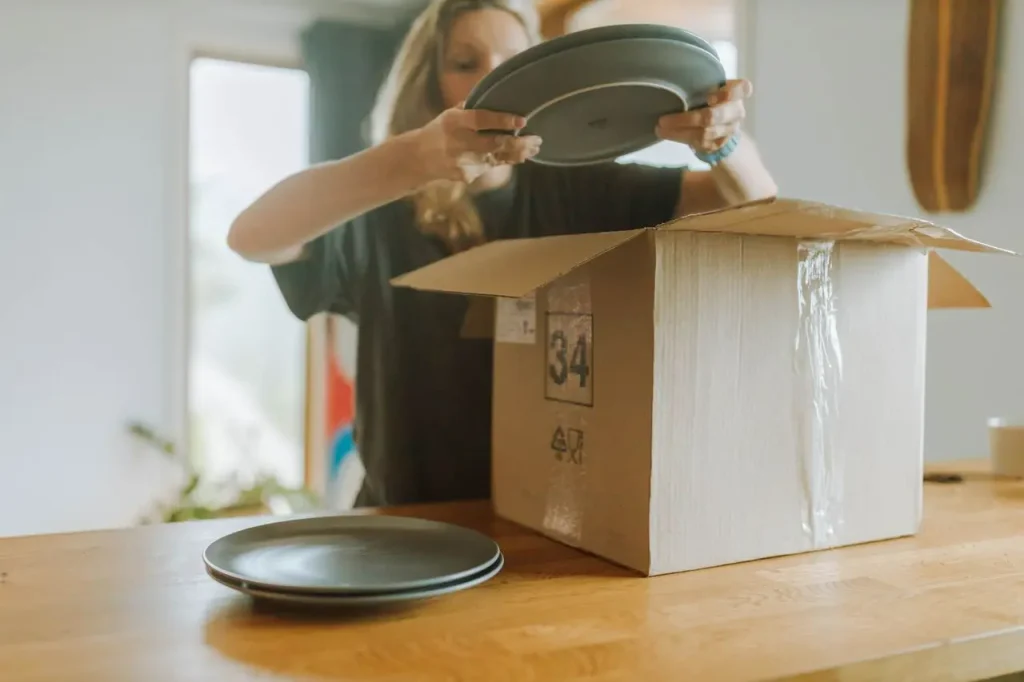
Knowing how to pack plates and glasses for moving in the same box can save space – but only if you do it carefully.
The key rule: plates go in first, glasses go on top.
Plates are heavier and more robust than glasses. They should always form the bottom layer of any mixed box. Here’s how to do it safely:
Pack plates vertically, not flat. Standing plates on their edge (like records in a crate) distributes weight more evenly and dramatically reduces the risk of cracking. Wrap each plate individually in packing paper first.
Add a dividing layer between the plates and glasses. A sheet of thick cardboard or a folded layer of bubble wrap creates a firm, flat surface for the glasses to sit on.
Pack glasses upright on top, following the standard wrapping method above.
Keep the box light. A combined plate-and-glass box can get very heavy very quickly. Aim for no more than 15–18 kg per box to keep it manageable and safe.
Fill all gaps with crumpled paper before sealing.
If you have a large collection of both, it’s generally safer to keep plates and glasses in separate boxes. Mixed boxes are best reserved for smaller collections or when you’re running low on boxes close to moving day. For plates and bowls specifically, including bone china, stoneware and anything with a raised rim, see our guide to how to pack crockery for moving house. For the plate-specific technique in full, including dinner plates and bowls, see the best way to pack plates and glasses for moving.

How to Pack Glasses for Moving Without Paper
Running out of packing paper? Moving at short notice? Or simply trying to reduce waste? There are several effective ways to pack glasses for moving without paper – and some of them work just as well as traditional wrapping.
Clothing and Textiles
T-shirts, socks, and tea towels are the most popular paper-free alternatives. They’re soft, they’re already packed, and they provide surprisingly good cushioning.
Socks are ideal for stuffing inside glasses – roll a pair into a ball and push it gently into the opening of each glass for internal support.
T-shirts can be used to wrap individual glasses in the same diagonal rolling technique as packing paper.
Tea towels and hand towels work well for larger glasses, mugs, and tumblers – fold them around the glass and secure with a rubber band.
Foam Pouches
Foam pouches (sometimes called foam sleeves) are reusable, eco-friendly, and extremely effective. Simply slide each glass into its own foam pouch and place upright in the box. No wrapping required. They’re widely available from UK packaging suppliers and are a great investment if you move regularly.
Bubble Wrap Alone
If you have plenty of bubble wrap but no paper, you can wrap glasses in bubble wrap directly. It’s slightly bulkier than paper, so you’ll fit fewer glasses per box – but the protection is excellent.
What to Avoid
Newspaper with printed ink – the ink can transfer onto your glasses, particularly crystal or glasses with decorative finishes.
Plastic bags – they provide no cushioning and can trap moisture.
Packing glasses loose – even in a box full of clothing, unsupported glasses can shift and knock together. Always provide some form of individual wrapping or compartmentalisation.
Choosing the Right Packing Boxes for Glasses
The box you choose matters almost as much as how you wrap each glass. Here’s what to look for when sourcing packing boxes for glasses in the UK.
Cell Divider Boxes
A glasses packing box with cell dividers is the gold standard for moving glassware. These boxes come with pre-cut cardboard inserts that slot together to create individual cells – typically 16, 24, or 30 cells per box. Each glass sits in its own compartment, completely isolated from its neighbours.
In the UK, you can find packing boxes for glasses UK from suppliers including:
Glassjacks – specialist glassware storage and moving boxes with 12- and 15-cell options
Argos – the StorePAK Eco Glass Moving House Box with 32 divisions is a widely available mainstream option
Bagsofroom – glass and mug inserts with 30 cells
The Packaging Depot – 30-cell glass cartons and 15-cell bottle cartons
Dish Pack Boxes (Double-Walled)
If cell divider boxes aren’t available, a double-walled dish pack box is the next best option. These are significantly stronger than standard single-walled boxes and are designed specifically for heavy, fragile kitchen items. They’re available from most removal supply companies and self-storage facilities across the UK.
Standard Small Boxes
If specialist boxes aren’t an option, use small, sturdy single-walled boxes – not large ones. Large boxes encourage overpacking, which makes them heavy and increases the risk of the base giving way. A good rule of thumb: if the box is too heavy to lift comfortably with one hand, it’s too heavy.
Can EcoGreen Movers Help?
If you’d rather not source boxes yourself, EcoGreen Movers can supply packing boxes as part of their moving service – including specialist boxes suitable for glassware. It’s one less thing to worry about in the run-up to moving day.
Common Mistakes to Avoid When Packing Glassware
Even experienced movers make these errors. Knowing what to avoid is just as important as knowing the right technique.
1. Packing glasses flat or upside down Always pack glasses upright, base-down. Packing them flat or rim-down puts pressure on the most fragile part of the glass.
2. Skipping the internal stuffing Stuffing the inside of each glass with crumpled paper is not optional. Without it, the walls of the glass are unsupported and far more likely to crack under pressure.
3. Using boxes that are too large Large boxes lead to overpacking and excessive weight. Stick to small or medium boxes for glassware.
4. Leaving gaps in the box Any empty space in the box allows glasses to shift during transit. Fill every gap with crumpled paper, foam, or bubble wrap until nothing moves.
5. Forgetting to reinforce the box base An untaped or weakly taped box base is a disaster waiting to happen. Always tape the bottom seams with two or three strips of strong packing tape before loading.
6. Wrapping glasses together Wrapping two glasses in the same sheet of paper and hoping for the best is one of the most common causes of breakage. Every glass needs its own individual wrap.
7. Not labelling boxes clearly A box labelled FRAGILE on only the top can end up on its side in the van. Label all four sides and the top.
8. Packing glassware in large, heavy boxes with other items Glasses should never be at the bottom of a mixed box with heavy books or kitchen appliances on top. Keep glassware in dedicated boxes.
How Many Boxes Do You Need?
A practical question – and one that’s easy to underestimate. Here’s a rough guide based on a typical UK household:
| Glassware | Estimated Boxes Needed |
|---|---|
| Small collection (up to 12 glasses) | 1 cell divider box |
| Average household (12–24 glasses + 6–8 wine glasses) | 2–3 boxes |
| Large collection (30+ glasses, crystal, stemware) | 4–6 boxes |
| Full kitchen (glasses + plates + mugs) | 6–10 boxes total |
Tips for estimating:
A standard 30-cell divider box holds approximately 24–30 wrapped glasses, depending on size.
Wine glasses take up more space than tumblers – allow roughly 12–15 wine glasses per cell box.
Always buy or source one or two extra boxes. Running out mid-pack is stressful and leads to poor decisions (like overfilling).
If you’re using standard boxes without dividers, aim for no more than 8–10 glasses per box to keep the weight manageable.
What to Do on Moving Day
Good packing is only half the battle. How you handle your glassware boxes on moving day is equally important.
Labelling and Organisation
Write the destination room on every box as well as FRAGILE and THIS WAY UP. This means whoever is unloading knows exactly where each box goes – and handles it accordingly.
Use a colour-coding system if you have a large number of boxes. A red sticker for kitchen, blue for dining room, and so on makes unloading faster and reduces the risk of boxes being mishandled.
Keep an inventory. A simple numbered list of boxes and their contents means nothing gets lost or left behind.
Loading Order in the Van
Glassware boxes go in last and come out first. They should be positioned near the van doors, not buried under furniture.
Never stack heavy items on top of glassware boxes. Even a box of books placed briefly on top of a glass box can cause damage.
Keep glassware boxes upright at all times. If a box is tipped on its side, even well-wrapped glasses can shift and crack.
Wedge boxes firmly so they cannot slide during transit. Use furniture blankets or soft items to fill gaps between boxes in the van.
On Arrival
Unload glassware boxes first and carry them directly to the kitchen or dining room.
Don’t leave glassware boxes in a stack while you unload the rest of the van. Place them on a flat surface and unpack them as soon as possible.
Inspect each glass as you unwrap it and set aside anything that’s chipped or cracked. Chipped glassware is a safety hazard – a small chip on the rim can cause a glass to shatter unexpectedly when used.
Thinking About Professional Help?
If you’d rather leave the fragile stuff to the experts, EcoGreen Movers has completed over 400 moves across the UK and handles glassware and fragile items with the kind of care that comes from genuine experience. Fully insured, eco-conscious, and with a track record of customer care that speaks for itself – it’s the kind of reassurance that makes moving day feel a lot less daunting.
Frequently Asked Questions
How do you pack glasses for moving without them breaking?
Wrap each glass individually in packing paper or bubble wrap, stuff the inside with crumpled paper for internal support, and pack them upright in a sturdy box with cell dividers. Fill every gap with padding so nothing can move, reinforce the box base with tape, and label the box FRAGILE and THIS WAY UP on all sides. These steps, taken together, are the most reliable way to prevent breakage.
What is the best way to pack wine glasses for moving?
The best way to pack wine glasses for moving is to wrap the stem first with a separate strip of bubble wrap, then stuff the bowl lightly with tissue paper, and wrap the whole glass diagonally in a large sheet of packing paper. Pack each wine glass upright in its own cell in a divider box – never on its side or stacked. For crystal or particularly valuable stemware, add a final layer of bubble wrap around the papered glass.
Can I use tissue paper for packing glasses?
Yes – tissue paper for packing glasses is an excellent first layer, particularly for fine crystal, decorated glassware, or anything with a delicate finish. Acid-free tissue paper is non-reactive and won’t stain or mark surfaces the way printed newsprint can. Use it as a soft inner wrap, then add packing paper or bubble wrap as an outer layer for full protection.
What are the best packing boxes for glasses in the UK?
Cell divider boxes are the best packing boxes for glasses in the UK. These come with cardboard inserts that create individual compartments for each glass, preventing any glass-to-glass contact during transit. Look for boxes with 24–32 cells for tumblers and everyday glasses, or narrower-cell options for wine glasses and flutes. Glassjacks, Argos (StorePAK Eco Glass Box), and Bagsofroom all stock suitable options. Double-walled dish pack boxes are a strong alternative if cell boxes aren’t available.
How do I pack glasses for moving without paper?
To pack glasses for moving without paper, use clothing instead: stuff socks inside each glass for internal support, and wrap each glass in a t-shirt or tea towel using the same diagonal rolling technique as packing paper. Foam pouches are another excellent paper-free option – simply slide each glass into its own foam sleeve. Avoid plastic bags (no cushioning) and never pack glasses loose, even in a box of soft clothing.
How do I wrap wine glasses for moving?
To wrap wine glasses for moving, start by wrapping the stem separately in bubble wrap or a strip of packing paper – this protects the most fragile part first. Then stuff the bowl lightly with tissue paper, lay the glass at the corner of a large sheet of packing paper, and roll diagonally, tucking in the sides as you go. Secure with tape and, for extra protection, add an outer layer of bubble wrap. Always pack wine glasses upright in a cell box.
How do I pack plates and glasses for moving together?
If packing plates and glasses in the same box, always put plates in first – packed vertically on their edge, each wrapped individually. Add a firm dividing layer (thick cardboard or folded bubble wrap) on top of the plates, then pack wrapped glasses upright above. Keep the box light (no more than 15–18 kg) and fill all gaps with padding. Separate boxes for plates and glasses are safer for larger collections.
How many boxes do I need to pack glasses for moving?
For a typical UK household with 12–24 glasses and 6–8 wine glasses, allow 2–3 specialist boxes. A small collection of up to 12 glasses fits in a single cell divider box. Larger collections with crystal, stemware, and everyday glasses may need 4–6 boxes. Always buy one or two more than you think you need – running out mid-pack leads to overfilling, which is one of the most common causes of breakage.
Useful Sources
Compare My Move – Moving House Damage Survey (2025) – UK survey data on item damage during house moves, including glassware and crockery statistics.
British Association of Removers (BAR) – Fragile and Non-Fragile Packing Training – The UK removal industry’s professional training standard for packing fragile items.
Glassjacks – Glass Packing Boxes for Moving – UK specialist supplier of cell divider boxes and glassware moving solutions.
Space Station – How to Pack Glassware for Moving House – Practical UK guide covering wrapping techniques and box selection.
Bournes Moves – How to Pack Stemmed Wine Glasses (Video Tutorial) – Step-by-step video guide from a long-established UK removal company.
The Van Man Co – How to Pack Plates, Glasses and Fragile Items for Moving Day – Detailed UK guide covering combined packing of plates and glasses.