
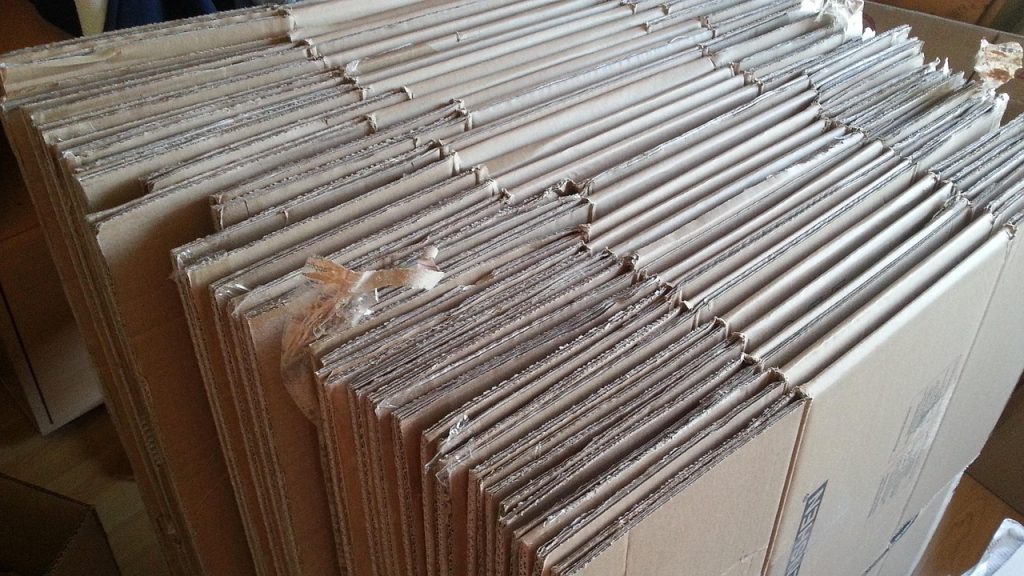
IKEA sells one cardboard moving box, the DUNDERGUBBE, in two sizes. The large one is 64 x 34 x 40cm and holds 80 litres; the small one is 50 x 31 x 40cm and holds 54 litres. Both are corrugated board with at least 50 percent recycled content, both have cut-out handles on two sides, and both carry a stated maximum load of 30kg. They are cheap, they fold flat for reuse, and for most household packing they are genuinely good value.
They are not the right box for everything, and the reasons are specific rather than general. The handle cut-outs are the obvious failure point under heavy loads, the board grade is not stated as double wall, and buying them means a trip to a store or a delivery charge that can wipe out the saving. This is an honest assessment of where they work and where a specialist box is worth the extra pound.
Quick answer: Good boxes for the money. IKEA UK lists the large 80-litre box at £3 and the small 54-litre box at £2, both rated to 30kg, both scoring 4.6 out of 5 across more than 1,800 customer reviews. Prices are IKEA’s own and were checked in August 2026. Best for clothing, bedding, kitchenware and general packing. Do not put a full load of books or crockery in the large size, because the handle holes are where it will give.

The two sizes, and which to buy
| Size | Dimensions | Volume | Stated max load | IKEA UK price, Aug 2026 | Best for |
|---|---|---|---|---|---|
| Large DUNDERGUBBE | 64 x 34 x 40cm | 80 litres | 30kg | £3 | Bedding, cushions, clothing, soft furnishings |
| Small DUNDERGUBBE | 50 x 31 x 40cm | 54 litres | 30kg | £2 | Kitchenware, books, toys, general household items |
Both sizes share the same 40cm height and similar depth, which is the detail that matters most in a van. Boxes with a common footprint stack squarely and fill space efficiently. A collection of mismatched sizes leaves air gaps, and air gaps are what turn one van load into two.
Buy more of the small one than you think. Households consistently over-order large boxes because a bigger box feels like better value, then find they have nothing light enough to fill them and end up packing books into a 26-litre void. The rule that holds everywhere applies here too: heavy items in small boxes, light bulky items in large ones.
Neither size is a wardrobe box, a picture box or a specialist carton. IKEA does not sell those, so if you need hanging space for clothing or protection for framed pieces, that is a separate purchase or a hire from your removals company.
Cost per litre, and the surprise in the numbers
The two sizes cost almost exactly the same per litre. Using IKEA UK’s published prices and volumes in August 2026, the large box works out at roughly £37.50 per cubic metre of capacity and the small one at roughly £37. So there is no volume discount for going big, which removes the main reason people buy large boxes they cannot fill.
That is worth pausing on, because it reverses the usual instinct. Ordinarily the bigger unit is cheaper per litre and you accept some waste to get the rate. Here you gain nothing by going large except the risk of overloading a box you then cannot lift.
Note also that the small box holds 54 litres rather than the 62 litres its external dimensions suggest. That gap between outside and inside is normal, since board thickness and fold allowances eat into it, and it is one reason to compare on published capacity rather than on the measurements printed in a listing.
Cost per litre is the only sensible way to compare boxes, and almost nobody does it. A twenty-box kit at £55 sounds better than twenty individual boxes at £3, until you notice the kit boxes are considerably smaller and you need thirty of them.
Work it out before ordering anything. Take the stated capacity in litres, divide the price by it, and compare that number across the options in front of you. Where a seller quotes only external dimensions, multiply length by width by height in centimetres and divide by 1,000, then treat the answer as an optimistic ceiling rather than a real capacity. Doing this once across three options takes five minutes.
Where IKEA loses is delivery. A home delivery charge on a bulky low-value order can exceed the cost of the boxes themselves, so this is a product that makes sense if you are already going to a store or ordering something substantial anyway. Buying twenty boxes as a standalone delivery is poor value against a specialist supplier that ships flat-packed bundles on a standard courier rate.
For a full comparison of the sources and what they charge, see our guide to where to buy moving boxes in the UK.
The handle problem, and what the 30kg figure means
IKEA’s stated maximum load of 30kg is a rating for the box, not a recommendation for how much to put in it. A cut-out handle is a convenience and also a hole in the side of a cardboard box, and it is the point where concentrated weight will find the weakness first.
This is the single most useful thing to understand before buying. Load a large box with 25kg of books and the entire weight transfers through the narrow strip of board above each handle cut-out. The box body may be perfectly capable. The strip above the hole is what you are actually relying on.
Two fixes work. The simple one is to run a strip of packing tape along the top edge of each handle hole before filling the box, which spreads the load across board rather than across a cut edge. The better one is to keep heavy contents in the small size and to keep any single box light enough that one person can carry it down a staircase without changing grip.
That last test is the one that matters on the day. What the cardboard can technically withstand is a different question from what a person can carry safely on stairs, and a box that survives the journey but injures whoever lifts it has not done its job.
Tape the base properly too. Fold-together bases are quick but rely on the interlocking flaps holding, and a strip of tape across the seam removes the failure mode entirely.

Assembly, reuse and storage
These fold together rather than requiring taped construction, and IKEA publishes an assembly instruction sheet for them. Read it once. The interlocking base is not obvious from the flat pack, and improvising produces a weaker construction than the design intends. They also fold flat again afterwards, which changes the cost per use substantially across repeat moves.
The flat-packed large box weighs 0.82kg and the small one 0.70kg, which gives you a sense of the board on offer. It is a decent weight for the price and noticeably more substantial than a supermarket box, without being double wall.
- Unpack by slitting the tape, not tearing the box. A box opened carefully folds flat again; one ripped open does not.
- Store flat and dry. Corrugated board loses strength when damp, so a loft is better than a garage over a UK winter.
- Do not stack heavy items on flat-stored boxes. Compression over months weakens the flutes.
- Label on the short side, not the top. Stacked boxes hide their own lids, which is why IKEA prints the tick-box panel where it does.
- Pass them on if you will not move again soon. Local community groups take clean flat-packed boxes immediately.
The printed pictogram panel deserves a mention, because it is the quietly clever bit of the design. You tick the icon matching the contents rather than writing a description, which is faster while packing and easier to read across a stacked room while unpacking.
What else IKEA sells that helps a move
The boxes are not the only useful thing in that aisle. IKEA’s moving supplies range is small, but the large woven storage bags, the zip-top laundry bags and the clear plastic boxes all earn their place in a move, and in some cases outperform cardboard for the job.
The large woven bags are the standout. They hold a lot of bedding, cushions, coats and soft furnishings, they have proper handles, they cost little, and they last for years afterwards as loft storage. For anything light and bulky they beat a large cardboard box, because they compress into gaps in a van that a rigid box cannot fill.
Clear plastic boxes with lids are the right choice for anything going into storage for months, where cardboard softens and slumps. They cost several times as much per unit, so use them selectively for the items that justify it rather than for a whole house.
What is worth skipping is buying new furniture-protection products for a single move. Blankets, corner protectors and mattress bags get used once and stored forever. If a removals company supplies them as part of the job, that is the cheaper and less wasteful route.
One practical warning about combining an IKEA trip with packing week: the store is designed to take an hour and rarely does. If the only reason for the visit is boxes, order online or use a specialist supplier instead, because a Saturday lost in a warehouse is worth more than the pound or two saved.
How they compare on the things that matter
We set the DUNDERGUBBE against the other realistic ways of getting boxes for a house move, judged on the criteria that actually decide whether a pack goes well.
| Criterion | IKEA DUNDERGUBBE | Specialist box supplier | Free supermarket boxes | Hired crates |
|---|---|---|---|---|
| Cost per litre | About £37 per cubic metre, both sizes | Competitive in bundles | Free | Hire, often included with a move |
| Board grade stated | Corrugated board, wall type not specified | Usually stated, commonly double wall | Unknown | Rigid plastic |
| Consistent sizing | Two sizes, shared height, stack well | Modular ranges | Random | Fully modular |
| Handles | Cut-out, and the weak point | Usually, often reinforced | Rarely | Moulded, strong |
| Availability | Store trip or delivery | Next-day courier | Ask in store, hit and miss | Delivered before the move |
| Disposal afterwards | Flatten and recycle | Same | Same | Collected with the van |
Two conclusions came out of this. First, the unstated board grade is the real difference between IKEA and a specialist supplier. Boxes marketed specifically for house moves usually state a wall type; IKEA describes the DUNDERGUBBE simply as corrugated board with at least 50 percent recycled content. For stacking three or four high in a van, or for anything going into storage for weeks, that distinction matters.
Second, availability is the practical decider for most people. If there is an IKEA on your route and you are going anyway, these are hard to beat on price. If there is not, the delivery charge erases the advantage and a specialist supplier shipping a flat-packed bundle next day is the better call.
All specifications and prices here are taken from IKEA’s own UK product pages and were checked in August 2026. They are IKEA’s figures rather than ours, and retail pricing moves, so confirm before ordering.
One further note on quantity. Because these fold flat and store easily, buying a few more than you need is less wasteful here than with sealed multipacks, since the surplus keeps indefinitely for the next move rather than becoming clutter. IKEA also runs a 365-day returns policy, which takes some of the risk out of over-ordering. That changes the calculation slightly in their favour for anyone who expects to move again within a few years.
Equally, do not buy in bulk on the assumption that cardboard is cardboard. Two boxes of the same external dimensions can differ substantially in board weight, and the cheapest box in any given size is almost always the thinnest one. Where the contents matter, the specification matters more than the price.
When these are the wrong box
Do not use these for a full crockery pack, for long-term storage in an unheated unit, or as the structural base layer of a heavily stacked van load. In each case an explicitly double-wall box is worth the extra, because the failure cost is high and the price difference is not.
Most reviews of this product are positive and stop there. The honest position includes where it does not fit.
Crockery and glassware are heavy for their size and break easily, so any weakness in the box matters. A dedicated dish pack or a double-wall small carton, with plenty of paper between layers, is the right tool. The consequence of getting this wrong is not a torn box, it is a dinner service.
Long-term storage is the other case. Cardboard in an unheated unit absorbs moisture over months and a stack that was square in June leans by October. If belongings are going into storage for more than a couple of months, rigid plastic boxes justify their cost, a point covered in our guide to storage unit sizes.
And if a removals company is supplying crates as part of the job, buying boxes at all is usually unnecessary. Ask before you order, because a hallway full of cardboard you did not need is an avoidable expense and an avoidable disposal task.
How EcoGreen Movers handles packing materials
It depends who is doing the packing. If we are moving you, EcoGreen Movers brings reusable crates, delivered before the day and collected afterwards, so there is no packaging mountain in the hallway on day three and no trips to the recycling centre. If you are packing yourself, we sell packing boxes and materials as a standalone order with no move attached, which spares you a trip to a warehouse retailer for the sake of forty cartons.
Beyond boxes on their own, the move itself comes three ways. Standard is loading and unloading. Standard Plus adds dismantling and reassembling your furniture at both ends. Premium adds professional packing on top, done to whatever specification you set, which is the option where the question of which box to buy stops being yours at all. Our packing and storage services set out the range, and we run residential moves nationwide including London, Manchester and Edinburgh. Our eco-friendly packing tips cover the lower-waste alternatives to buying cartons at all. Send us the property details and we will quote the move, the materials, or both.
Frequently asked questions
Are they strong enough for a house move?
For most contents, yes. IKEA rates both sizes to 30kg and they score 4.6 out of 5 across more than 1,800 customer reviews. The weak point is the cut-out handles under heavy loads, so keep books and crockery in the small size and tape above the handle holes before filling.
Are they double wall?
IKEA describes the material as corrugated board with at least 50 percent recycled content and does not specify a wall type. Suppliers selling boxes specifically for house moves generally state theirs. If you are stacking high in a van or storing for weeks, that stated grade is worth paying for.
How much do IKEA moving boxes cost?
IKEA UK listed the large 80-litre box at £3 and the small 54-litre box at £2 in August 2026. That works out at roughly £37 per cubic metre of capacity either way, so there is no saving in buying the larger size. These are IKEA’s prices, not ours, and retail pricing changes.
Can they be reused?
Yes, and this is one of their strengths. They fold flat rather than needing to be cut open, so a carefully handled box comes back for the next move. Store them flat and dry, since damp corrugated board loses strength quickly.
How many are needed for a three-bedroom house?
Highly variable, since it depends on how much a household owns rather than on room count. Order roughly what you estimate and top up rather than over-buying, though IKEA’s 365-day returns policy makes over-ordering less costly here than with a sealed multipack.
Are they recyclable afterwards?
IKEA states the product can be recycled or used for energy recovery where those services exist locally. Flatten it, remove tape and labels first since adhesive contaminates the card stream, and check your council’s rules, which differ. Better still, keep them flat for the next move or pass them to someone who is moving.
In summary: good boxes, with one known weakness
Buy them if you are passing a store, weight the order towards the small size, and tape above the handle holes before filling anything heavy. There is no per-litre saving in the large box, so choose size by what you are packing rather than by what looks like better value.
Buy specialist double-wall boxes instead for crockery, for anything going into storage, and for the base layer of a stacked van. And check whether your removals company supplies crates before ordering anything at all.