
Polystyrene is technically recyclable and practically is not, at least not through your household bins. Almost every UK council excludes it from kerbside collection, and the Simpler Recycling reforms that standardised collections across England from March 2026 left it off the mandatory materials list entirely. The honest answer for most households is the general waste bin, and the better answer is to avoid generating it in the first place.
That matters most in the week after a house move, when the appliance packaging, television corner blocks and flat-pack protection all come out at once and fill a wheelie bin on their own. This guide covers which forms of polystyrene exist, why the collection infrastructure does not want them, the drop-off and take-back routes that genuinely work in the UK, and what to use instead next time.
Quick answer: Expanded polystyrene cannot go in UK kerbside recycling bins. It is roughly 98 percent air, which makes it uneconomic to collect and transport, and it fragments into beads that contaminate other recycling streams and damage sorting machinery. Some Household Waste Recycling Centres accept clean white blocks, and some retailers take back appliance packaging. Everything else goes in general waste.

The four forms of polystyrene and what happens to each
People use the word polystyrene for several different materials with genuinely different disposal routes. Identifying which one you are holding is the first useful step, because the white block protecting a washing machine and the takeaway container from Friday night do not have the same options.
| Type | Where you see it | How to identify it | Realistic UK disposal route |
|---|---|---|---|
| EPS, expanded polystyrene | Appliance and electronics packaging, insulation boards, fish boxes | White, visibly made of fused beads, squeaks when squeezed | Selected HWRCs and retailer take-back, otherwise general waste |
| XPS, extruded polystyrene | Insulation sheets, sometimes branded Styrofoam | Smooth, dense, usually blue, pink or green | General waste or construction waste stream, not kerbside |
| GPPS, general purpose polystyrene | Clear yoghurt pot lids, CD cases, some food trays | Rigid, transparent, cracks rather than bends | Check your council, some accept rigid plastics marked 6 |
| Loose fill, packing peanuts | Mail order and courier packaging | Small S-shaped or peanut-shaped pieces | Reuse or return to a packing shop, never kerbside |
All four carry resin identification code 6, the number 6 inside a triangle. That symbol is a material identifier, not a promise that anyone will collect it. This is one of the most persistent misunderstandings in UK household recycling, and the reason polystyrene keeps appearing in recycling bins where it does real damage.
One useful test for loose fill: starch-based biodegradable peanuts look almost identical to polystyrene ones but dissolve in water within seconds. Drop one in a glass. If it disappears, the rest can go in your food waste or compost. If it floats indefinitely, it is polystyrene.
Why councils refuse it when they take other plastics
Expanded polystyrene is around 98 percent air by volume. A lorry collecting it carries mostly nothing, so the transport cost per tonne recovered is far higher than for any other plastic. It also shatters into small beads during collection, which contaminate paper and plastic streams and jam optical sorting equipment.
The economics are the whole story. A council collection vehicle has a fixed cost per round. Fill it with plastic bottles and you recover a meaningful weight of material with a resale value. Fill it with EPS and you have moved a lorry-load of air. Densifiers exist that compress EPS at roughly 50 to 1, but they are specialist industrial machines, and very few municipal sorting facilities have one.
The contamination problem compounds it. EPS breaks into beads under any mechanical handling. Those beads travel through a materials recovery facility, settle in the paper stream, and reduce the value of a bale that was otherwise saleable. Ealing Council is among the authorities that state plainly that polystyrene damages their sorting equipment, which is why it is banned rather than merely discouraged.
The Simpler Recycling reforms were expected by many households to fix this. They did not. The programme standardises collection of glass, metal, plastic and paper or card across England, and polystyrene is not among the mandatory materials. Councils remain free to collect it and almost none do. Recycle for Greater Manchester, covering nine local authorities including Manchester, Salford, Stockport and Trafford, directs residents to the general waste bin.
The drop-off and take-back routes that actually exist
Three routes work in practice: selected Household Waste Recycling Centres that accept clean white EPS blocks, retailer take-back of appliance packaging at the point of delivery or in store, and commercial collection for businesses producing EPS in volume.
HWRC acceptance is genuinely local. Some centres in Nottinghamshire, north London and Edinburgh take clean EPS blocks. Many do not. The only reliable way to check is the postcode locator at recyclenow.com, or your council’s own A to Z waste page, and it is worth doing before loading the car rather than after.
Retailer take-back is the most underused route. Currys accepts protective packaging back at its stores, and most large appliance retailers will remove packaging at the point of delivery if you ask when booking. That single question, asked when arranging a fridge or washing machine delivery, removes the problem before it enters your house. It costs nothing and almost nobody asks.
For businesses, licensed waste carriers offer dedicated EPS collection where volumes justify it, and this is where most genuine UK polystyrene recycling actually happens. Recovered EPS is reprocessed into new packaging, construction insulation, or blended into other plastic products. Universities in Glasgow and Edinburgh have run campus collection point trials, which is a promising model but not yet national coverage.
- Do check first: recyclenow.com postcode search, then your council’s A to Z listing.
- Do clean it: any food residue makes EPS permanently unrecyclable, so fish boxes and takeaway trays are out.
- Do ask at delivery: retailer packaging removal is free and takes one sentence to arrange.
- Do not put it in the recycling bin: it contaminates the load and can damage sorting equipment.
- Do not burn it: combustion releases styrene and other harmful compounds, and it is not a garden bonfire material.

The pile that appears after a house move
A typical three-bedroom move generates protective foam from appliances, televisions, computer monitors, mirrors and flat-pack furniture. By weight it is trivial. By volume it can fill a wheelie bin on its own, which is why it becomes visible on day two of unpacking.
The order in which you deal with it matters more than people expect, because once EPS has been walked on, dragged across a floor or crushed into a bin bag it has fragmented, and fragmented EPS has no remaining routes at all. Keep the blocks whole while you decide.
Reuse is the first and most obvious option, and the one nearly everyone skips. Moulded appliance corners are the single best protection available for that specific appliance, and if you are likely to move again inside five years, they are worth flat-storing in a loft. Beyond that, whole blocks make excellent void fill for anything you post or store, and local reuse networks and community groups take clean packaging surprisingly readily.
Whatever is left after reuse and drop-off goes in general waste, and there is no better answer available. Breaking it into a bin bag is fine at that point. What you should not do is put it in the recycling bin because it feels wrong to throw plastic away. That decision makes the outcome worse rather than better, because it risks downgrading a whole load of genuinely recyclable material.
If your move is generating large volumes of packaging of every kind, our guide to unpacking your new home room by room sets out a sequence that keeps the waste manageable instead of letting it accumulate into a single overwhelming pile.
Protective packing materials compared for a move
Reusable moving blankets and crates avoid the disposal question entirely. Corrugated card and paper are the best single-use options because they are collected kerbside everywhere in the UK. Foam of any kind is the worst choice for anything you have a say over.
| Material | Protection level | Kerbside recyclable? | Best for | Main tradeoff |
|---|---|---|---|---|
| Moving blankets and reusable crates | High | Not applicable, reused many times | Furniture, appliances, whole-house moves | Needs a supplier who collects them again afterwards |
| Corrugated cardboard and edge protectors | Medium to high | Yes, everywhere | Mirrors, artwork, flat panels | Loses strength when damp |
| Packing paper and newsprint offcuts | Medium | Yes, everywhere | Crockery, glassware, void fill | Needs more volume than foam for the same protection |
| Starch-based loose fill | Medium | Compostable, water soluble | Awkward-shaped small items | Ruined by damp storage |
| Expanded polystyrene | High for its weight | No | Appliance corners it was moulded for | No mainstream disposal route once you have it |
| Bubble wrap | Medium to high | Not kerbside, some carrier bag points | Fragile items in transit | Soft plastic, so drop-off only |
The reusable option is the one that removes the problem rather than relocating it. Crates and blankets go back on the van at the end of the job and get used on the next move, which is why we use them instead of building a cardboard mountain in every customer’s hallway. Our eco-friendly packing tips cover the rest of the swaps worth making.
What we found comparing volume against weight
We compared the packaging waste streams a household generates during a move on two measures: the weight that appears in council recycling statistics, and the bin volume the household actually has to deal with. The two tell completely different stories, and the gap explains why polystyrene feels like a much bigger problem than the tonnage figures suggest.
| Material from a three-bed move | Relative weight | Relative bin volume | Collected kerbside? | Practical consequence |
|---|---|---|---|---|
| Flattened cardboard boxes | High | Low once flattened | Yes | Heavy but genuinely recycled, and flattening solves the volume |
| Packing paper | Medium | Medium | Yes | Compresses well, no disposal friction |
| Expanded polystyrene | Very low | Very high | No | Dominates bin space while barely registering in waste statistics |
| Bubble wrap and soft plastics | Low | Medium | No | Requires a separate drop-off trip most people never make |
| Tape, labels and strapping | Very low | Low | No | Contaminates card if left attached to boxes |
The finding worth acting on: polystyrene occupies the top of the volume column and the bottom of the weight column simultaneously. That is exactly the profile that makes a material uneconomic to collect and infuriating to store. It is also why the reduction strategy has to happen at the point of delivery, not the point of disposal. Once the foam is in your house, the outcome is largely fixed.
The second finding: three of the five streams above are not collected at the kerb, and each needs a different destination. That is a lot of separate trips for one week of packaging, which is the practical reason so much of it ends up in general waste regardless of intention.
Volume and weight comparisons are relative rather than measured, based on typical household packaging profiles for a three-bedroom move.
When general waste is genuinely the right answer
Food-contaminated foam, already-fragmented beads, coloured XPS insulation offcuts and any polystyrene that has been stored outdoors and degraded should go in general waste. Driving these to a recycling centre burns fuel for a load that will be rejected at the gate.
Environmental content rarely says this, because telling people to bin something reads as defeatist. It is the honest position, and pretending otherwise leads to worse outcomes.
Fish boxes, meat trays and takeaway containers are permanently unrecyclable once they have held food. No amount of rinsing changes that, because the material absorbs residues rather than shedding them. Loose beads that have already escaped are unrecoverable and should be swept up carefully, since they are a genuine hazard to small children and pets and they blow into watercourses.
There is also a straightforward carbon argument. Driving eight miles each way to a recycling centre with a boot of low-density foam that the site may not accept is not an environmental win. If the centre takes it and you were going anyway, excellent. If it means a dedicated round trip for a material that weighs three kilograms, the general waste bin is the lower-impact choice, and it is fine to make it.
Polystyrene does not biodegrade in any meaningful timeframe, with estimates running to several hundred years. That is an argument for generating less of it, not for driving it around the county first.
How EcoGreen Movers keeps foam out of the equation
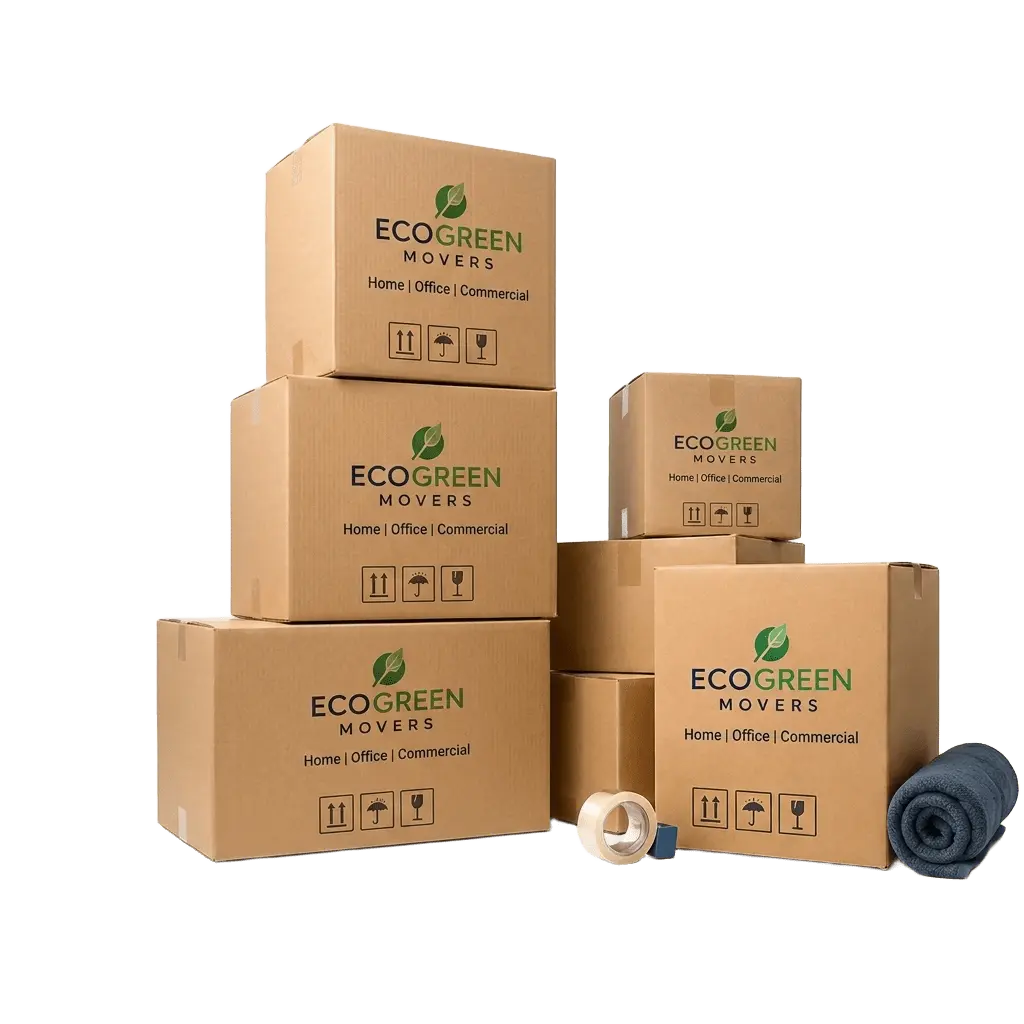
Our whole packing method is built to avoid this problem rather than solve it afterwards. EcoGreen Movers is a nationwide UK removals company using reusable crates, moving blankets and corrugated protection instead of foam and single-use plastic, which means the packaging leaves with the van rather than filling your bin for a fortnight.
Our packing and storage services cover the range, and we run residential moves UK-wide, including house moves in London, removals in Manchester and removals in Edinburgh. Premium is the level where the foam question disappears entirely, since the crew brings and takes away its own protective materials. Standard Plus covers furniture dismantled and rebuilt, Standard covers the loading and unloading, and boxes and materials can be bought on their own if you would rather pack but not source. Storage is available where the two dates do not meet. If the low-waste approach matters to you, here is why an eco-friendly moving company is worth choosing, or get in touch for a quote.
Frequently asked questions
Which bin does polystyrene go in?
The general waste bin in almost every UK local authority area. It is excluded from kerbside recycling collections nationwide and was not included in the mandatory materials under the Simpler Recycling reforms. Check your council’s A to Z listing for the small number of exceptions.
Why is it marked with a recycling symbol if it cannot be recycled?
The number 6 in a triangle is a resin identification code. It tells a processor what the polymer is, not that a collection service exists for it. Several plastics carry codes without having any kerbside route in the UK, and polystyrene is the most common.
Can I put polystyrene in the recycling bin anyway?
No, and it does real harm. It fragments into beads that contaminate paper and plastic streams and can damage optical sorting machinery. A contaminated load can be downgraded or rejected, which means genuinely recyclable material from your whole street goes to disposal instead.
What can I do with appliance packaging after a delivery?
Ask the retailer to take it away at the point of delivery, which most large appliance retailers will do free if you request it when booking. Currys also accepts protective packaging back in store. Failing that, keep the moulded corners for the next time you move that appliance.
Are packing peanuts the same as polystyrene?
Not always. Starch-based biodegradable loose fill looks nearly identical but dissolves in water within seconds and can go in food waste or compost. Drop one piece in a glass of water to tell them apart. Polystyrene peanuts float indefinitely and belong in general waste.
In summary: solve it at delivery, not at the bin
Expanded polystyrene is not collected at the kerb anywhere meaningful in the UK, and the reasons are structural rather than a gap somebody will close soon. Check recyclenow.com for a local drop-off, ask retailers to take packaging back at delivery, keep moulded appliance corners for reuse, and put the rest in general waste without guilt.
The genuinely effective action happens earlier than disposal. Choose reusable crates and blankets for a move, corrugated card for flat and fragile items, and refuse foam wherever a supplier gives you the choice. A move that never generates the pile is a much better outcome than a move that recycles half of it.