
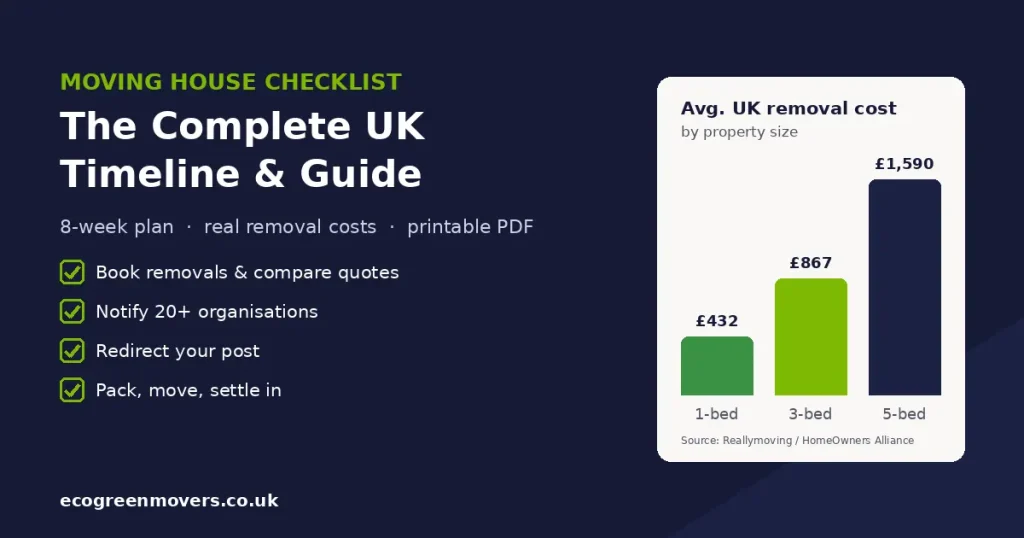
UK moving house checklist, updated August 2026: start eight weeks before the move, notify 20+ organisations, book a removal firm (£432 to £1,590 industry average by house size, Reallymoving data), set up Royal Mail redirection from £45, and photograph your meter readings on the day. The full cost of moving averages £13,018 nationally, rising to £17,831 in England when you buy and sell at the same time.
Moving day always feels bigger than it is once the plan is on paper. This moving house checklist breaks the whole process into a week-by-week timeline, a room-by-room packing list, real 2026 cost figures with sources, and the practical details most guides skip: what time the keys actually arrive, how much a parking bay suspension costs, and which items the removal van is not allowed to carry. There is a printable PDF version at the end so you can stick the whole thing on the fridge.
What this guide covers
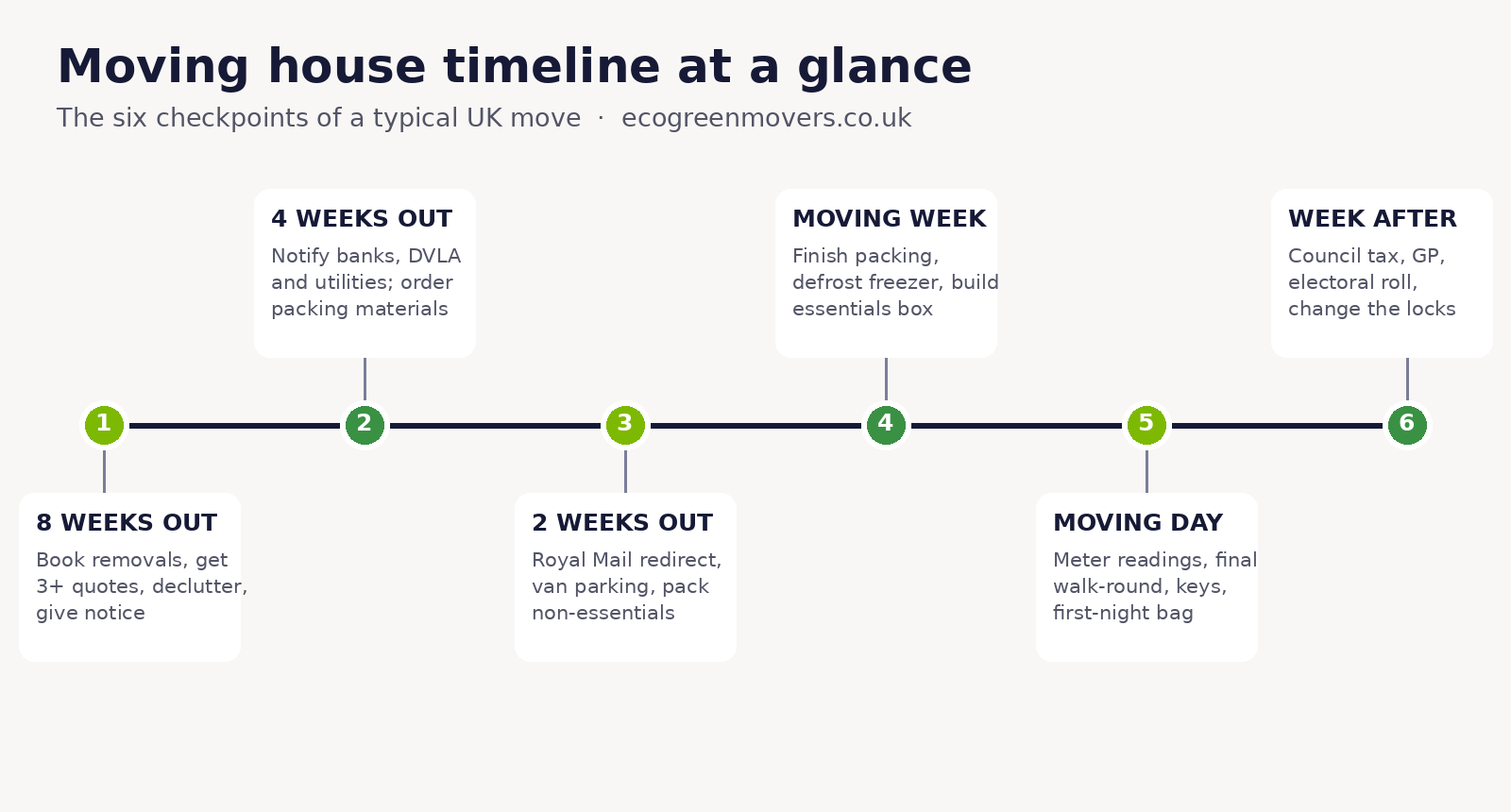
The move at a glance: six checkpoints
- 8 weeks before: book your removal company, get at least three quotes, start decluttering, give notice if renting.
- 4 weeks before: notify the DVLA, banks, HMRC, schools and utilities; order packing materials.
- 2 weeks before: set up Royal Mail redirection, sort parking for the van, start packing non-essential rooms.
- Moving week: finish packing, defrost the freezer, build an essentials box.
- Moving day: photographed meter readings, a final walk-round, keys, and a first-night bag.
- First week after: council tax, electoral roll, GP registration, and change the locks.
Why a written plan beats a good memory
Most moving-day stress comes from things nobody wrote down: a meter reading that never got photographed, a parking bay that needed ten working days’ notice, a box of phone chargers that vanished into the van. A written plan turns one enormous job into forty small ones, and it gives every task a week it belongs to. Removal crews will tell you the same thing: the easy jobs are never the small houses, they are the organised ones.
Use this as the working list for any UK move, whether you are renting, buying, selling, or relocating for work. Where a task only applies to renters or only to buyers, it says so.
Eight weeks out: book the removal firm and start the cull
Eight weeks before the move: fix the date, collect at least three removal quotes, check each firm’s British Association of Removers membership and goods-in-transit insurance, give written notice on a tenancy, and start decluttering. Quotes are priced on volume, so every cubic metre you clear now is money off the bill.
- Set your moving date and confirm it with your landlord, letting agent or conveyancer.
- Get at least three removal quotes. Ask for a video or in-person survey rather than a guess over the phone; surveyed quotes are the ones firms will actually stand behind.
- Check credentials. British Association of Removers (BAR) membership means the firm is vetted, inspected and covered by a dispute-resolution scheme. Ask every firm two questions: what insurance covers your goods in transit, and what happens to the price if completion slips.
- Start decluttering room by room. Anything unused for twelve months is a candidate to sell, donate or recycle.
- Give written notice if you rent. Most tenancy agreements ask for one to two months, and the notice usually has to line up with a rent period, so read the agreement before you count back from moving day.
- Book time off work for moving day and, ideally, the day after.
- Start a moving folder for quotes, emails, meter photos and receipts. One place, findable at midnight.
The decluttering point is financial, not just tidy-minded. Removal firms price by volume and time: industry pricing data puts a typical three-bedroom house at around 30 cubic metres of belongings. If a loft’s worth of boxes you never open adds a few cubic metres to that survey, you are paying to transport things you would not buy back for a pound at a car boot sale. Clear first, then get surveyed.
Six weeks out: the decisions that set your budget
Six weeks before the move, lock in the three choices that drive the final cost: the level of removal service (full pack, standard, or DIY van hire), whether you need storage between properties, and your broadband order at the new address, which can take one to four weeks to install.
- Choose your service level. Checkatrade puts a full packing service at roughly £400 on a 3-bed move; it saves two to three days of your time. A standard service (they load, you pack) is the mid-point most households choose.
- Do the DIY maths honestly. With the industry-average 1-bed removal at £432 (Reallymoving data), a self-drive van, fuel and two favours from friends can undercut a firm for a small flat. From two bedrooms up, the numbers usually flip: multiple trips, a full day of heavy lifting, and no cover if anything breaks.
- Book storage now if your sale and purchase dates might not line up. Move-and-store availability disappears fastest in summer.
- Order broadband at the new address. Full-fibre installations commonly take one to four weeks, so ordering at the six-week mark is what gets you connected on day one. More on the switching rules below.
- Apply for school places through the new council’s in-year admissions process if children are changing school.
- Arrange childcare and pet care for moving day itself. Both are genuinely better elsewhere while the furniture walks out of the door.
- Moving a business as well? An office move runs on a completely different checklist: staff, IT, licences and landlords. Our office removals London guide covers it.
Four weeks out: who you need to tell
Around 20 organisations need your new address. Start with the legally important ones: the DVLA (an out-of-date driving licence address can mean a fine of up to £1,000), your car insurer (the wrong address can invalidate the policy), HMRC, and your local councils for council tax.
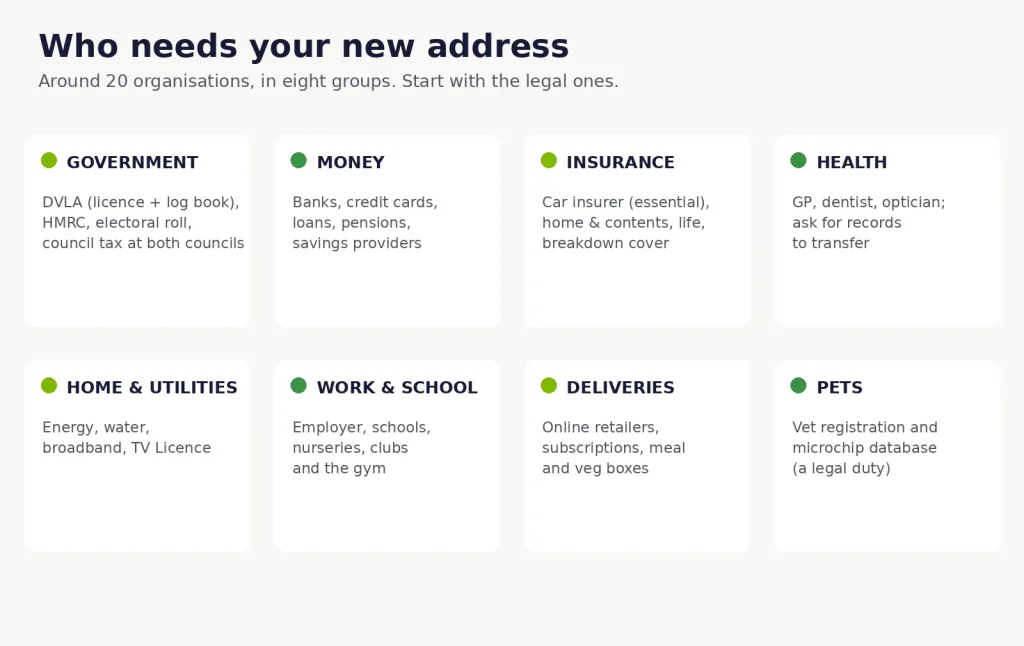
This is the most administrative fortnight of the move, and the stage where things silently go wrong months later: a missed fine at an old address, an insurance claim refused, a final bill that went to the wrong house. Work through the table once and it is done.
| Who to tell | How | Worth knowing |
|---|---|---|
| DVLA: driving licence and V5C log book | gov.uk/tell-dvla-changed-address | Free, but licence and log book are updated separately. Driving with an out-of-date licence address risks a fine of up to £1,000. |
| Car insurer and breakdown cover | Phone or online account | Address changes the premium and an unreported move can invalidate cover. Tell them before the day if you are driving between the two houses. |
| HMRC and your employer | Personal tax account / HR | Keeps tax codes, refunds and payslips landing in the right place. |
| Banks, credit cards, loans, pensions | App or online banking | Also update the address on any card registered to online retailers. |
| Council tax: old and new council | Both councils’ websites | Close the old account with your move-out date and final reading of occupancy; open the new one in week one after moving. |
| GP, dentist, optician | In person or online | Ask how records transfer; register with the new GP before you need them. |
| TV Licence | tvlicensing.co.uk | Free to update, takes minutes, easily forgotten. |
| Home, contents and life insurers | Phone or online | Ask specifically what covers your belongings on moving day itself; contents policies differ and the removal firm’s cover has limits. |
| Schools, nurseries, clubs, gym | Direct | Gyms and clubs often need a month’s notice to cancel or transfer. |
| Electoral roll | gov.uk/register-to-vote | Re-register at the new address; it also quietly helps your credit file. |
| Deliveries and subscriptions | Each account | Online retailers, meal boxes, streaming billing addresses, veg boxes, newspapers. |
- Order packing materials now, or start collecting used boxes free from supermarkets, offices and local community groups.
- Start eating the freezer. Four weeks is exactly the right runway to run stocks down to nothing.
- Book a cleaner for the old property: end-of-tenancy standard if you rent and want the deposit back, a lighter clean if you are selling.
Two weeks out: redirection, parking and the paperwork sprint
Two weeks before the move: set up Royal Mail redirection (it needs at least five working days to start), confirm access and timings with the removal firm, book any parking bay suspension, and start packing every room you do not use daily.
- Set up Royal Mail redirection. Details and current prices below; it is per person, not per household.
- Confirm final details with your removal company: parking at both ends, lift access, stair counts, anything oversized, and the earliest access time at the new property.
- Pack the non-essential rooms: loft, garage, spare room, books, out-of-season clothes.
- Register with the new GP, dentist and vet if you have not already.
- Photograph the meter positions at the old house so you know where everything is when the final readings happen on the day.
- Return what is not yours: library books, borrowed ladders, the neighbour’s drill.
Royal Mail redirection prices (from April 2026)
| Duration | One adult | Two adults |
|---|---|---|
| 3 months | £45.00 | £56.00 |
| 6 months | £66.50 | £79.00 |
| 12 months | £95.00 | £108.50 |
Source: Royal Mail redirection prices, effective 7 April 2026.
Three details catch people out. Redirection is priced per person, so each adult whose post should follow you needs to be named on the application. It needs at least five working days to activate, and you can set it up as much as six months ahead, so there is no reason to leave it late. And if you receive Universal Credit or Pension Credit, a concession rate starts at £22.50, which is roughly half the standard price. Fraud-prevention advice consistently favours the 12-month option: a year of redirected post is cheap insurance against identity fraud at your old address.
Booking parking for the removal van: what eight councils charge
If either street has permit bays, pay-and-display, or double parking that would force the van to block the road, you may need a parking bay suspension. In August 2026 we checked the moving-day suspension rules of eight English councils, and the spread is remarkable:
| Council | Cost for a home move | Notice needed |
|---|---|---|
| Islington | Free | 10 to 14 working days |
| Camden | Admin charge only; first day free for up to 3 spaces | About 17 days ahead |
| Tower Hamlets | Service charge only; no bay fee for up to 2 bays, 1 day | Apply as early as possible |
| Westminster | Charged per bay per day | 10 working days; £20 extra inside 10 calendar days |
| Kensington & Chelsea | £72 per space per day (first 5 days); £357 application fee at short notice | 7 days for resident bays |
| Merton | Charged; admin fee plus per-bay charge | At least 10 full working days |
| Ealing | Charged per bay | At least 3 working days |
| West Berkshire | £16.90 admin plus £11.20 per bay | Apply in advance |
All figures and notice periods from each council’s own published fee schedule, checked August 2026.
The takeaway: identical vans, identical jobs, and a cost that runs from free to £72 a day depending on the postcode, with notice periods from 3 to 17 working days. Kensington & Chelsea also confirms something few residents realise: you are allowed to carry out a domestic removal from any bay you can legitimately stop in without causing an obstruction, so a suspension there is a convenience rather than a requirement. Ask your removal firm whether they arrange suspensions as part of the job; many do. And note that a suspended bay is signposted, not physically reserved: if someone parks in it anyway they collect a penalty notice, but the council cannot guarantee you the space.
Moving week: finish packing and empty the freezer
In the final week: finish packing everything except daily essentials, defrost the fridge-freezer 24 to 48 hours before the move, dismantle flat-pack furniture, and separate out the items no removal van is allowed to carry: gas bottles, fuel, paint, aerosols and corrosives.
- Finish packing all but the essentials. Leave one open ‘last box’ per room for the final-morning stragglers.
- Defrost and dry the fridge and freezer at least 24 hours ahead; 48 is safer for older freezers. A wet freezer in a van ruins whatever sits beneath it.
- Dismantle flat-pack furniture that will not survive the stairs assembled. Tape the fixings to the furniture in a labelled freezer bag.
- Drain the petrol from mowers and strimmers, and use up or safely dispose of barbecue gas bottles.
- Label boxes on the side, not the top, with the destination room. Stacked boxes hide their lids.
- Charge everything: phones, power banks, the drill you will need for the beds at the other end.
What goes in the essentials box
One box travels last into the van, or better still in your own car, and comes out first at the other end:
- Kettle, mugs, tea, coffee, milk and biscuits. The crew will work faster too.
- Toilet roll, soap, hand towel and a bin bag.
- Phone chargers, and one extension lead.
- Bedding for every bed, so nobody hunts for a duvet at 11pm.
- Basic tools, scissors, packing tape and a torch.
- Medication, glasses, and anything a child or pet cannot sleep without.

What the removal van will not take
Every reputable firm carries a prohibited list, and discovering it on the morning of the move is miserable. Plan a separate trip to the tip or a hazardous-waste point for:
- Gas bottles and cylinders, even empty ones.
- Petrol, diesel, paraffin and other fuels.
- Paint, white spirit, thinners and most aerosols.
- Bleach, drain cleaner and corrosive chemicals.
- Fireworks and ammunition.
- Perishable food on long-distance moves or anything going into storage.
Plants are usually carried at the owner’s risk rather than refused, so ask. And a short list should never go in the van at all: passports, house documents, jewellery, cash, laptops with your life on them, and medication all travel with you.
Moving day: meter readings, keys and the completion clock
On the day: photograph final meter readings at both properties, keep documents and valuables with you, do a last sweep of the loft, shed and dishwasher, and know the completion timeline: a no-chain purchase typically completes around 11am, most buyers collect keys between 1pm and 4pm, and the typical CHAPS transfer cut-off is about 4:25pm, according to conveyancers’ published guidance.
- Strip the beds early and keep the bedding aside for the first-night bag.
- Take and photograph final readings for gas, electricity and water at the old house, and again at the new house before you switch anything on. Photos beat memory in every billing dispute.
- Walk the crew round the house before loading starts: point out fragile boxes, what stays, and what goes in last.
- Do the final sweep everyone forgets: loft, shed, garage, dishwasher, washing machine, behind every door, and the drawer under the oven.
- Lock everything and hand over keys exactly as agreed with the agent, landlord or solicitor, including window keys and the garage fob.
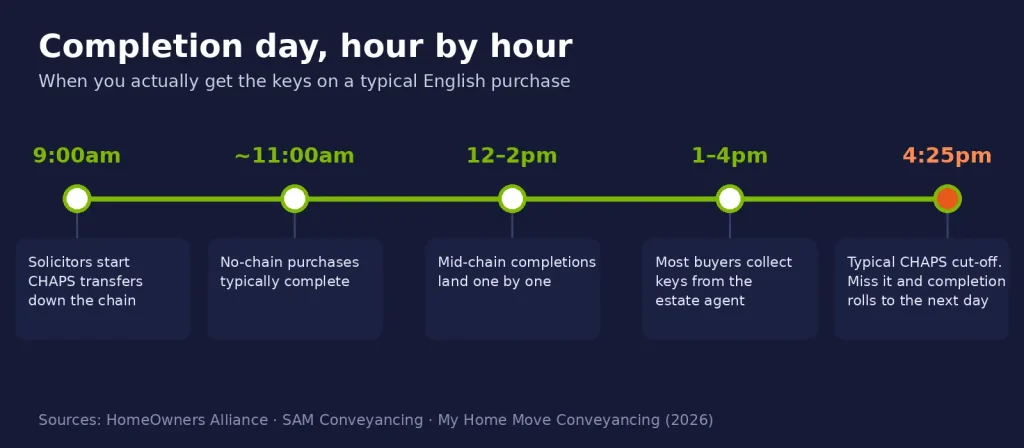
If you are buying, the schedule belongs to the banks, not the removal van. Completion money moves by CHAPS transfer between solicitors, and in a chain each transfer has to land before the next can start, which is why a no-chain purchase often completes around 11am while a mid-chain family gets keys after lunch. The practical rules: do not book the crew on the assumption of morning access to the new house, get your own funds to your solicitor the day before, and treat 4:25pm as the cliff edge, because a transfer that misses the cut-off rolls completion to the next working day. It is also why so many people move on Fridays, and why midweek is quietly the better choice: removal firms have more availability, and if anything does go wrong there is a working day tomorrow to fix it rather than a weekend of waiting.
If you rent: the deposit-protection routine
- Photograph every room, empty and clean, with the date visible on the phone.
- Attend the check-out inventory if you can, and query anything on the spot.
- Return every key, including window keys and fobs, and get a receipt or email confirming it.
- Give your forwarding address in writing; deposit schemes need it to return your money.
- Take a final meter photo and submit it to your supplier the same day, so the last bill is yours and no longer than it should be.
The first week in your new home
In week one: register for council tax, update the electoral roll, register with a GP, find the stopcock and fuse box, and change the locks. You have no idea how many copies of the old keys exist, and a lock change costs a fraction of what it insures against.
- Register for council tax with the new council, and confirm the old account is closed with your move-out date.
- Update the electoral roll at gov.uk/register-to-vote. It takes five minutes and helps your credit record at the new address.
- Register the water account. You cannot choose a water supplier, but you do need to open the account and give an opening reading.
- Find the stopcock, fuse box and meters before the first small emergency, not during it.
- Change the locks. Previous owners, their cleaners, their dog walker: every old key is a stranger’s key now.
- Test the smoke and carbon monoxide alarms, and find the boiler, thermostat and any service history left behind.
- Update pet microchip records. Keeping the address current on the database is a legal requirement for dogs across Great Britain and for cats in England, and it is the difference between a lost pet and a returned one.
- Unpack kitchen and bedrooms first. A house where you can cook and sleep is already a home; everything else can wait a week.
One quiet gotcha: smart meters. If the previous occupant’s meter is an older first-generation (SMETS1) unit, it can temporarily lose its smart functions when accounts or suppliers change, and you will need to submit manual readings until it is enrolled on the national network. It still measures correctly; it just stops phoning home. Take your own photographed reading on day one regardless of what the display promises.
Room-by-room packing guide
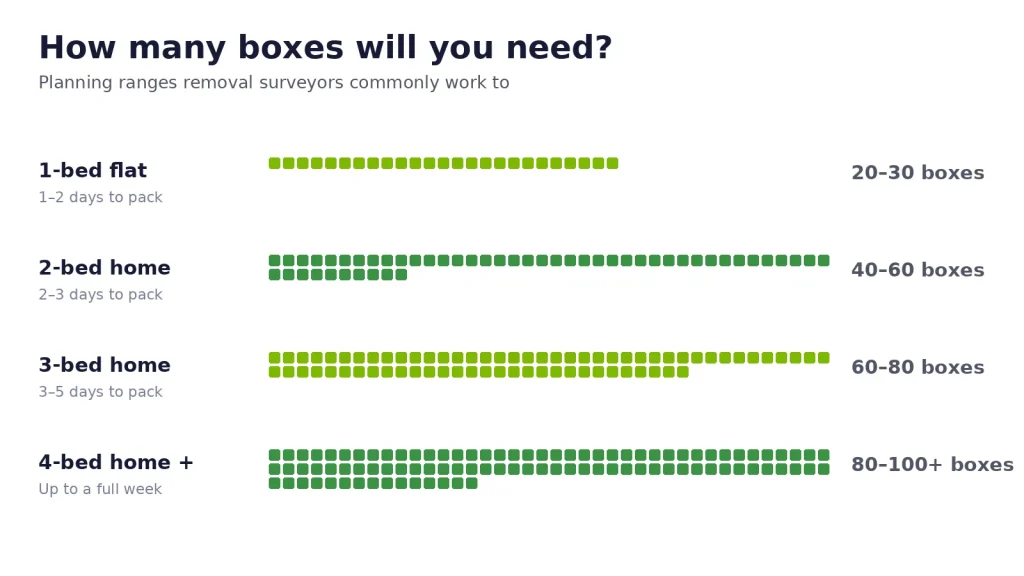
Pack by room, label by room, and budget boxes by property size: a 1-bed home typically needs 20 to 30 boxes, a 3-bed 60 to 80, and a 4-bed upwards of 80. Start with the rooms you use least and leave the kitchen until last.
| Property size | Typical box count | Realistic packing time |
|---|---|---|
| 1-bed flat | 20 to 30 boxes | 1 to 2 days |
| 2-bed home | 40 to 60 boxes | 2 to 3 days |
| 3-bed home | 60 to 80 boxes | 3 to 5 days |
| 4-bed home and larger | 80 to 100+ boxes | Up to a full week |
Planning figures based on the ranges removal surveyors commonly work to; your declutter results may beat them.
Kitchen
- Pack plates vertically like records, with paper between each; they survive far better on edge than flat.
- Use tea towels and clothes as padding for glassware; you are moving them anyway.
- Keep a ‘first morning’ bag: kettle items, one pan, plates and cutlery for everyone.
- Empty, defrost and dry the fridge-freezer 24 to 48 hours ahead.
- Seal open packets, and give away what will not survive the trip.
Glassware is where most kitchen breakages happen, and tea towels on their own will not save a set of wine glasses over a long journey. Our guide to how to pack glasses for moving covers the wrapping method, the box choice and the errors that cost people a full set. Plates and bowls follow their own rules, and our guide to packing crockery for moving has the step-by-step method, with packing plates for moving going further on plates alone.
Living room
- Photograph the back of the TV and router before unplugging; the photo is your rewiring diagram.
- Keep remote controls, cables and brackets in one labelled bag taped to the TV box.
- Box books flat in small boxes only; a large box of books is unliftable.
- Roll rugs, never fold them, and wrap sofas in covers or old sheets.
Bedrooms
- Leave clothes in drawers if the drawers can be carried, or use wardrobe boxes for hanging clothes.
- Bag bedding by bed and label it; first night depends on it.
- Vacuum bags shrink duvets, pillows and out-of-season clothes to half their volume.
- Dismantle bed frames last, and tape the bolts to the headboard in a labelled bag.
Bathroom
- Tape or cling-film the lids of every bottle before boxing; one open shampoo ruins a box.
- Bin expired medicines via a pharmacy, not the box.
- Keep one wash bag per person out of the boxes for the first night.
Home office and documents
- Passports, certificates, warranties and house paperwork travel in your car, not the van.
- Back up computers before they are moved; photograph cable setups first.
- Shred, do not bin, anything with account numbers on it during the declutter.
Garden, garage and loft
- Start these rooms first; they are the slowest and the most forgotten on the day.
- Drain fuel from machinery and disconnect gas from the barbecue.
- Clean garden tools; most firms will not load soil-caked equipment next to furniture.
- Empty the shed of the chemicals on the prohibited list above and tip-run them separately.
What moving house costs in 2026
Industry-average UK removal costs in 2026, from Reallymoving customer data published by the HomeOwners Alliance: £432 for a 1-bed, £867 for a 3-bed and £1,590 for a 5-bed, with Checkatrade putting a professional packing service at roughly £400. The whole move, including legal fees, surveys and stamp duty, averages £13,018 nationally and £17,831 in England when buying and selling together.
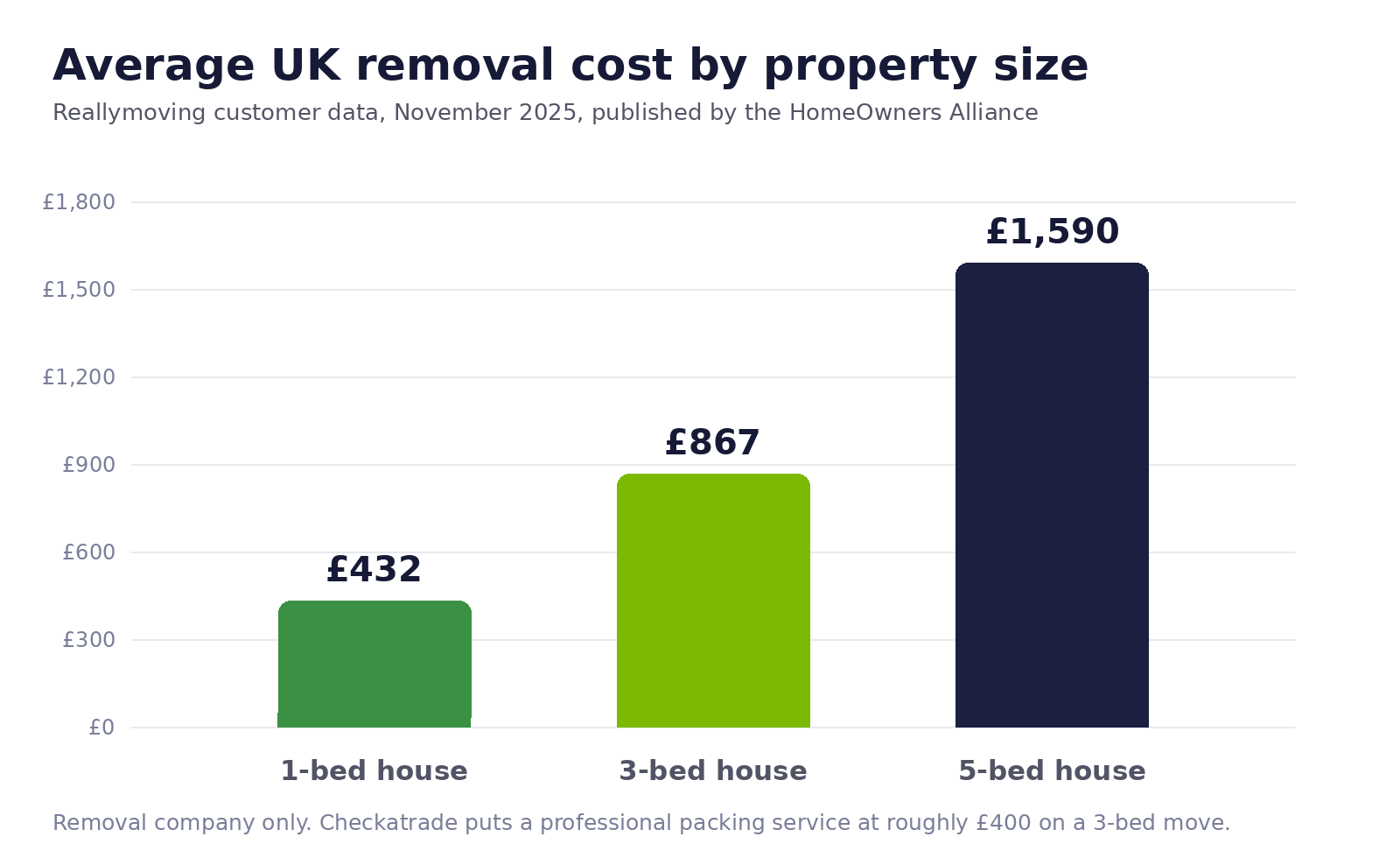
| Cost line | Typical 2026 figure | Source |
|---|---|---|
| Removals, 1-bed | £432 | Reallymoving data via HomeOwners Alliance |
| Removals, 3-bed | £867 | Reallymoving data via HomeOwners Alliance |
| Removals, 5-bed | £1,590 | Reallymoving data via HomeOwners Alliance |
| Professional packing, 3-bed | About £400 | Checkatrade cost guide |
| Two movers and a van, hourly | £50 to £80 per hour | Checkatrade cost guide |
| Royal Mail redirection | £45 to £95 per adult | Royal Mail, April 2026 prices |
| Whole move, UK average | £13,018 | HomeOwners Alliance cost of moving calculator |
| Whole move, England, buying and selling | £17,831 | Which? |
Two things the averages hide. First, geography: price-comparison platform data for the same 3-bed move shows averages near £694 in Liverpool against £1,930 in Oxford, nearly a threefold difference for the same lorry and the same day’s work. Second, timing: Fridays and the summer months are the most booked and the most expensive, while a midweek move in the middle of the month is consistently the cheap seat. If your dates are flexible, say so when you ask for quotes; flexibility is a discount you already own.
And the honest framing: the removal company is one of the smaller lines in the total. Legal fees, surveys, stamp duty and agent fees make up most of the £13,018 average tracked by the HomeOwners Alliance cost of moving calculator, with Which? putting the England buy-and-sell figure at £17,831. That means the removal is also one of the few lines where shopping around and preparing well genuinely changes what you pay.
Broadband: the switch most people mistime
Order broadband for the new address around six weeks before the move: full-fibre installations commonly take one to four weeks. Under Ofcom’s One Touch Switch rules, in force since September 2024, you only contact the new provider, you cannot be double-billed beyond the switch date, and you are owed compensation if you are left offline for more than one working day during a switch.
A home move is slightly different from a straight switch, and the order of operations matters. First check what networks actually serve the new address; the answer changes street by street. If your current provider covers it, they can usually move your contract, though some restart the minimum term when they do, so ask the exact question: does this reset my contract, and at what price? If they cannot serve the new address, Ofcom’s rules oblige them to waive early-termination fees, but you have to ask and show evidence of the move. One gap to know about: One Touch Switch covers broadband and landline only, so a TV bundle still needs a separate conversation with the old provider.
Moving with children and pets
Arrange care for children and pets away from the house on moving day itself; removal firms cannot transport animals, so pets always travel with you. Update microchip records within days of arriving: it is a legal duty for dogs, and for cats in England.
- Book the day out: grandparents, a trusted friend, nursery, or a familiar kennel or cattery. An open front door, heavy furniture and a curious toddler or spooked cat is the one combination everyone regrets.
- Pets travel in your car, in a carrier or restraint, with water and a familiar blanket.
- Register with a vet in the new area and ask the old practice to transfer records.
- Give cats two to three weeks indoors at the new house before letting them out, and walk dogs on the lead locally until the new territory feels like theirs.
- Set up one calm room first at the new house: bed, toys, water, litter tray, door closed while the crew works.
- For children, pack their room last and unpack it first, and let them carry one box of their own things; small control beats big reassurance.
When you do not need a removal company at all
Honestly: not every move needs a firm like ours. If you are leaving a furnished rental and everything you own fits in a car and a friend’s estate, spend the money on the deposit instead. If you are moving a few streets with flexible dates and no large furniture, a hired van and a favour is a perfectly good plan. And if your completion date is still wobbling, do not book anyone on non-refundable terms; ask every firm, including us, what their postponement and cancellation terms are before you pay a deposit, because a moving date that slips is the single most common way people lose money on removals. Where a professional crew earns its fee is volume, stairs, distance, insurance and time: the two-bedroom-and-up moves where a DIY plan quietly becomes three van trips and a lost weekend.
How to make the move greener
The greenest move is the lightest one: fewer boxes, reused materials, and a single well-planned trip. Decluttering to charity, borrowing used boxes and choosing paper wrap over bubble wrap cut both waste and cost.
- Source used boxes free from supermarkets, offices, and local giveaway groups, and pass them on again afterwards; a moving box has three or four moves in it.
- Consider rental crates: sturdier than cardboard, delivered and collected, no waste pile at the end.
- Donate, do not tip. Charities including the British Heart Foundation collect furniture and working electricals from your home, often free.
- Recycle dead electronics properly at a WEEE point rather than paying to move them.
- Use paper wrap and towels instead of bubble wrap where you can; the kitchen packs almost entirely in things you already own.
- Run the freezer down and give surplus food away locally rather than binning it on the last night.
- One right-sized van beats many small trips: the accurate survey that gets the vehicle size right is also the lowest-emission version of your move.
Get the printable checklist (PDF)
The whole timeline above is condensed into a free two-page PDF: every task as a tick box, organised by week, with the key numbers (redirection prices, notice periods, the essentials-box list) printed on it. No email address required; print it and put it on the fridge.
Frequently asked questions
When should I start packing for a house move?
Start packing non-essential rooms two weeks before moving day, and begin decluttering six to eight weeks out. A 3-bed home realistically takes three to five days of packing, so leaving it to moving week means doing nothing else that week.
Who needs to be told when you move house?
Around 20 organisations. The legally important ones are the DVLA (licence and log book separately), your car insurer, HMRC and both councils; then banks, GP and dentist, TV Licence, insurers, schools and subscriptions. The full table above lists each with the direct route.
How much does it cost to move house in the UK in 2026?
Industry data (Reallymoving via the HomeOwners Alliance) averages £432 for a 1-bed, £867 for a 3-bed and £1,590 for a 5-bed, plus about £400 for professional packing per Checkatrade. The full cost of moving, with legal fees, surveys and stamp duty, averages £13,018 nationally and £17,831 in England when buying and selling together.
What time do you get the keys on completion day?
A purchase with no chain typically completes around 11am; most buyers in a chain collect keys between 1pm and 4pm. Funds move by CHAPS transfer with a cut-off around 4:25pm, after which completion rolls to the next working day.
How long does Royal Mail redirection take to start?
At least five working days from application, and you can apply up to six months ahead. From April 2026 it costs £45 for three months, £66.50 for six or £95 for twelve, per adult, with a concession from £22.50 for people on Universal Credit or Pension Credit.
What will removal companies refuse to move?
Hazardous items: gas bottles, petrol and other fuels, paint and thinners, aerosols, corrosive cleaners, fireworks and ammunition. Perishable food is refused on long moves and anything going to storage. Passports, jewellery, cash and medication should travel with you rather than in the van.
What is the cheapest day to move house?
Midweek, mid-month, outside summer. Fridays are the most booked day because completions cluster there, and August is the busiest month, so a Tuesday or Wednesday move with flexible dates is where quotes come in lowest.
Ready to put the checklist into action?
Work the list week by week and moving day becomes a schedule rather than a scramble. How much of it you actually do yourself is a choice: EcoGreen Movers runs Standard for the loading and unloading, Standard Plus with the furniture taken apart and rebuilt at both ends, and Premium with the packing done for you as well, which removes most of the six-week and moving-week sections of this checklist outright. Packing boxes can also be ordered on their own if you are doing the packing but would rather not source materials. Tell us your dates and both addresses and we will put a real quote against the plan. And if it is a workplace on the move rather than a home, start with our office removals London guide instead.

From Edinburgh to London and Manchester, our team supports residential moves UK-wide. Explore Edinburgh removals, London removals or Manchester removals, and get in touch for a quote.