
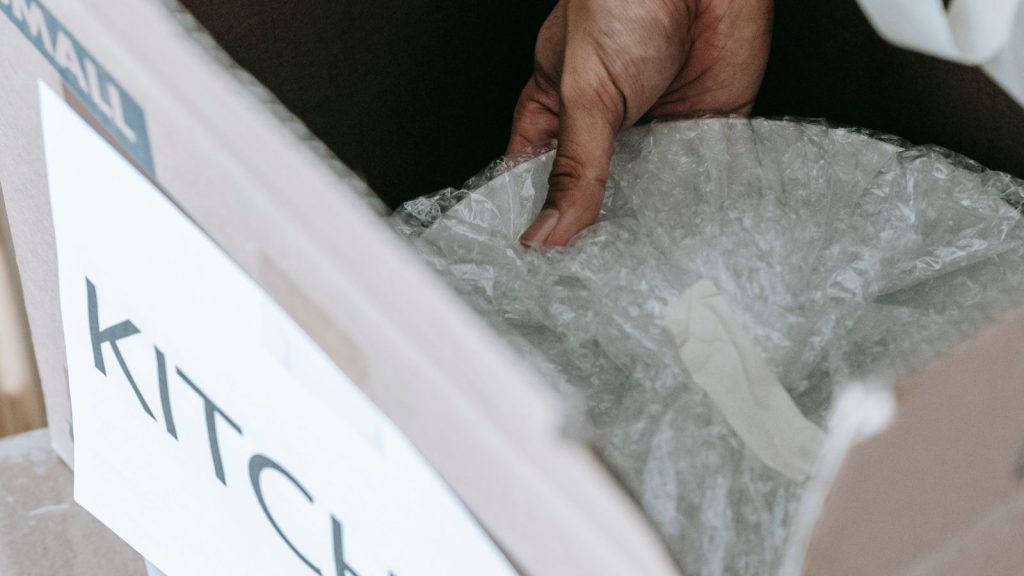
Large moving boxes exist for light bulky things, and almost every problem people have with them comes from filling them with heavy ones. The cardboard is rarely the limiting factor. You are, and so is whoever carries the box down the stairs behind you.
Get that one thing right and large boxes are genuinely useful. Duvets, pillows, coats, cushions and soft furnishings all take a huge amount of space and weigh almost nothing, and packing them in small boxes wastes both boxes and van space.
Summary: Use large boxes for bedding, cushions, coats, lampshades and soft toys. Never for books, crockery, tools, tinned food or anything dense. On weight, HSE guidance INDG143 on manual handling gives a guideline figure of 25kg for men and 16kg for women lifting at waist height close to the body, and stresses that these are risk filters rather than safe limits. Carrying a box downstairs is harder than a straight lift, so stay well under them.

What actually belongs in one
| Suits a large box | Why | Never in a large box | Why not |
|---|---|---|---|
| Duvets and pillows | Bulky, almost weightless | Books, files, vinyl | Dense, and the weight compounds fast |
| Coats and winter clothing | Fills volume, light | Crockery and glassware | Weight plus fragility, needs small boxes |
| Cushions and soft furnishings | Compressible, light | Tools and hardware | Concentrated weight, sharp edges |
| Lampshades | Fragile but very light | Tinned and dry food | Deceptively heavy in quantity |
| Soft toys and bedding | Bulk without mass | Anything from a garage | Dense, dirty, often oily |
| Empty storage baskets | Awkward shapes, no weight | Paperwork and documents | Paper is heavier than people expect |
Paperwork surprises people most. A box of files feels like nothing while you are putting individual folders in and becomes immovable by the time it is full. Archive boxes exist at that size precisely because paper is dense.
The test that works is the tilt test. When a box is packed, tip it slightly with one hand. If you cannot control it comfortably, it is too heavy, regardless of how full it looks or what the side of the box claims it will take. A printed rating describes what the board withstands in a stack, not what a person can carry through a doorway and down a flight of stairs.
Why they fail, and how to stop it
Large boxes rarely fail through the walls. They fail at the base seam, which splits under concentrated weight, and at the cut-out handles, where the load bears on a thin strip of board. Both are preventable with tape.
Tape the base properly before filling. Run a strip along the central seam and then two more across it at right angles, forming an H. Interlocking the flaps without tape is quick and it is the single commonest cause of a box emptying itself onto a staircase.
For handles, run a strip of tape along the top edge of each cut-out on the inside before packing. It takes seconds and it spreads the load across a wider area of board, which is the specific failure that reviewers of every brand of handled box report.
- Double-wall board throughout. Single wall is fine for light contents that will not be stacked; a large box in a van will be stacked.
- Fill it completely. A part-filled large box collapses when something is stacked on it, because the walls have nothing supporting them from inside.
- Pad the void rather than leaving it. Crumpled paper or soft items to the top, then close the flaps flat.
- Keep them dry. Damp corrugated board loses strength, which matters on a wet moving day.
- Stack large boxes at the top. Small heavy boxes at the bottom of any stack, always.
- Two hands and a straight back. Bulky boxes are awkward rather than heavy, which is its own injury risk on stairs.
The part-filled point is worth dwelling on. Cardboard boxes carry stacked weight through their walls, and the contents brace those walls from inside. A large box that is two-thirds full is structurally much weaker than the same box packed to the top, which is why padding the void matters as much as the contents do. Our guide to choosing and using packing paper covers what to fill it with.

How many of each size to buy
Households consistently over-order large boxes and run out of medium ones. Supplier pack sizes are a better guide than a bedroom count: the published packs at Boxes for Moving Home run to 35 boxes for a one to two bedroom home, 45 for two to three bedrooms and 60 for three to four, as indicative market guidance in August 2026. Their two to three bedroom pack is 30 medium, 10 large and 5 extra large, which is the ratio worth copying.
That ratio is the useful part. Roughly two thirds medium, and large boxes as a minority rather than the backbone. It is close to the opposite of what most people buy, because large boxes look like better value per box, so households order them and then discover they own nothing light enough to fill them. You end up either packing books into a large box, which is the mistake this article exists to prevent, or shipping air.
Treat any pack size as a starting point rather than an answer. The number depends far more on how much a household owns than on how many bedrooms it has, which is why no calculator gets this right and why a survey does.
Order roughly what you estimate and top up near the end rather than over-buying, since unused boxes are rarely returnable once a bundle is opened. Running short is easier to fix than running long. We sell packing boxes on their own without booking a move, which is the easy way to top up mid-pack without paying convenience prices for whatever the local shop happens to have. Say roughly how big the property is and we will put a figure against the materials.
For prices and the other sources, see our guide to where to buy moving boxes in the UK, our review of IKEA moving boxes, and where to find free cardboard boxes if the budget is tight.
Labelling so the box ends up in the right room
Label the sides, never the top. Boxes are stacked, so the top of every box except the highest one is hidden, and a crew carrying a box into a house reads whatever faces them.
Write the destination room first and in large letters, then the contents underneath in smaller writing. The room is what the crew needs; the contents are what you need later. Putting the contents first means somebody has to read a whole line to work out where a box goes.
Colour coding works better still if you have a lot of boxes. A roll of coloured tape per room, plus a matching sheet of paper taped to each doorway at the new property, means a crew can place boxes correctly without asking a single question. It costs very little and saves an hour of redistributing boxes afterwards.
Mark the boxes you want opened first with something unmistakable. Not fragile stickers, which are on half the boxes anyway, but a distinct mark used only for priority items, so the kettle and the bedding are findable without opening twenty boxes.
The specialist large boxes worth knowing about
Wardrobe boxes with a hanging rail move clothes still on their hangers, which saves hours at both ends. They are expensive to buy and usually cheap to hire, so taking them from a removals company is almost always the better choice. We supply them alongside crates, and they are worth asking about specifically, because a single one takes a surprising amount of a wardrobe and clothes arrive without needing ironing.
Picture and mirror boxes are adjustable flat cartons for framed items, and they are worth it if you own anything you would be upset to break. Combined with corrugated wrap, they are the correct answer for artwork and mirrors, which are among the most commonly damaged items in a self-managed move.
Television boxes exist too, though the original packaging is better if you kept it. Screens travel upright, never flat, and never with anything resting on them.
What is generally not worth buying is a box beyond the standard extra-large size. Above a certain point a box becomes impossible to carry through a doorway when full, and the extra capacity is unusable in practice.
A note on where boxes come from, since strength varies enormously. Boxes collected free from shops were designed to hold one product once, on a pallet, in a lorry. Some are excellent, particularly those from wine and spirits deliveries, which are built to carry heavy glass. Others are single-wall trays that will not survive being stacked.
Use free boxes as a supplement for light, non-fragile contents rather than as the backbone of a move, and check each one for damp staining and soft corners before trusting it. A box that has sat in a stockroom under a leak looks fine and fails when lifted. Never reuse a box that has held food without checking it thoroughly either, since fruit and vegetable boxes in particular can carry residue and the occasional passenger.
Why box size affects the van, not just your back
Box choice does more to the loading of a removal van than most people expect, and it can decide whether a move takes one load or two.
| Approach | Effect on van space | Effect on time | Verdict |
|---|---|---|---|
| Two or three modular sizes | Stacks squarely, minimal gaps | Fast to load | Best |
| Many mismatched sizes | Air gaps throughout | Slow, needs constant rearranging | Worst |
| All large boxes | Wasted volume in part-filled boxes | Awkward carries | Poor |
| All small boxes | Efficient but high box count | Many more trips | Slow |
| Free boxes of random sizes | Poor stacking, unknown strength | Collapses need repacking | Supplement only |
Consistency beats size. Boxes sharing a footprint stack into a solid block that fills the van efficiently and does not shift in transit. A mixed collection leaves gaps, and gaps are both wasted space and the reason loads move on the road.
Part-filled large boxes are the specific offender. A large box containing a duvet and a lot of air occupies its full external volume in the van while carrying very little, which is the least efficient thing you can load. Fill it, or use a smaller box.
Crates are the other alternative and they solve the consistency problem outright. Plastic moving crates stack perfectly, do not collapse when damp, have proper handles and lids, and go back at the end of the job. That is what we bring to moves we are carrying out, in consistent sizes, delivered before the day and collected afterwards. The choice between crates and boxes comes down to whether we are doing the transport: if we are, crates; if you are packing and moving yourself, boxes you buy and keep.
For anyone moving into storage, crates are clearly better than cardboard, since corrugated board softens and slumps in an unheated unit over several months while a plastic crate does not.
When not to use a box at all
Bedding, coats and soft furnishings do not need boxes. Large woven storage bags, vacuum bags and even bin liners handle them perfectly well, cost less, and compress into gaps in a van that a rigid box cannot fill. Box suppliers will not mention this, and it removes a meaningful share of the large boxes most households buy.
Soft goods in bags are also useful load-fillers. A removal crew can push a bag of duvets into the awkward space above a wardrobe or beside a sofa, which is space that would otherwise be wasted. Rigid boxes cannot do that.
Vacuum bags go further and are worth it for bulky winter bedding, though be aware that compressed feather and down needs time to recover afterwards and some items never fully do. Use them for synthetic bedding rather than good duvets.
Suitcases are the other underused option. You already own them, they have wheels, and they are ideal for heavy items that would otherwise need small boxes. A suitcase of books is much easier to move than a box of them.
Order boxes about three weeks before the move. Earlier and they occupy a room you still need; later and you are packing under pressure with whatever arrives. Three weeks gives time to start on the loft, the spare room and anything seasonal while leaving the everyday rooms until the final week.
And afterwards
Flattened cardboard is the easiest packing material to get rid of, which is its quiet advantage over foam and film. Under GOV.UK guidance on the Simpler Recycling reforms, councils in England must collect paper and card from every household, so a three-bedroom move’s worth of boxes needs bin collections rather than trips.
Take the tape off first. You will have used a lot of it if you followed the advice above, and Recycle Now guidance on recycling contamination warns that too much contaminated material can stop a whole lorry load being recycled. Keep the card dry as well, since wet cardboard is no longer recyclable.
Better still, keep the good ones. A box used across three moves costs a third as much per move as one used once, and flattened boxes take almost no space in a loft. If you expect to move again within a few years, that is the cheapest box decision available.
How EcoGreen Movers approaches this
Everything above is a decision you only have to make if you are packing. On our Premium service you are not: the crew decides what goes in which box, and the sizing problem this article describes stops being yours. Standard Plus stops short of the packing but takes every piece of furniture apart and rebuilds it at the far end, and Standard is the loading and unloading on its own for households who want to do the rest.
If you are packing yourself, buying the boxes from us skips the courier order and the guesswork about board grade, and the mix arrives weighted the way this article recommends rather than the way a bundle happens to be sold. EcoGreen Movers also handles disposal and clearance, so the things that turn out not to be worth packing can go in the same conversation as the move.
What Premium actually involves is set out room by room in our guide to how a packing service works on the day, and the packing and storage pages cover the rest. We run residential moves nationwide including London, Manchester and Edinburgh. Get in touch for a quote.
Frequently asked questions
How heavy should a large box be?
Lighter than the cardboard allows. HSE guideline figures for a two-handed lift at waist height, close to the body, are 25kg for men and 16kg for women, and the guidance is explicit that these are risk filters rather than safe limits. A box carried down stairs is harder than a straight lift, so treat them as a ceiling. If you cannot tilt a packed box comfortably with one hand, it is too heavy.
What should go in them?
Light bulky items: duvets, pillows, cushions, coats, lampshades, soft toys and empty baskets. Never books, crockery, tools, tinned food or paperwork, all of which are dense enough to make a large box unliftable and likely to split.
How many boxes does a house need?
One UK supplier sizes its packs at 35 boxes for a one to two bedroom home, 45 for two to three bedrooms and 60 for three to four. Note the mix: their two to three bedroom pack is 30 medium, 10 large and 5 extra large, so large boxes are a minority. It depends far more on how much you own than on room count.
Why do the handles tear?
Because a cut-out handle is a hole in the side of a cardboard box, and heavy contents concentrate the load on the thin strip above it. Run tape along the inside top edge of each handle before packing, and keep the weight down.
Are wardrobe boxes worth it?
Yes, but take them from a removals company rather than buying. They move clothes on their hangers, which saves folding and ironing at both ends. We supply them alongside crates, and buying them outright rarely makes sense for a single move.
In summary: light and bulky, tape the base, fill it up
Reserve large boxes for bedding, coats and soft furnishings, and keep everything dense in small ones. Tape the base in an H before filling, tape the inside edge of the handles, and pack to the top so the walls are braced.
Buy large boxes as a minority of the order rather than the backbone, stick to two or three sizes so the load stacks squarely, and use bags for soft goods rather than boxes wherever you can. If you would rather not work any of it out, we sell the boxes and we also pack them.