
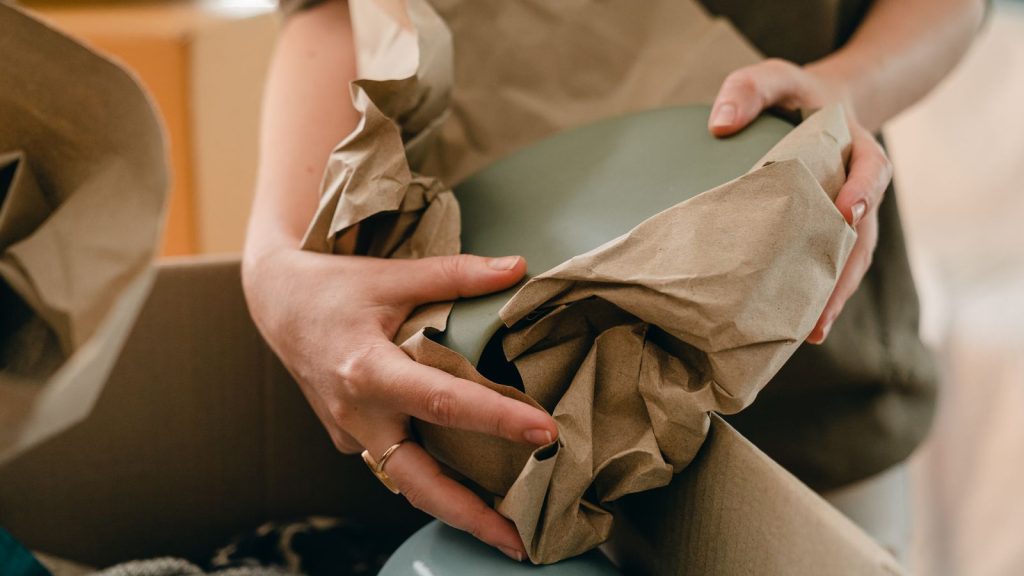
Paper protects fragile items by two mechanisms: it separates surfaces so they cannot touch, and it fills space so nothing moves. Foam and plastic film work mainly by cushioning impact. For household crockery and glassware, separation and immobilisation matter far more than cushioning, which is why professional packers reach for paper and why a properly paper-packed box survives better than a badly bubble-wrapped one.
It also has one advantage nothing plastic can match. Used paper goes straight into the household paper and card recycling, with no drop-off trip and no soft plastics collection point. For a move that generates a room’s worth of used packaging, that is the difference between one bin collection and several journeys.
Summary: Use plain unprinted newsprint for general wrapping and acid-free tissue for anything that stains or tarnishes. Never use printed newspaper on crockery or textiles. Wrap every item individually, then fill every gap until nothing shifts. The disposal advantage is real and now backed by law in England, where GOV.UK guidance on the Simpler Recycling reforms requires councils to collect paper and card from every household, while kerbside plastic film collections do not arrive until 31 March 2027.

The types, and which to buy
| Type | What it is | Best for | Avoid for |
|---|---|---|---|
| Plain newsprint | Unprinted newspaper stock, sold on rolls or in reams | General wrapping, crockery, void fill | Nothing, this is the workhorse |
| Acid-free tissue | Thin, soft, chemically neutral | Silver, jewellery, textiles, artwork, photographs | Heavy items, it tears |
| Kraft paper | Brown, tougher, heavier weight | Wrapping furniture edges, outer layers | Delicate surfaces, it can scuff |
| Corrugated wrap | Flexible single-faced cardboard on a roll | Mirrors, framed pictures, screens, flat panels | Small items, it is too stiff |
| Printed newspaper | Yesterday’s paper | Void fill only, in sealed bags | Anything you will eat off or wear |
The printed newspaper point is worth being firm about. Newspaper ink transfers onto ceramics, glass, painted surfaces and fabric, particularly under pressure and in a warm van. Unpacking a box of white crockery smeared with grey print is a well-known moving experience and an entirely avoidable one. Plain newsprint is the same material without the ink and costs very little.
Acid-free tissue matters for a narrower set of things than people assume, but for those things it matters a lot. Silver tarnishes against ordinary paper, textiles yellow over time, and photographs and artwork can be permanently marked. If something is going into storage rather than straight into a new house, the case for tissue is stronger still.
Working out how much to buy
Paper is sold by weight, which is close to useless as a planning unit. Nobody knows what a kilo of newsprint looks like, and the kilos-per-bedroom figures floating around online come from suppliers with an obvious interest in the answer. Estimate by room instead, because that is something you can actually see.
The kitchen consumes most of it, by a wide margin. Crockery, glassware, mugs and anything ceramic each need individual wrapping plus layers between them, so count the fragile items on the shelves, allow a few sheets for each, and add a margin for the layers between bundles and the crumpled filling at the top and bottom of every box. Bedrooms and living rooms use comparatively little, because most of what is in them is soft or robust.
Then buy more than that. Running out mid-pack means either stopping to buy more at convenience prices or resorting to newspaper and tea towels, and the second half of a pack done badly is where breakages come from. Unused paper is not wasted either, since it recycles or keeps indefinitely for the next move.
On format, rolls are easier for continuous wrapping and flat sheets are faster for repetitive items like plates. Most households do best with a large ream of sheets for the kitchen and a roll for everything else. For where to buy it alongside boxes, see our guide to where to buy moving boxes in the UK, or our list of places to find free cardboard boxes for moving house if the budget is tight.
Wrapping crockery and glassware properly
Plates travel on their edges, not stacked flat. A plate lying flat takes the full weight of everything above it through its weakest axis; a plate standing on edge, wrapped and packed tightly, is remarkably difficult to break. Keep the box small while you are at it, because a full crockery box gets heavy fast and HSE guidance INDG143 on manual handling at work is explicit that its published weight figures are risk filters rather than safe limits.
The plates-on-edge change does more for breakage rates than any material choice. It feels counterintuitive, which is why almost everyone stacks plates flat the first time they move.
The method for plates: lay a sheet flat, place the plate in the centre, fold the corners in over the face, then place a second plate on top and repeat, building bundles of three or four. Wrap the whole bundle in another sheet. Stand the bundles on their edges in a box with a thick layer of crumpled paper beneath them, and pack them tight enough that nothing shifts when you tilt the box. Bowls, serving dishes and anything with an awkward shape need a slightly different approach again, which our guide to how to wrap crockery for moving works through in full. For dinner plates and side plates specifically, how to wrap plates for moving covers the fold and the box choice in detail.
Glasses and stemware need the inside filled as well as the outside wrapped. Push a small piece of crumpled paper into the bowl of each glass, then wrap from the base upward, twisting the excess around the stem. Stemmed glasses go upright, never on their sides, and never touching each other. Tumblers, wine glasses and anything with a stem each behave differently in a box, and our guide to how to pack glasses for moving works through them one at a time.
- Heaviest at the bottom, lightest at the top. Within every box, without exception.
- Crumpled paper at the base and the top. Two inches at each end absorbs the vertical shock of a box being set down.
- Fill every gap. Movement is what breaks things. A box should not rattle when gently shaken.
- Small boxes for heavy items. A large box of crockery is both a breakage risk and an injury risk.
- Label the side, and mark it fragile. Stacked boxes hide their own lids.
- Lids off teapots and casseroles. Wrap separately, since lids rattle and chip against their own rims.

Where paper is the wrong material
Paper is not waterproof, it gives almost no impact cushioning over a large flat surface, and it is a poor choice for anything with a screen. Televisions, monitors and framed glass need corrugated wrap or a purpose-made carton, not sheets of newsprint. Corrugated wrap still recycles with your cardboard afterwards, provided you keep it clean and dry: Recycle Now guidance on recycling contamination warns that too much contaminated material can stop a whole lorry load being recycled.
Most packing guidance treats paper as universally suitable. It is not, and knowing where it fails saves damage.
Large flat items are the clearest case. A framed mirror wrapped in newsprint has no protection against a corner knock, because the paper simply compresses. Corrugated wrap, which is single-faced cardboard on a roll, provides a rigid layer that spreads any impact.
Damp is the other. Paper in a van on a wet day, or in a storage unit over winter, absorbs moisture and transfers it to whatever it is wrapping. For anything going into long-term storage, or for a move happening in poor weather, add a sealed outer layer for items that would be damaged by damp. Wet paper is also no longer recyclable, so a soaked pile becomes general waste rather than a bin collection.
Electronics with screens are best moved in their original boxes if you kept them. Failing that, corrugated wrap plus a rigid carton, and always upright rather than flat, because a screen lying face down takes the weight of anything placed on it.
Awkward items and how to handle them
A few household items defeat the standard method and have their own technique: knives, lamps and shades, houseplants, and anything with a liquid in it. Each takes a minute to do properly and causes real damage done badly.
- Knives. Wrap the blade in several layers, then tape a folded sheet of card over the edge before wrapping the whole knife. Label the bundle so nobody opens it carelessly.
- Lamps and shades. Bulb out, shade off, and pack shades separately with paper inside them rather than around them, so the frame is not crushed.
- Houseplants. Not in sealed boxes. Move them in open crates in the car, and water sparingly the day before rather than the morning.
- Bottles and liquids. Tape the lids, bag each one, and pack upright in a box lined with paper. Never with anything you would mind losing.
- Mirrors and glass shelves. Tape an X across the face so a break holds together, then corrugated wrap and upright transport.
- Cutlery and utensils. Wrap in bundles rather than individually, which is faster and just as effective for items that cannot break.
The tape-an-X trick on mirrors is worth knowing. It does not prevent a break, but it holds the glass together if one happens, which turns a dangerous mess in a van into a contained problem.
Comparing the protective materials honestly
The two questions that decide a packing choice are how well a material protects a given item and what happens to it afterwards. On the second, the gap is wider than most people expect: Recycle Now advice on polystyrene is that it is not commonly recycled and should be placed in the waste bin, while paper and corrugated wrap both go in the recycling.
| Material | Best use | Household recycling? | Main weakness |
|---|---|---|---|
| Plain newsprint | Crockery, glassware, void fill | Yes, with paper and card | No impact protection on flat surfaces |
| Corrugated wrap | Mirrors, frames, screens, panels | Yes, with cardboard | Too stiff for small items |
| Acid-free tissue | Silver, textiles, artwork | Yes, with paper | Tears under any weight |
| Bubble wrap | Awkward-shaped fragile items | Not at the kerb in England until 31 March 2027; supermarket drop-off until then | Disposal requires a shop trip |
| Expanded polystyrene | Appliance corners it was moulded for | No, waste bin | Bulky, and no kerbside route |
| Moving blankets | Furniture, appliances | Reused many times | Must be returned to the supplier |
Two things stand out from that comparison. The first is that paper and corrugated wrap between them cover almost everything a household needs, and both go in the recycling. The plastics on the list each solve a narrow problem and each create a disposal task, which is a poor trade for most items.
The second is the volume of used packaging, which people consistently underestimate. A three-bedroom move generates enough material to matter, and the difference between a stream that goes in the recycling bin and one that requires separate trips shows up as several hours in the week after the move. Our guides on bubble wrap recycling and polystyrene set out what those trips involve.
One more point on technique that applies across all of it: wrap for the journey, not for the shelf. Packaging is doing its job when the box is being carried down stairs, driven over speed bumps and set down heavily, and none of those are gentle. A wrap that looks neat but leaves an item able to shift has failed, however tidy it appears.
The test is simple. Close the box, lift it, and tilt it side to side. If you can hear or feel anything move inside, open it and add more filling. Silence means it is packed properly, and it takes ten seconds per box to check.
What to use instead of buying any
Towels, tea towels, bedding and clothing are all excellent protective material, they are already in the house, and they need moving anyway. Using them means packing two things at once and buying less. Packing suppliers will not suggest this. It works well, with two caveats.
The first is that soft items compress, so a box packed with crockery separated by tea towels needs to be tighter than one packed with paper, and gaps still need filling. The second is labelling: a box containing both crockery and bedding is neither a kitchen box nor a bedroom box, and it ends up in the wrong room and unpacked last. Keep the contents to one destination room even when mixing materials.
Clean, dry towels around appliances and furniture corners work particularly well and cost nothing. What does not work is anything you would be upset to see stained, since packing materials pick up dust and marks from whatever they wrap.
The reverse also applies: do not wrap dirty garden tools or greasy kitchen items in good linen. That combination produces two problems where you had one.
How EcoGreen Movers packs fragile items
We pack with paper, corrugated wrap and reusable blankets rather than foam and film, which is a practical choice as much as an environmental one: paper packs tighter, it does not slip inside a crate, and it leaves nothing for the customer to dispose of. EcoGreen Movers takes its crates away at the end of the job.
If you would rather not do any of this yourself, our Premium service covers professional packing to whatever specification you set, alongside dismantling and reassembly. Below it, Standard Plus handles the furniture without the packing, and Standard covers the loading and unloading. And if you only want the materials, we supply packing boxes on their own without booking a move, which is the useful option for anyone who has read this far and simply wants the right paper and the right boxes. Our packing and storage services cover the range, and our guide to what a packing service actually does, room by room sets out what it looks like on the day.
We run residential moves nationwide including London, Manchester and Edinburgh. For more swaps worth making, see our eco-friendly packing tips, or get in touch for a quote.
Frequently asked questions
Can I use newspaper instead?
Only as void fill, ideally inside a bag. Newspaper ink transfers onto ceramics, glass, painted surfaces and fabric under pressure, and it is particularly bad in a warm van. Plain unprinted newsprint is the same material without the ink and costs very little.
How much do I need?
Estimate by room rather than by weight, since paper is sold in kilos and nobody can picture a kilo of newsprint. The kitchen takes most of it, so count the fragile items on the shelves, allow a few sheets each plus the layers between bundles, and then buy more than that count suggests. Running out mid-pack is where breakages come from, and surplus recycles or keeps for next time.
Should plates be packed flat or on edge?
On edge, wrapped in bundles of three or four, packed tightly with crumpled paper above and below. A plate lying flat takes the weight of everything above it through its weakest axis. This single change reduces breakages more than any material choice.
Is it recyclable afterwards?
Yes, with your household paper and card, which is its main practical advantage over bubble wrap and foam. Under Simpler Recycling, councils in England must collect paper and card from every household. Keep it clean and dry and remove any tape, because contamination can stop a whole load being recycled. Reuse it first if you are likely to move again.
What about mirrors and pictures?
Use corrugated wrap rather than sheets, or a purpose-made picture carton. Paper compresses on impact and gives a large flat surface almost no protection against a corner knock. Transport framed items upright, never flat.
In summary: plain paper, tight boxes, plates on edge
Buy plain newsprint rather than using newspaper, add acid-free tissue for silver and textiles, and use corrugated wrap for anything flat and framed. Estimate by room rather than by weight, and buy more than you expect to need.
Wrap every item individually, stand plates on edge, fill every gap until nothing rattles, and keep heavy things in small boxes. Then put the used paper straight in the recycling, which is the one thing no plastic alternative lets you do.