
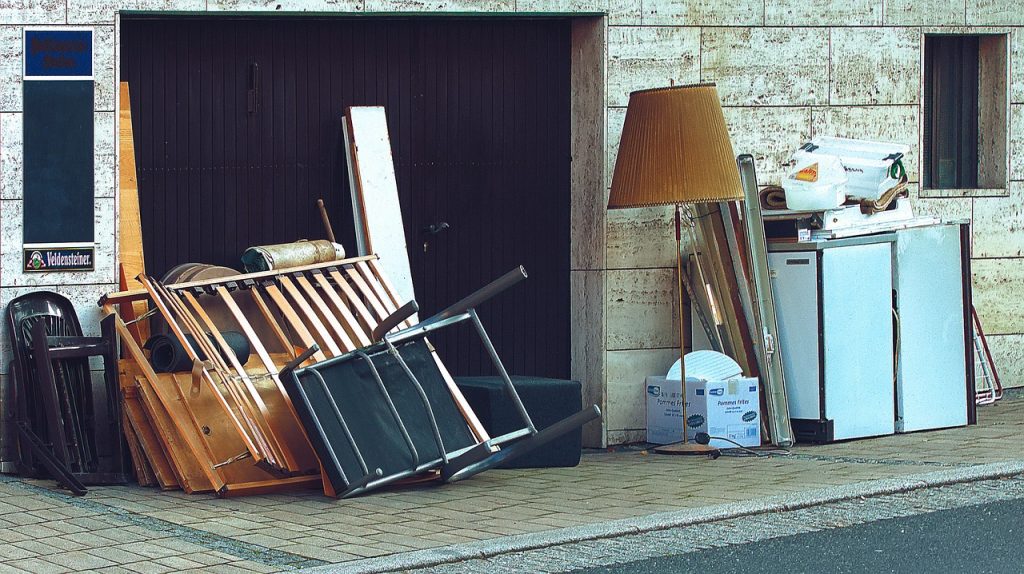
Furniture you are not taking has four possible destinations: sell it, donate it, recycle it, or pay to have it taken away. The right one depends less on the item’s value than on its condition, whether it has a fire safety label, and how much time you have before the van arrives.
The single most useful thing to check first is the label. Upholstered furniture without an intact fire safety label cannot be taken by charities or second-hand dealers, which removes two of the four options immediately. Check before you photograph anything for a listing or book a charity collection that will be refused at the door.
Quick answer: Check the fire label on anything upholstered. Business Companion guidance on second-hand upholstered furniture is that used furniture has to meet the same standards as new, and compliant items carry a permanent label. Good condition with a label means sell or donate, and many charities collect free. No label, or damaged, means a council bulky waste collection or a licensed carrier. Flat-pack furniture rarely survives a second assembly and is usually not worth moving.

The decision, item by item
| Condition | Best route | Typical outcome | Lead time |
|---|---|---|---|
| Good, with fire label, desirable | Sell privately | Money, but you handle viewings | Days to weeks |
| Good, with fire label, ordinary | Charity collection | Free removal, often booked in advance | One to three weeks |
| Good, no fire label | Keep it, or disposal | Charities and dealers cannot accept it | Variable |
| Worn but functional, labelled | Community reuse project | Free or low cost removal | One to two weeks |
| Broken or unsafe | Council bulky waste or licensed carrier | Charged per item | One to three weeks for councils |
| Flat-pack, previously assembled | Usually disposal | Rarely survives dismantling twice | Immediate |
Lead time is the constraint people underestimate. Charity collections and council bulky waste both run on schedules measured in weeks, not days, and both get busier at month ends when tenancies turn over. Deciding what is going three days before the move leaves only the paid options.
Start this six weeks out. It is the single change that converts furniture disposal from an expense into either free removal or a small return.
The fire label rule
Anyone supplying upholstered furniture in the course of a business, which includes charities, auctioneers and second-hand dealers, has to satisfy the Furniture and Furnishings (Fire) (Safety) Regulations 1988, and the permanent label is how an item shows it complies. The regulations cover sofas, armchairs, beds, mattresses, cushions, bean bags and padded headboards, and exclude anything made before 1 January 1950.
The label is usually a small fabric tag stitched under a cushion, beneath the base, or on the underside of a frame. It is easy to miss and easy to lose, and once it is gone the item is effectively out of the second-hand trade regardless of condition.
Check every upholstered item before making plans for it. Finding the label takes a minute and saves booking a collection that gets refused on the doorstep, which happens often enough that charity collection teams have a standard script for it.
The pre-1950 exclusion is worth knowing if you have inherited anything genuinely old. A Victorian chair is outside the regulations, so the absence of a label is not the obstacle it would be on a sofa from the 1990s. Anything re-upholstered since, though, has to meet the standard on the materials used.
Hard furniture is unaffected. Tables, wardrobes, chests of drawers, bookcases and dining chairs without padded seats have no labelling requirement, and their resale or donation depends purely on condition.
One recent change is worth noting if you remember the swing tag on new furniture. Since October 2025 the separate display label at the point of sale is no longer required, but the permanent label is unchanged and still applies to second-hand supply. It is the permanent one you are looking for.
Why a sofa costs more to get rid of than a table
Upholstered seating is treated as chemical waste once it is thrown away. Under GOV.UK guidance on persistent organic pollutants, waste containing these substances has to be destroyed rather than landfilled or recycled, and regulators treat waste upholstered domestic seating as containing them unless it can be shown otherwise. That is why a sofa and a table of the same size are priced differently for disposal.
The scope is narrower than the phrase suggests and worth getting right. It covers seating: sofas, sofa beds, armchairs, dining and kitchen chairs with padding, office chairs, stools, footstools, futons, bean bags, and floor and sofa cushions, including anything with a part made of leather, synthetic leather, fabric or foam. It does not cover mattresses, carpets or curtains, which follow ordinary bulky waste routes even though mattresses do need a fire label to be resold.
Two practical consequences follow. Stripping the cushions off a sofa does not turn it into ordinary waste, because any part still carrying fabric or foam is treated the same way. And a site that would happily take a wooden chair may refuse the same chair with a padded seat, because it cannot go in the same container.
There is a genuinely important exception, and it is the argument for acting early. An item you donate while it is still usable is not waste, so none of this applies to it. Once a sofa is thrown out it is committed to incineration; the same sofa given to a charity a fortnight earlier goes back into a living room. That is a better outcome by any measure, and it is only available to people who decide in time.
Selling, donating and giving away
Charity furniture collection is free, arranged in advance, and takes items straight from the room they are in. It is the best option for anything in genuinely good condition, and it is dramatically under-used because people assume they must transport things themselves.
Most large national charities run furniture collection services, as do many local hospices and community reuse projects. They will usually assess from photographs, confirm what they can take, and collect on a booked date. Some will also take items they cannot resell themselves and pass them to community projects instead.
- Send photographs first. Including the fire label. It saves a wasted visit for both sides.
- Book early. Collection slots run one to three weeks out and fill at month ends.
- Be honest about access. Third floor with no lift changes whether they can take it.
- Clean it. An item that looks cared for gets accepted; the same item covered in dust gets declined.
- Ask about Gift Aid. Many charities can claim it on donated goods they sell, at no cost to you.
- Try local groups if a charity declines. Community pages and reuse networks move furniture quickly and sometimes take things charities cannot.
Selling privately is worth it for solid wood, mid-century pieces, quality brands and anything with a recognisable name. It is rarely worth it for ordinary modern furniture, where the effort of listing, answering messages and arranging collection exceeds the return. Be realistic about which category an item is in.
Free listings on local groups clear items fastest of all, and collection is the buyer’s problem, which is the main advantage. Whatever route you choose, insist the person collecting brings help, since a sofa carried by one determined stranger through your hallway is a damage risk you are absorbing.

Paying to have it taken
Councils run bulky waste collections, usually charging per item with a minimum booking, and they take a few weeks. Put upholstered seating out separately from everything else: SEPA guidance on waste upholstered domestic seating requires it to be segregated from other waste streams, and a sofa mixed in with a broken table is liable to be left behind.
Council collections are usually the cheapest paid route and the slowest. Charges vary widely between authorities, some offer a number of free collections a year, and most require the items to be left in an accessible place such as a front garden on the collection day. Expect seating to be quoted separately from everything else.
Private clearance is faster and priced by volume rather than per item. If you have several pieces going, that often works out better than a per-item council charge. We offer disposal and clearance ourselves, which is worth asking about at the same time as the move rather than arranging separately, since one visit can cover both. Our guide to house clearance costs covers what to expect and the licence check that protects you.
Taking it yourself to a recycling centre is free in most areas for household quantities, but check the rules before loading a van. Several sites restrict access for vans and trailers or require a permit, and a permit application can itself take a few days.
Whatever you do, do not accept an unsolicited offer from someone knocking or advertising to take furniture away cheaply for cash with no paperwork. As a householder you have a duty of care over where your waste ends up, so if it is fly-tipped the enforcement traces back to you. Check the carrier is registered before anything leaves the house, and keep the paperwork.
Selling it without wasting your week
Price it to go rather than to maximise. In the weeks before a move you are not running a furniture business, and an item that does not sell becomes a disposal cost plus the time you spent listing it.
Set a deadline when you list. If something has not sold two weeks before the move, switch it to free collection or book a charity pickup, because at that point speed matters more than the money. Holding out for the asking price on a wardrobe until three days before completion is how people end up paying for clearance.
- Photograph in daylight, from the front and at an angle. Clear the clutter around it first.
- Give dimensions in the listing. It removes the most common question and filters out buyers it will not fit.
- Say collection only and mean it. You are not delivering furniture the week you move.
- State the fire label position for upholstery. Buyers who know the rules will ask.
- Be honest about marks and wear. A buyer who arrives to something worse than described will not take it.
- Arrange collection well before moving week. Not the day before, when you have no capacity for a no-show.
Take payment on collection rather than promising to hold something. No-shows are common on free and cheap listings, and an item promised to someone who never arrives has cost you the buyer who would have taken it.
Whether to move it at all
Removals are priced by volume, so large low-value items are the most expensive things in the van per pound of worth. Set the cost of moving a piece against the cost of replacing it and the picture changes for a few categories in particular.
| Item | Van space | Second-hand value | Usually worth moving? |
|---|---|---|---|
| Solid wood wardrobe or table | High | Genuine | Yes, if it dismantles |
| Quality sofa with label | Very high | Moderate | Yes, if it fits the new room |
| Flat-pack wardrobe or bookcase | High | Minimal | Rarely |
| Mattress | High | None | Only if nearly new |
| Chest of drawers | Medium | Moderate | Usually |
| Garden furniture | High | Low | Rarely, unless good quality |
Flat-pack furniture is the clearest case for leaving behind. Chipboard panels lose their fixings’ grip once dismantled, cam locks strip, and an item that went together perfectly once frequently will not go together properly a second time. Moving it assembled takes enormous van space for something that may not survive the journey.
Measure before deciding, too. Furniture that does not fit the new room, or will not go up the new staircase, gets moved twice and disposed of anyway, which is the most expensive possible outcome. Check doorways, stair turns and ceiling heights at the new property before committing anything large to the van.
Decluttering before the survey also reduces the removal quote directly, since pricing follows volume. Our guide to decluttering before a move covers the wider sort, and how to dispose of a mattress deals with the one item that follows different rules again.
Two categories worth handling separately from the rest. White goods, meaning fridges, freezers, washing machines and dishwashers, are frequently included in a sale and equally frequently taken, so establish which on the fittings and contents form early. If they are staying with you, they need disconnecting properly, and a fridge or freezer should travel upright and be left to stand for several hours before being switched on.
Garden furniture is the other. It is bulky, low value, usually weathered, and it fills van space that household contents need. Unless it is genuinely good quality, it is a strong candidate for selling or passing on locally rather than moving. Note that padded outdoor seating suitable for indoor use falls under the same fire label rules as indoor furniture.
When to keep it despite the arithmetic
Replacing furniture is expensive in ways the disposal calculation ignores. A house cleared of everything ordinary still needs beds, a table and somewhere to sit on the first night, and buying all of that at once costs far more than moving it. Advice to leave furniture behind is easy to over-apply: individual low-value items are often not worth moving, and a whole household of them certainly is.
Beds and mattresses in particular are worth taking unless they are genuinely worn out. Arriving at a new house with nowhere to sleep is a bad first night, and a replacement bought in a hurry is usually the wrong one.
Anything with sentimental value sits outside this entirely and should not be argued about on cost grounds. A piece inherited from a family member is not a volume calculation.
And if money is tight, moving what you have is almost always cheaper than replacing it, even accounting for van space. The disposal-and-replace approach suits people upgrading, not people economising.
One last consideration for renters. Furniture supplied by a landlord stays, obviously, but anything you added and are leaving behind should be agreed with them in writing first. A tenant who leaves a sofa as a favour can find it treated as abandoned goods and charged for its removal at the end of the tenancy, and that removal is now an incineration cost rather than a tip run.
The same applies in reverse to items a previous tenant left for you. If they are not on the inventory, ask the landlord to confirm in writing whether they are yours to dispose of, because removing something recorded as a fixture is a deposit deduction waiting to happen.
How EcoGreen Movers handles what stays behind
Deciding what travels changes the quote, which is why we survey volume before pricing rather than estimating from a room count. EcoGreen Movers works to fixed quotes and prioritises donation and reuse over disposal for anything you are not taking.
We also handle the disposal and clearance side, so the wardrobe that will not fit and the sofa nobody wants do not have to become a separate job you organise around moving week. Tell us what is staying behind when you enquire and it can be quoted alongside the move.
Standard covers the loading and unloading if the rest is under control, and Premium adds professional packing to whatever specification you set. If dismantling is the obstacle, our Standard Plus service covers taking all your furniture apart and reassembling it at the other end, which is often what decides whether a wardrobe is worth moving at all. Packing boxes are sold on their own for anyone working through the house in advance. We run residential moves nationwide, including London, Manchester and Edinburgh, plus storage where you need to decide about furniture later rather than now. Get in touch for a quote.
Whichever route you choose, do it before the removals survey rather than after. Quotes are based on volume, so a house assessed with three wardrobes you intend to dispose of is priced for three wardrobes you will not be moving.
Frequently asked questions
Will a charity collect furniture for free?
Many will, from the room the item is in, at no cost. Most large national charities and many local hospices run collection services. Send photographs including the fire safety label first, and book one to three weeks ahead because slots fill at month ends. Donating before an item becomes waste is also the only route that keeps an upholstered sofa or chair out of the incinerator.
Why does the fire label matter?
Anyone supplying upholstered furniture in the course of a business, including charities and second-hand dealers, has to meet the Furniture and Furnishings (Fire) (Safety) Regulations 1988, and the permanent label is how an item shows it complies. No label means they cannot take it. Furniture made before 1 January 1950 sits outside the regulations.
Why is a sofa more expensive to dispose of than a table?
Waste upholstered seating is assumed to contain persistent organic pollutants unless shown otherwise, and it has to be kept separate from other waste and destroyed by incineration rather than landfilled or recycled. That route costs more, which is why councils and clearance firms price sofas and armchairs separately from hard furniture.
How much does council collection cost?
It varies widely by authority, generally charged per item with a minimum booking, and some councils include a number of free collections a year. Expect to wait one to three weeks, to leave the items somewhere accessible on the day, and to see upholstered seating priced separately.
Is flat-pack furniture worth moving?
Usually not. Chipboard panels lose their grip on fixings once dismantled and cam locks strip, so an item rarely reassembles properly a second time. Moving it assembled consumes a lot of van space for something with minimal resale value.
Can I take furniture to the tip myself?
Usually yes for household quantities, though check first. Many recycling centres restrict vans and trailers or require a permit, and upholstered seating goes in a separate container rather than in with general bulky waste. A permit application can itself take a few days.
In summary: check the label, then start early
Look for the permanent fire safety label on everything upholstered before making any plans for it. Items in good condition with a label can be sold or collected free by a charity; items without one, or in poor condition, need a council collection or a licensed carrier, and upholstered seating has to be presented separately from the rest.
Begin six weeks out, because the free routes run on schedules and the paid ones do not. Donating a sofa while it is still usable is also the only way to keep it out of an incinerator. And measure the new property before committing anything large to the van, since furniture that will not fit gets moved twice and disposed of anyway.