
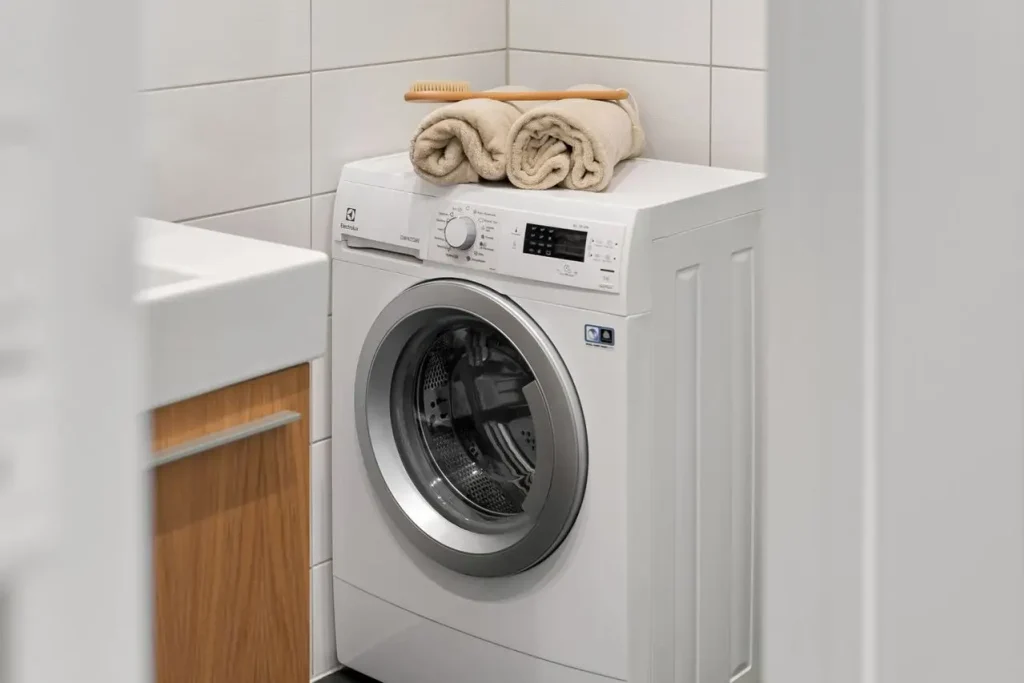
Move a washing machine the wrong way and you’ve got two problems, not one: a dented drum and a warranty that’s now worthless. Every major manufacturer – Bosch, Samsung, LG, Miele – builds transit bolts into the design specifically because the drum swings freely on springs, and that’s fine when it’s washing your towels but disastrous when it’s bouncing around in the back of a van. Get the prep right and it’s a 20-minute job. Get it wrong and you could be looking for a new machine sooner than you’d like.
This guide walks through exactly what to do, in order, whether you’re doing it yourself or handing the job to movers.
Why transit bolts matter (and what happens if you skip them)
A washing machine drum isn’t bolted rigidly to the casing. It hangs on springs and shock absorbers so it can spin at 1,200–1,600rpm without shaking the room apart. That flexibility is brilliant for washing, terrible for transport.
Transit bolts (also called shipping bolts or transport locks) clamp the drum to the outer frame so it can’t swing during a move. Without them, every pothole, gear change and speed bump sends the drum slamming against the sides of the machine.
The damage isn’t cosmetic. It’s usually:
Snapped or bent shock absorbers – the parts that dampen the spin cycle
Cracked drum spiders or bearings – expensive, often not economical to repair
Torn suspension springs
Loosened internal wiring or hose connections from the impact
Here’s the part that actually costs people money: Bosch’s own UK support page on moving a washing machine explicitly tells customers to refit the transit bolts before any move and states this is standard practice for protecting the drum. Samsung’s UK installation guidance carries the same instruction, and both brands treat damage from an unsecured drum as accidental damage rather than a manufacturing fault – which typically falls outside the warranty. In plain English: if an engineer opens up your machine and finds drum or bearing damage consistent with transit without bolts fitted, most UK manufacturers will decline the claim.
This is exactly the kind of detail that gets missed in a rushed move. If you’re already juggling a completion date, keys, and a van booked for four hours, it’s worth building appliance prep into your moving checklist early rather than remembering it in the driveway.

How to find and reinsert transit bolts
If you kept the original packaging or the little bag of bolts from when the machine was first installed, you’re halfway there. Most people don’t – which is the actual problem.
Where they usually end up:
Taped inside the drum door, in a small plastic pouch
In the utility drawer or cupboard where the manual lives (people often move them there “for safe keeping” and then forget)
In the loft or garage with other appliance manuals and spare parts
Occasionally still in the machine’s original cardboard box, if you kept it
If you can’t find them:
Don’t run the machine and don’t move it unsecured “just this once.” Order replacement transit bolts direct from the manufacturer or a parts supplier – they’re inexpensive, usually £10–£25 for a full set, and model-specific, so have your appliance’s model number (on a sticker on the door frame or back panel) ready when you order.
As a stopgap if bolts genuinely can’t arrive in time, some engineers use tightly packed cardboard wedged between the drum and the outer casing through the door, then tape the door shut. It’s not as secure as proper bolts and manufacturers don’t endorse it as equivalent, but it’s better than moving a completely unsecured drum. Reinstall proper bolts and remove the cardboard the moment you have them.
Step-by-step pre-move prep
Do this the night before or morning of the move – not while the van’s idling outside.
1. Run a hot maintenance wash first (optional but sensible). A 60°C or 90°C empty cycle clears detergent residue and reduces the chance of standing water sitting in the drum for weeks in transit.
2. Turn off the water supply. Isolate the valve behind the machine – usually a small tap on the pipe – before touching any hoses.
3. Disconnect the inlet hose. Unscrew it from the tap connection. Have a towel and shallow bowl ready; there’s always a cupful of water still sitting in the hose.
4. Disconnect the outlet (drain) hose. Pull it from the standpipe or under-sink connection. Drain any residual water into a bucket – tip the hose gently, don’t just yank it free.
5. Drain the machine itself. Most machines have a small drain filter at the bottom front. Open it over a shallow tray; expect anywhere from a splash to a litre of water depending on the last cycle.
6. Fit the transit bolts. Covered above – this is the step people skip under time pressure, and it’s the one insurers and manufacturers care about most.
7. Secure the door. Tape the door shut, or use the transit strap if your model came with one, so it can’t swing open and knock against the frame in the van.
8. Unplug and coil the power cable. Loosely coil it and secure with tape or a cable tie – don’t wrap it tightly around the machine’s feet, as this stresses the cable at the plug end.
9. Coil and tape both hoses to the back panel. Loose hoses snag on doorframes and stair rails, and a torn hose is an unplanned expense at the new place.
If any of this feels like a lot to remember on moving day itself, it’s one of the reasons people bring in specialists rather than DIY it. At EcoGreen Movers we’ve handled appliance prep as part of over 400 completed house moves, and disconnecting and securing a washing machine correctly takes our crews a few minutes because it’s routine. If you’d rather hand the whole job over, get a quote and we’ll take it from the utility room to the new property.
How to physically move a washing machine
Know the weight before you lift. Most freestanding washing machines weigh between 60kg and 90kg, with integrated and larger-capacity (9kg+ drum) models sitting at the heavier end. That’s roughly the weight of a large adult – not something to lift solo, and not something to twist your back over.
Lifting technique that actually protects you:
Per the HSE’s official guidance on manual handling, the principles that matter most here are:
Keep the load close to your body, not held at arm’s length
Bend your knees and hips, not your back – don’t stoop or squat fully
Get a firm grip low down, using the frame or base, not the control panel or door
Lift smoothly, using your legs to straighten up – no jerking
Never twist while carrying; move your feet to turn instead
Two people, one at each side, is the realistic minimum for lifting a washing machine even a short distance. If you’re doing this alone because no one’s around to help, that’s the point to stop and call in help rather than risk a back injury.
Use an appliance trolley (sack truck) for any real distance. Tilt the machine back slightly, slide the trolley’s plate under the base, strap it in place across the middle, and wheel it rather than carrying it. This is non-negotiable on anything beyond a few steps – appliance weight plus an uneven grip is exactly how backs get injured.
Protecting floors and stairs. Lay down a moving blanket or thick cardboard runner on stairs and hallway flooring before you start. A dropped or dragged washing machine will gouge wood flooring and crack tiles in seconds. On stairs, go slowly, one step at a time, with the heavier end controlled by the person below.
This is genuinely one of the more common ways house moves go wrong on the day – not the packing, but a heavy appliance on a narrow staircase. It’s a big part of why people search for a removals company that actually cares rather than the cheapest van hire they can find; the right team has the trolleys, straps and floor protection already sorted.

Transit in the van: upright only
This is where a lot of DIY moves go wrong even after the bolts are fitted correctly.
Washing machines must travel upright – never on their side or back. Lying a machine down, even briefly, can:
Let residual water run into the motor or electronics
Shift the drum against the transit bolts at an angle they’re not designed for
Strain the door seal and hinges under uneven weight
In the van:
Stand it upright against the van wall, ideally in a corner where two sides are supported
Strap it securely using ratchet straps through the frame or handles, not just resting against other boxes
Don’t stack anything heavy against the door or control panel
Keep it away from the very back doors, where it takes the brunt of braking
If you’re moving to Manchester or another city and hiring a local team, ask directly how they secure appliances – a reputable house removals service in Manchester or elsewhere should have appliance straps and blankets as standard kit, not an afterthought.
Reinstallation at the new property
1. Position the machine roughly in place before connecting anything – you’ll want a little room to reach behind it.
2. Reconnect the inlet hose to the water valve, hand-tight plus a quarter turn with pliers. Over-tightening cracks the plastic fitting.
3. Reconnect the outlet hose to the standpipe or waste connection, making sure it isn’t kinked and sits at the height specified in the manual (usually 60–100cm).
4. Turn the water supply back on and check every connection for leaks before plugging in – run your hand along each joint and look for drips over the next few minutes rather than walking away immediately.
5. Remove the transit bolts again. This is the step people forget once they’re mid-unpack and just want the machine running – but leaving bolts in during a live cycle causes the same drum damage as skipping them on the way out. Store them somewhere logical (taped inside a kitchen drawer, labelled) for the next move.
6. Level the machine. Adjust the feet so it doesn’t rock; an unlevel machine vibrates, walks across the floor during spin, and wears the drum bearings faster.
7. Run a first cycle empty, ideally a quick or rinse cycle, before you trust it with a full laundry load. Watch it for the first few minutes to check it’s not walking, leaking, or making an unusual noise.
Both Bosch’s UK support page and Samsung’s UK installation guidance list this exact sequence – bolts out, level, reconnect, leak-check – as the standard post-move routine, and it’s worth following it in that order rather than rushing to switch it on.
Common mistakes that get warranty claims rejected
Manufacturers and engineers see the same handful of errors again and again:
Running the machine with transit bolts still fitted – by far the most common cause of drum and bearing damage, and the easiest for an engineer to spot on inspection
Moving it on its side to fit through a doorway or into a van more easily
Not draining the machine or hoses, leading to water damage to electronics during transit
Reconnecting hoses cross-threaded or over-tightened, causing a leak that’s then blamed on a “faulty machine”
No proof of correct installation – some manufacturers ask for evidence the machine was reinstalled to spec if a fault appears shortly after a move
DIY house moves without appliance experience, where the washing machine gets treated like any other box rather than a heavy item with a suspended drum
Which?’s consumer appliance guidance is a useful general reference for appliance care and what’s reasonable to expect from a machine’s lifespan – worth a read if you’re weighing up whether an older machine is even worth moving versus replacing.
If you’re totting up removal costs anyway, it’s worth checking a realistic moving costs guide for the UK so you know where professional appliance handling sits against DIY van hire once you’ve factored in the risk of a warranty claim going wrong.
When to call a professional vs DIY
DIY makes sense if:
You’ve got the original transit bolts (or genuine replacements) and the model’s manual
You have a second pair of hands and an appliance trolley
It’s a short move – same building, ground floor, no stairs
The machine’s out of warranty anyway, so the financial risk is lower
Call in professionals if:
You’ve lost the transit bolts and can’t get replacements before moving day
There are stairs, tight doorways, or long carries involved
The machine is integrated (built into cabinetry) and needs careful removal
You’re moving several heavy appliances alongside furniture and don’t want the day to become a logistics exercise
The machine is still under warranty and you want documented, correct handling in case anything’s ever questioned
We’ve built our reputation over 400+ completed moves partly on getting the boring-but-critical stuff right – appliances secured properly, floors protected, nothing rushed. We’re fully insured, so if something did go wrong it’s covered, not an argument. And because we’ve planted over 100 trees as part of how we run the business, choosing us also means the move itself is a bit lighter on the planet. If a washing machine (or a fridge-freezer, or a piano) is part of your move, get in touch for a quote and we’ll tell you honestly whether it’s a job for us or a job you can handle yourself.
FAQ
Do I really need to refit transit bolts every time I move a washing machine? Yes. Every move counts, whether it’s across the country or just to a different room. The drum can shift and damage itself over a surprisingly short, bumpy journey – manufacturers like Bosch and Samsung specify this in their own UK support guidance, not as a precaution but as a requirement.
What happens if I’ve already moved my washing machine without transit bolts? Stop using it and check for obvious signs of damage – unusual noise, excessive vibration, or the drum sitting unevenly. If it seems fine, run an empty test cycle and watch it closely. If it’s making noise it didn’t make before, get an engineer to inspect it before you rely on it, and be upfront about the move if you ever raise a warranty claim.
Can I lay a washing machine on its back to get it through a doorway? No. Keep it upright at all times, even for tight manoeuvres. If it genuinely won’t clear a doorway upright, that’s a sign to call professional movers with the right equipment rather than force it on its side.
How much does it cost to have a washing machine moved by professionals? It varies by distance, access (stairs, parking, van size) and whether it’s part of a full house move or a standalone appliance job. Our moving costs guide breaks down typical UK removal pricing, and we’re happy to give you a specific figure through a quick quote.
Will moving my washing machine myself void the warranty even if nothing looks broken? Not automatically – the warranty covers manufacturing faults, not the move itself. But if damage does show up later and an engineer finds evidence consistent with an unsecured drum (bent shocks, cracked bearings), most manufacturers will treat that as accidental damage rather than a covered fault, regardless of when the move happened.
Key takeaway
Move a washing machine correctly – bolts in, hoses drained, upright the whole way – and it’s a non-event. Skip a step, and you’re gambling with a machine that costs several hundred pounds to replace and a warranty that manufacturers like Bosch and Samsung will quite reasonably decline to honour.
If you’d rather not carry that risk on your own moving day, that’s exactly the kind of job we’re set up for. EcoGreen Movers has handled appliances across 400+ completed house moves, we’re fully insured for peace of mind, and we run the business with over 100 trees planted so far as part of doing this a little more responsibly. Whichever level you book makes no difference to how the machine is handled: Standard covers loading and unloading, Standard Plus adds furniture dismantling, and Premium adds the packing. Boxes are sold separately for anyone packing themselves, and storage is available where an appliance has to wait for a kitchen to be finished. Get a free quote and let us worry about the transit bolts.