
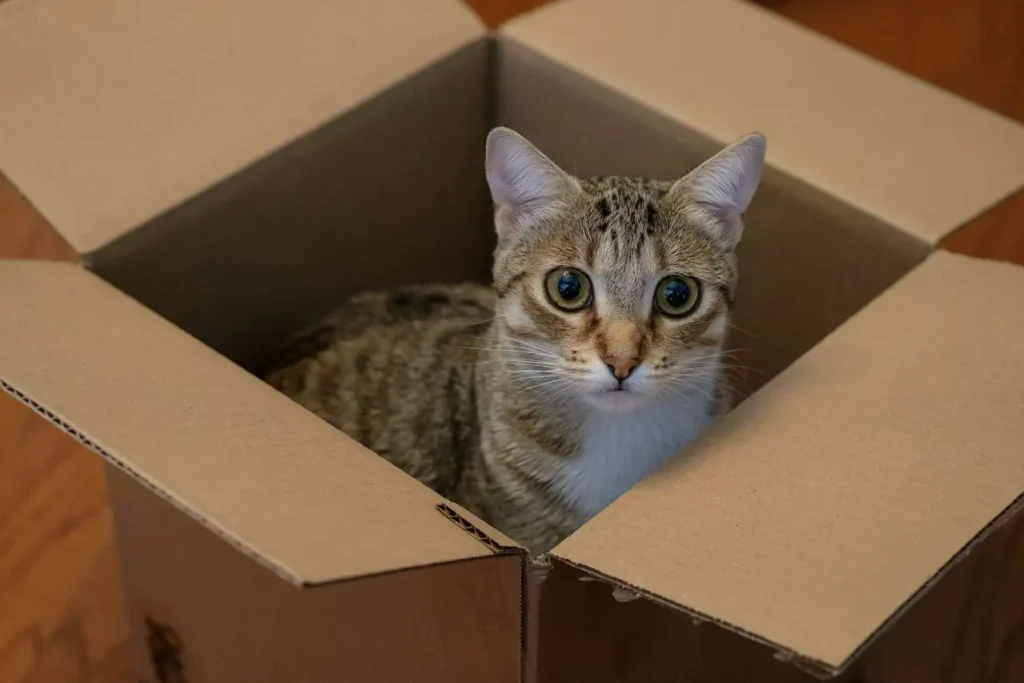
Moving house with pets doesn’t have to mean a stressed cat hiding under the bed for a week or a dog bolting through an open van door. Get the basics right – update the microchip, keep pets somewhere quiet and familiar on the day itself, and rebuild their routine fast in the new place – and most cats and dogs settle within a couple of weeks. This guide walks you through exactly how, step by step, from six weeks out to the first month in your new home.
If you’re a UK homeowner or renter with a cat, a dog, or both, you already know they can’t just be told what’s happening. They pick up on the boxes, the smell of bubble wrap, the strange silence where the sofa used to be – and it unsettles them. The good news: with a bit of planning, you can keep that stress to a minimum.

Preparing Your Pet Weeks Before Moving Day
Start early. The pets that cope best with a move are the ones whose routine barely changes until the last possible moment.
6-8 weeks before:
Book a vet check-up. Ask for a copy of vaccination records, especially if you’re registering with a new practice.
Confirm your pet’s microchip details are current – this is a legal requirement, not just good practice (more on that below).
If your dog or cat is on repeat medication, order enough to cover the move plus a couple of weeks either side, in case registering with a new vet takes time.
2-4 weeks before:
Start bringing packing boxes into rooms gradually rather than all at once. A house that fills with boxes overnight is far more alarming than one that changes slowly.
Keep feeding times, walks, and play sessions exactly as they are. Routine is the single biggest stress-reducer you have.
If your cat or dog is naturally anxious, ask your vet about calming aids – plug-in pheromone diffusers (Feliway for cats, Adaptil for dogs) started a few weeks ahead can take the edge off.
Research vets, parks, and (for dogs) secure walking routes near your new address so you’re not scrambling on day one.
The week before:
Pack a “first night” bag for your pet: food, bowls, lead, litter tray, favourite bedding, a couple of toys, and any medication. Keep this separate from the general packing so it doesn’t end up buried in a van.
If you’re working to a proper timeline, our complete house move checklist is worth running through alongside this list – pets are one part of a much bigger picture.
For Cats
Cats are territorial and scent-driven, so the run-up matters more for them than it does for dogs. Don’t wash bedding or blankets in the final week – that familiar smell is genuinely comforting once you arrive.
For Dogs
Dogs pick up on your stress levels, so try to stay calm and stick to normal walk times right up to moving day. A well-exercised dog on the morning of the move is a calmer dog by the afternoon.
Choosing Safe Transport for Cats and Dogs
How your pet travels matters as much as where they end up. The RSPCA is clear that animals must be safely restrained during any journey, kept away from extreme temperatures, and never left unattended in a vehicle.
Pet | Recommended transport | Key rule |
|---|---|---|
Cat | Secure hard-sided carrier, seatbelted or wedged flat | Never let a cat travel loose in the car |
Small dog | Crate or carrier, secured in the boot or rear footwell | Ventilation and shade are essential |
Large dog | Dog seatbelt harness or travel crate | Frequent breaks on longer journeys |
Moving With Cats
Cats find the car itself stressful before you’ve even started the engine. A hard carrier with a blanket over the top (leaving airflow at the front) mimics a den and cuts down visual stimulation. Line it with something that already smells of home. For journeys over an hour, stop somewhere quiet to offer water – but keep the carrier closed.
Moving With Dogs
Most dogs cope better with car travel than cats do, but that doesn’t mean no preparation. Use a crash-tested harness or a secured crate – loose dogs in a moving car are a genuine safety risk, both to them and to the driver. Build in a stop every couple of hours on a long-distance move for water, a toilet break, and a stretch. Don’t feed a large meal right before travelling if your dog is prone to car sickness.
If you’re moving any real distance, it’s worth checking your removals company is genuinely comfortable working around pets. Our guide on how to choose a removals company that actually cares covers exactly what to ask before you book – including whether they’re happy for a pet to stay in one room while they load the van, rather than expecting you to have everything crated and gone by 8am.

Moving Day: Keeping Pets Calm While It All Happens Around Them
Moving day is the single most disruptive point for any pet – strangers in the house, doors left open, furniture disappearing. The safest option, by a distance, is to remove your pet from the chaos entirely.
Best option: Ask a friend or relative to look after your cat or dog for the day, somewhere completely separate from both properties. This is genuinely the lowest-stress choice and worth arranging well in advance.
If that’s not possible:
Set aside one room that’s already been cleared and won’t be touched until last. A bathroom or a bedroom works well.
Put a clear sign on the door so nobody – including the removal team – opens it by accident.
Inside, provide food, water, a litter tray (cats), bedding, and a couple of familiar toys.
Check on them periodically, but keep visits calm and brief – you don’t want to add more foot traffic to an already unsettling day.
Load your pet into the car (or hand them to whoever’s minding them) last, once the van is packed and the noise has died down.
Never let a dog roam free while the van’s being loaded, even if your garden’s normally secure – an open gate or an unfamiliar removal team member holding a door is all it takes for a spooked dog to bolt.
If your move has come together in a rush, our advice for a last-minute house move is worth a quick read – pets are usually the first thing to get overlooked when time’s tight, and a five-minute plan now saves a much harder evening later.
Settling Pets Into the New Home
The first hour in a new house sets the tone for the following weeks, so slow it down deliberately.
Settling Cats
Cats Protection recommends confining a cat to one quiet “safe room” for at least the first week, sometimes two. Set it up before you bring the cat in:
Litter tray, food, and water – kept well apart from each other.
A hiding spot (a box or carrier with the door removed works fine).
Something with your scent, and something with the cat’s own scent, like unwashed bedding.
Carry the cat straight into that room in their carrier and open the door, letting them come out in their own time. Don’t force interaction. Leave them be for the first hour or so. Only expand their territory to the rest of the house once they’re confidently eating, using the tray, and moving around the safe room. Most cats need 2-3 weeks indoors before you consider letting them outside, and even then, go out with them the first few times and call them in before a meal so they learn the way back.
Settling Dogs
Dogs generally adjust faster than cats because they’re led by you rather than by territory. Still:
Take them to a quiet room first, away from unloading and unpacking, with their bed, water, and a familiar toy.
Dog-proof before you let them explore – check garden fencing, gaps under gates, and anything toxic (unpacked cleaning products, plants) left within reach.
Reintroduce mealtimes and walk times immediately, at the same hours as before. Familiar structure does more for a settling dog than anything else.
Let them explore the house one room at a time, on a lead if needed, rather than free-ranging on day one.
Both Dogs Trust and the RSPCA note that even normally well-behaved dogs can act unpredictably in the first few days somewhere new, so keep supervision tight until you’re confident they know the boundaries of the new place.
Recognising Pet Anxiety and How to Calm It
Even with the best prep, some stress is normal. Knowing what to look for means you can step in early.
Signs to watch for, per the PDSA:
Hiding, freezing, or a tucked tail
Excessive panting or drooling when it’s not hot
Pacing, trembling, or repetitive lip-licking
Loss of appetite or toileting accidents
Excessive vocalisation – meowing, barking, or whining
Clinginess or, conversely, avoiding you altogether
What actually helps:
Don’t over-comfort a distressed pet – it can reinforce the anxiety rather than ease it. Stay calm, neutral, and present.
Stick rigidly to feeding and walk times – predictability is calming in itself.
Use pheromone diffusers or sprays in the new home from day one.
Give them a defined retreat space they can return to whenever things feel too much.
If signs persist beyond a couple of weeks, or you see ongoing appetite loss, destructive behaviour, or toileting issues, speak to your vet. Persistent anxiety sometimes needs a proper behavioural plan, not just patience.
Microchipping and Legal Requirements for UK Moves
This bit’s not optional. Under UK law:
All dogs must be microchipped, with contact details up to date, since 2016.
All cats in England must be microchipped by 20 weeks old, a rule that became mandatory from 10 June 2024 under the Microchipping of Cats and Dogs (England) Regulations 2023.
Failing to update your address on the microchip database isn’t itself an offence, but it defeats the entire point of the chip if your pet goes missing during the chaos of a move – and yes, this happens more often during moving week than almost any other time.
Fines for non-compliant microchipping can reach £500.
Update these the moment you have your new address:
The microchip database (most let you do this online in minutes)
The council, if your dog needs a new licence area for anything local
Your vet practice
Pet insurance policy
If you’re only moving within the UK, you don’t need a pet passport or any of the paperwork that comes with travelling abroad – that’s strictly for pets leaving Great Britain. A domestic move, however far, is a microchip update and nothing more from a legal standpoint. Full detail on the current rules is on the government’s official microchipping guidance.
Long-Distance vs Local Moves: What Changes for Pets
A move across town is a very different proposition to one across the country, and it’s worth planning for the difference rather than assuming “a move’s a move.”
Local moves (under an hour):
Pets can usually travel in one go, in the family car, with minimal breaks.
Existing vet, walking routes, and routines can often stay the same.
Lower risk overall – but don’t skip the safe-room step; distance isn’t what causes the stress, disruption is.
Long-distance moves:
Plan rest stops for water and toileting, roughly every 2 hours for dogs.
Book a new vet in advance rather than waiting until you need one.
Consider whether your pet needs a light meal a few hours before travel rather than right before – reduces the odds of travel sickness.
If you’re relocating somewhere like Manchester or Edinburgh, it’s worth checking that your removals firm has real local experience – see our pages on house removals in Manchester and removals in Edinburgh for what a properly planned regional move looks like, pets included.
Keep your pet’s “first night” bag with you in the car, not in the removal van – you don’t want to be searching boxes for a food bowl after a five-hour drive.
Common Mistakes That Stress Pets Unnecessarily
Most pet-related move stress comes down to a handful of avoidable errors:
Packing everything at once. A room that changes overnight is far more alarming than one that empties gradually over two weeks.
Letting pets roam free on moving day. Open doors, strangers, and a van ramp are a genuine escape risk – even for pets that have never bolted before.
Skipping the microchip update. It costs nothing and takes minutes, yet it’s the single biggest factor in whether a lost pet gets home.
Rushing the settling-in period. Giving a cat the run of the house on day one, rather than one room first, is one of the most common reasons cats disappear or hide for days afterwards.
Changing food or routine at the same time as the move. Keep as much the same as possible – new food, new bed, and a new house all at once is a lot for any animal to process.
Forgetting a “first night” essentials bag. Nothing extends a stressful evening like hunting through forty boxes for the litter tray at 9pm.
Not booking pet care for moving day itself. Even a few hours with a friend on the day removes the single most chaotic part of the whole process for your pet.
Frequently Asked Questions
How long does it take a cat to adjust to a new home?
Most cats need around 2-3 weeks to feel settled, though nervous cats can take up to a month. Keeping them confined to one safe room for the first week, then gradually expanding their territory, speeds this up considerably.
Should dogs be present while the removal van is being loaded?
No – it’s best to keep dogs in a quiet, closed room or have a friend look after them elsewhere. Open doors and unfamiliar people moving furniture create a real risk of a stressed dog escaping.
Are sedatives a good idea for anxious pets on moving day?
Only if prescribed by a vet. Over-the-counter calming aids like pheromone diffusers are fine to try, but sedation should always be discussed with a vet first, particularly for animals with underlying health conditions.
Do I need a pet passport to move house within the UK?
No. Pet passports and related paperwork only apply when a pet is travelling abroad. A domestic move just requires an up-to-date microchip registration.
What should go in a pet’s “first night” bag?
Food, water bowls, a litter tray for cats, bedding, a couple of familiar toys, a lead, and any medication. Keep it separate from general boxes so it’s the first thing you unpack.
Can I let my cat outside straight after moving?
No – most advice, including from Cats Protection, recommends keeping cats indoors for at least 2-3 weeks so they can properly settle and won’t try to head back to the old address.
Moving day runs far more calmly for a nervous animal when the human side is under control. EcoGreen Movers works to a confirmed arrival window rather than a vague morning slot, which makes keeping one quiet room undisturbed considerably easier. Premium is worth considering with pets in the house, because a packed home is a shorter period of upheaval than a fortnight of boxes appearing one room at a time. Standard Plus deals with the furniture, Standard covers the lifting, and boxes are available on their own. Storage helps where a pet-friendly property is not ready on the same day.