
Light bulbs divide into two groups with completely different disposal routes, and the deciding question is whether the bulb contains electronics. Light-emitting diode bulbs, usually called LEDs, along with compact fluorescents and fluorescent tubes, are electrical waste and must not go in a household bin. Old-style incandescent bulbs and halogens contain no electronics and, awkwardly, have no recycling route at all.
The one thing that applies to all of them: none belong in the glass recycling bin. Bulb glass has a different composition and melting point from bottles and jars, and a single bulb can compromise a batch. This is one of the most common recycling mistakes in UK households.
Summary: LEDs, energy-saving bulbs and fluorescent tubes go to electrical waste recycling, available at recycling centres and many larger retailers. Nothing goes in the glass bin. Fluorescent tubes contain mercury, so handle them carefully and never break one deliberately. For the old filament sort, Recycle Now advice on light bulbs is that older style incandescent bulbs are not recyclable and should be put in the waste bin.

Identifying what you are holding
| Type | How to recognise it | Where it goes | Hazard |
|---|---|---|---|
| Light-emitting diode, LED | Plastic body, heavy for its size, cool to touch in use | Electrical waste recycling | None significant |
| Compact fluorescent, CFL | Curled or folded tube, slow to reach brightness | Electrical waste, treated as hazardous | Contains mercury |
| Fluorescent tube or strip | Long straight or circular glass tube | Recycling centre hazardous area | Contains mercury |
| Halogen | Small capsule or reflector, very hot in use | General waste | Glass fragments |
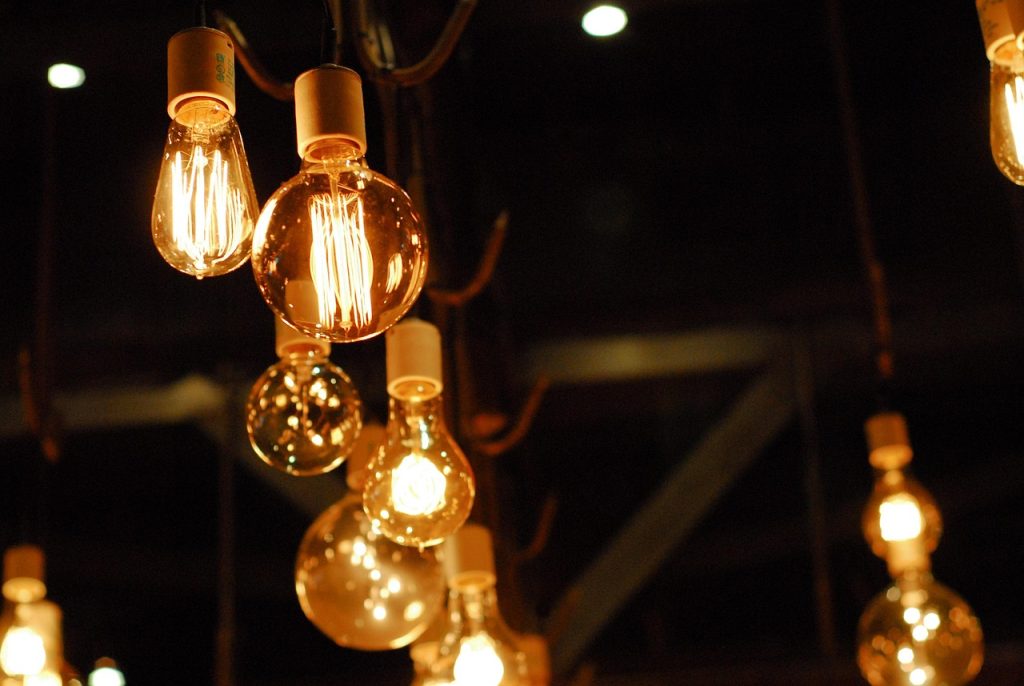
| Incandescent | Clear or pearl glass with a visible filament | General waste | Glass fragments |
| Smart bulb | LED with wireless control | Electrical waste recycling | None significant |
If you cannot tell, weight is a decent indicator. LEDs and compact fluorescents contain drivers and ballasts and feel noticeably heavier and more solid than an incandescent bulb of the same size. An old incandescent is mostly empty glass with a wire in it.
The crossed-out wheelie bin symbol is the definitive marker. Anything carrying it falls under electrical waste rules and must not go in a household bin. Most LEDs and compact fluorescents carry it; incandescent and halogen bulbs do not, which is precisely why they end up in general waste.
Where to take the recyclable ones
Household waste recycling centres accept all bulb types, usually with a separate container for fluorescent tubes because of the mercury. Larger shops must help too, but the rule is narrower than most people assume: under regulation 42 of the Waste Electrical and Electronic Equipment Regulations 2013, a store with an electrical sales area of at least 400 square metres must take back very small electrical waste free of charge with no obligation to buy anything, where very small means no external dimension over 25cm.
That 25cm limit is the detail worth carrying into the shop. A dead LED or a compact fluorescent comfortably qualifies. A four-foot or five-foot fluorescent tube does not, and no amount of asking at the customer service desk will change that, so tubes are a recycling centre job.
Smaller shops have a different duty. Every retailer selling electrical goods must offer some route for disposing of the old item when they sell you the new one, on a like-for-like basis, and GOV.UK guidance on retailer and distributor responsibilities confirms this applies however the sale is made, in store, online, by mail order or by telephone. Retailers without their own take-back service join a national scheme instead, which funds the recycling centre network rather than putting a bin in the shop. That is why participation feels so inconsistent from one store to the next.
The Recycle Now postcode locator will find your nearest option for a specific item, and your council’s A to Z waste page will confirm whether small electricals are collected at the kerbside where you live. Both take a minute and save a wasted journey.
What actually happens to a recycled bulb is worth knowing, because it makes the trip feel less pointless. LEDs are separated into glass, metal, plastic and electronic components. Fluorescent tubes are processed in sealed equipment that captures the mercury vapour, recovering the phosphor powder, the glass and the aluminium end caps. Both are genuine material recovery rather than energy recovery, which is not true of every recycling stream.
Mercury, and what to do about a breakage
Compact fluorescents and fluorescent tubes contain a small quantity of mercury, and the correct clean-up is different from sweeping up ordinary broken glass. Guidance from the United States Environmental Protection Agency, the most detailed published on the subject, is to get people and pets out, air the room for five to ten minutes, and switch off central forced-air heating or air conditioning before you touch anything.
The heating point is the one almost everybody misses. A system that moves air around the house will move vapour with it, so the switch matters as much as the open window. Britain has no equivalent published guidance, which is why the American agency’s version is the one worth following.
- Ventilate first, clean second. Five to ten minutes minimum with a window or door open to the outside.
- Switch off central heating or air conditioning. Anything that circulates air through the house.
- Do not vacuum. It can spread mercury-containing powder and vapour through the room and contaminate the machine.
- Use stiff card and sticky tape. Scoop the larger pieces with card, then lift the fine fragments and powder with tape.
- Wipe with a damp paper towel. Then put the towel in with the debris.
- Seal it in a jar or a double bag. A glass jar with a metal lid holds vapour better than a bag. Take it to the recycling centre rather than binning it.
- Throw away anything the powder touched directly. Clothing or bedding in direct contact with the debris should be binned rather than washed, because fragments can contaminate the machine.
On carpet, pick the fragments up by hand and with tape rather than reaching for the vacuum. The agency’s position is that vacuuming is a last resort once all the visible material has gone, and if you do use one, empty it into the sealed container and take that outside.
Never break tubes deliberately to make them fit a bin. That is the one action that turns a contained hazard into a released one, and it is depressingly common when people are clearing a garage in a hurry.

Why you have a drawer full of these
Both of the awkward types are on their way out of the shops. The GOV.UK announcement on the end of halogen light bulbs set out the sale of halogen bulbs ending from September 2021 and the removal of fluorescent lights from shelves from September 2023, following an earlier phase-out of higher-energy halogens that began in 2018.
That explains the drawer. Households stocked up, fittings outlived the bulbs made for them, and the leftovers migrated to the loft. It also explains why a house clearance turns up formats you cannot buy any more.
The same announcement banned something less obvious and more annoying: light fittings with fixed bulbs that cannot be replaced, meaning the whole fitting had to be thrown away when the bulb died. Those accounted for around 100,000 tonnes of electrical waste a year, out of a UK total of roughly 1.5 million tonnes. If you have one of those in a property you are leaving, it is worth knowing it goes to electrical waste whole rather than to general waste.
Fittings, and what stays with the property
Light fittings are generally treated as fixtures and stay with the property unless the fittings and contents form says otherwise. Taking one you intended to keep without declaring it is a common source of friction at completion.
If you want to take a particular pendant, chandelier or wall light, say so on the fittings and contents form at the outset rather than mentioning it later. Buyers price a property on what they saw, and removing something visible after an offer causes disproportionate ill feeling.
Where a fitting is being removed, it must be replaced with something safe and functional rather than leaving bare wires in a ceiling rose. That is both a courtesy and a safety obligation, and a basic pendant costs very little.
Any removal or replacement of a fitting is electrical work. Isolating the circuit at the consumer unit first is the minimum, and anything beyond swapping a like-for-like pendant is better left to a qualified electrician, particularly in a property you are about to hand over.
Smart bulbs are worth a specific mention. They are yours rather than the property’s, and they are easy to forget because they look like ordinary bulbs. Reset them to factory settings before removing them, and take the hub with you.
Bulbs and a house move
Bulbs are frequently removed by sellers, and arriving at a dark house on moving evening is a genuinely bad start. Buy a few spares before you move and put them in the box that travels with you rather than in the van. Standard bayonet and screw fittings in warm white cover most eventualities, and the cost is trivial against the alternative of hunting for a shop on the first evening.
If you are the one leaving, leaving the bulbs in is a small courtesy that costs almost nothing and is remembered. If you are taking specialist or expensive bulbs, say so in advance through the agent rather than surprising the buyer.
A move is also the natural point to clear the drawer of dead bulbs that every house accumulates. They sort quickly into the two groups described above, and dealing with them in one trip alongside batteries and paint is far easier than doing it in three. Our guides to battery disposal and paint disposal cover the other two items that surface from the same cupboards, and our guide to clearing the loft before moving house covers where most of them are hiding.
Pack any bulbs you are keeping properly. A bulb loose in a box of kitchen items will break, and a broken compact fluorescent inside a sealed box is the version of this problem you least want.
Loft and garage clear-outs commonly turn up boxes of spare bulbs bought for fittings that no longer exist, often in obsolete formats. Those are worth offering on a local community group before disposal, since somebody with an older fitting will genuinely want them. Unopened bulbs in their packaging are also accepted by some reuse projects and community repair groups. A working bulb in a box is a usable product rather than waste, and treating it as waste because it was in a loft is the wrong instinct.
Why the old bulbs have no route
It is genuinely counterintuitive that the simplest bulb is the hardest to recycle, so it is worth setting the two groups side by side.
| Factor | LED and fluorescent | Incandescent and halogen |
|---|---|---|
| Contains electronics | Yes | No |
| Covered by electrical waste rules | Yes | No |
| Recoverable material value | Metals, glass, phosphor | Negligible |
| Glass type | Not bottle glass either | Not bottle glass |
| Realistic destination | Electrical waste recycling | General waste |
Recyclability here follows regulation and material value rather than simplicity. An LED is recycled because it falls under electrical waste rules and contains metals worth recovering. An incandescent bulb contains a trace of tungsten in a thin glass envelope, and there is neither a legal obligation nor an economic case for processing it.
The practical consequence is that general waste is the correct destination for old filament bulbs, and this is one of the rare occasions where the bin genuinely is the right answer. Wrap them in paper first so they do not shatter loose in the bag and cut whoever handles it.
It is also an argument for replacing them. An LED lasts many times longer, uses a fraction of the electricity, and has a disposal route at the end of its life. Replacing remaining halogens during a move, when you are handling every fitting anyway, is a sensible moment.
One practical detail on the replacement side. If you are switching a whole house to LED during a move, check the fitting type before buying: bayonet or screw, and the pin spacing on any downlights. Buying a box of the wrong cap type is a common and irritating error when you are working from memory in a shop rather than standing under the fitting.
Check dimmer compatibility too. Older dimmer switches were designed for incandescent loads and can cause LEDs to flicker, buzz or fail early. Dimmable LEDs and a compatible switch solve it, but fitting standard LEDs to an old dimmer produces exactly the poor experience that puts people off them.
When it is not worth a special trip
Two or three dead LEDs do not justify driving to a recycling centre. Keep a small box somewhere and add to it, then take the accumulated lot when you are going anyway or when you have other electrical waste to drop off.
Environmental guidance rarely acknowledges that the journey has its own footprint. A dedicated eight-mile round trip for three bulbs is not an environmental win, and pretending otherwise makes the advice easy to ignore entirely.
The sensible approach is accumulation. A shoebox in a utility cupboard collecting dead bulbs, batteries and small electricals gets emptied two or three times a year on a trip you were making anyway. That is realistic behaviour, and realistic behaviour that happens beats ideal behaviour that does not.
Fluorescent tubes are the exception, because they are awkward to store safely and fragile. If you have several, take them promptly rather than leaving them propped in a garage where they will eventually get knocked over.
For businesses the position is different again. Commercial waste falls under a separate duty of care, and quantities of fluorescent tubes from an office refit need a licensed carrier rather than a trip to a household site.
How EcoGreen Movers handles the awkward items
Bulbs, batteries, half-used paint and garden chemicals all surface from the same cupboards during a move, and several of them cannot travel in a removal van. EcoGreen Movers flags this at the quoting stage rather than on the morning, so nothing is discovered when the van is already half loaded.
We run residential moves across the UK, including London, Manchester and Edinburgh, with a low-waste approach that applies to what leaves a property as much as what arrives. If you would rather hand the whole job over, our Premium service covers professional packing to your specification alongside dismantling and reassembly, with Standard Plus covering the furniture alone and Standard the loading and unloading. We also supply packing boxes and materials on their own without booking a move, offer storage between dates, and handle disposal and clearance for whatever the cupboard sort leaves behind. Get in touch for a quote.
Frequently asked questions
Can bulbs go in the glass recycling bin?
No, and this is the most common mistake with them. Bulb glass has a different composition and melting point from bottles and jars, and it contaminates the batch. No type of light bulb belongs in glass recycling.
Where do LED bulbs go?
Electrical waste recycling, because they contain electronic components. Recycling centres take them, and a store with an electrical sales area of at least 400 square metres must accept very small electrical waste free of charge with no obligation to buy anything. Some councils also collect small electricals at the kerbside.
Are old incandescent bulbs recyclable?
No. Recycle Now advises that older style incandescent bulbs are not recyclable and should go in the waste bin. They contain no electronics, so they fall outside the electrical waste rules, and there is no economic case for processing them. Wrap them in paper first so they do not shatter loose in the bag.
Can I take fluorescent tubes back to a shop?
Usually not. The free take-back that larger stores must offer without a purchase covers very small electrical waste only, meaning items with no dimension over 25cm. A four-foot or five-foot tube is far longer than that. Take tubes to a household waste recycling centre, which will have a dedicated container for them.
What if a fluorescent bulb breaks?
Get people and pets out, open a window and air the room for at least five to ten minutes, and switch off any central heating or air conditioning that circulates air. Do not vacuum. Use stiff card for the larger pieces and sticky tape for fine fragments, wipe with a damp paper towel, seal everything in a jar or double bag, and take it to a recycling centre. Bin anything the powder touched directly rather than washing it.
Should I leave bulbs in when I sell?
It is a courtesy that costs very little and is genuinely appreciated. Light fittings are usually included in a sale unless the fittings and contents form says otherwise, but bulbs are often removed. Buyers should pack a few spares in the box that travels with them.
In summary: electronics recycle, filaments do not
LEDs, energy-saving bulbs and fluorescent tubes are electrical waste and go to a recycling centre or a retailer take-back point, remembering that the no-purchase-needed take-back only covers items under 25cm. Incandescent and halogen bulbs go in general waste wrapped in paper. Nothing goes in the glass bin.
Keep a box for accumulating them rather than making special trips, handle fluorescent tubes carefully because of the mercury, and pack a few spare bulbs in the bag that travels with you on moving day.