
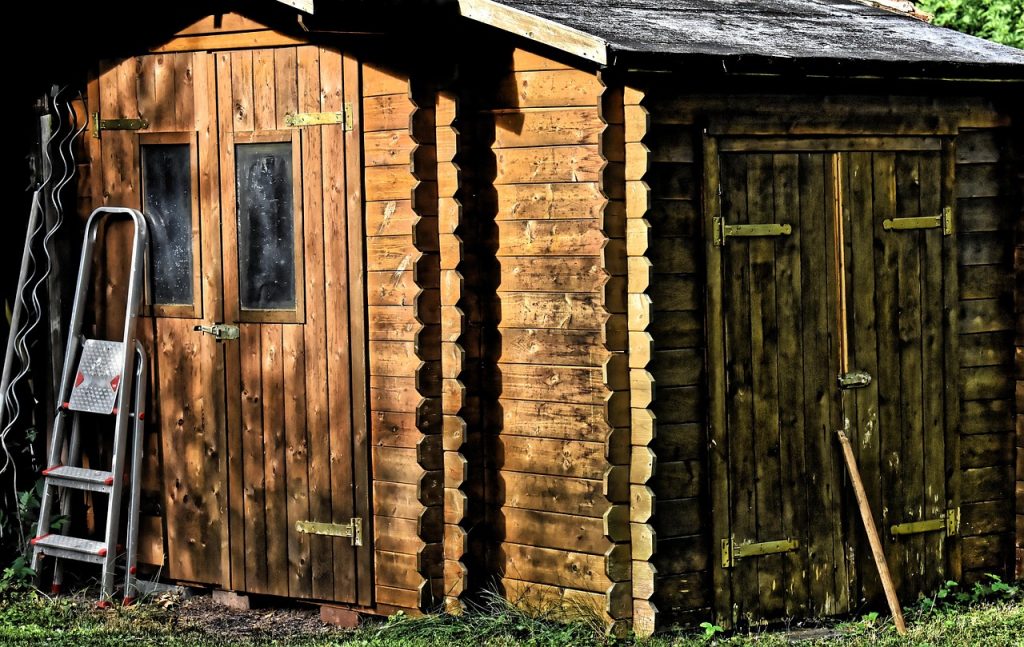
A garden shed can be moved in one piece or taken apart and rebuilt, and three things make the choice for you: how far it is going, whether it can get out of the garden without a detour through the house, and what state the felt and the floor are in. Anything over about eight feet, anything more than a few years old, or anything that has to leave the property is almost always a dismantle job.
Moving one intact across a lawn is genuinely possible. It takes four people, some rollers and a flat route, and it is one of the more satisfying afternoons in home ownership. Moving one intact to a different address is a specialist lift, usually a crane or a Hiab, and it costs more than most sheds are worth.
Summary: For a short move across the same garden, empty it, brace the frame, lift it onto rollers and walk it. For a move to a new address, take it apart panel by panel, label everything and rebuild on a new base. Deal with the fuel first, because the Health and Safety Executive (HSE) is blunt that petrol must never be taken into a house or flat and no removal crew will load it, so read HSE guidance on storing and using petrol safely before you touch the mower. Photograph everything before you start, and expect the roof felt to be a write-off either way.

Deciding between moving it whole and taking it apart
| Situation | Approach | People needed | Main risk |
|---|---|---|---|
| Moving a few metres in the same garden | Slide or roll it whole | Three or four | Racking the frame out of square |
| Moving to the other end of a large garden | Roll it whole if the ground is firm and level | Four | Soft ground, slopes, steps |
| Anything that must pass through a house or narrow gate | Dismantle | Two | Panels are heavier than they look |
| Moving to a new address | Dismantle | Two, plus transport | Damage in transit, missing fixings |
| Shed over 8ft, or older than about ten years | Dismantle | Two | Timber may not survive either way |
| Concrete or metal shed | Specialist advice | Varies | Weight, sharp edges, panel fixings |
Be honest about the shed’s condition before you commit to any of this. If the floor gives underfoot, the corners are soft, or a wall flexes when you lean on it, the structure will not survive being lifted or taken apart. At that point the sensible move is to strip anything reusable, dispose of the rest and buy new, which frequently costs less than the labour of moving an old one.
Check the base too. Most sheds sit on bearers over slabs, gravel or a concrete pad, and the new spot needs an equivalent. Set a shed straight onto soil and you have guaranteed rot within a couple of years, so the base is part of the job rather than an afterthought.
Moving one whole across a garden
Empty it completely first, including anything screwed to the walls, then brace the structure with a diagonal batten screwed across the inside of each wall, because an empty frame flexes badly and a shed that racks out of square rarely comes back. Spread the load across enough people: there is no legal maximum weight for a single lift, and HSE guidance INDG143 on manual handling at work is explicit that its published figures are risk filters rather than safe limits.
The bracing step is the one people skip and the one that decides whether the shed survives. Two battens forming a rough X inside each long wall, screwed rather than nailed, take about twenty minutes and hold everything square while it travels.
Clear and prepare the route before you lift anything. You want a path that is flat, firm and free of steps, wide enough for the shed plus a person on either side. Lay scaffold boards over soft lawn, because a shed corner sinking into wet grass is exactly how a frame twists.
Then jack or lever one end up far enough to slide lengths of scaffold pipe or round fence posts underneath as rollers. Four people, one to a corner, walk it forward while somebody else lifts the freed roller from the back and lays it at the front. It is slow, it looks faintly ridiculous, and it works. Keep everyone out from under the structure and never put a hand beneath a raised edge.
On a slope, do not attempt it. A shed that starts rolling downhill is genuinely dangerous, and that is a job for a dismantle or for a professional with lifting equipment.
Dismantling it properly
Photograph everything first, from every side and from inside, then work in reverse order of assembly: roof felt, roof panels, gable ends, wall panels, floor. Label each panel with a marker as it comes off, including which way up it goes. If the shed has power, that is an electrician’s job at both ends, because running a supply to an outbuilding counts as a new circuit and the Planning Portal page on Approved Document P sets out that notifiable electrical work must be certified by a registered competent person or signed off by building control.
Most sheds are built as panels bolted or screwed together at the corners, with the roof sitting on top. Once you have found the corner fixings the rest follows quickly, and two people can strip a standard 6×4 in an hour or two.
- Roof felt comes off first and does not go back on. Budget for a new roll. Felt is cheap, and old felt tears the moment it is disturbed.
- Keep every fixing. Screws, bolts and brackets into labelled bags taped to the relevant panel, not thrown into one tin.
- Use a screwdriver bit, not a drill on full torque. Old screws strip easily, and a stripped screw in a corner post is a long afternoon.
- Take the door off early. It is the heaviest single component, it swings about while you work, and the walls are far easier to handle once it is out of the way.
- Two people on every panel. Wall panels are awkward rather than heavy, and they flex and split if one person carries them.
- Stack panels flat and covered. Left on edge in the rain, they warp within days.
Panels are the awkward load in a van because they are large, flat and fragile at the edges. Stand them upright against a side wall, strapped, with something soft between each one. Do not lay anything on top of them.

The contents, which are the real job
Most sheds contain things no removal firm will load: petrol and diesel in cans, gas canisters, paint, white spirit, weedkiller, and often a car battery. Removers’ standard terms place dangerous, damaging or explosive items outside the contract entirely, so these need dealing with weeks ahead rather than on the day. Start with the GOV.UK hazardous waste disposal service finder, because many councils take this material by appointment only and cap how much they will accept per visit.
This is where clearing a shed actually eats the time. The structure is a couple of hours. The contents are a weekend and several trips.
Fuel is the first problem. Petrol cannot travel with the removal crew, and it is not accepted at every recycling centre either, so ring ahead. Running the mower until the tank is dry is usually simpler than trying to get rid of half a can. It is worth knowing the rules you are already living under: Schedule 2 of the Petroleum (Consolidation) Regulations 2014 caps domestic storage at 30 litres before you have to notify your local petroleum enforcement authority. Liquefied petroleum gas (LPG) canisters usually go back to the supplier or one of their agents rather than to the tip.
Paint, solvents and garden chemicals count as hazardous waste and go to the recycling centre’s hazardous area, normally pre-booked. Our guide to disposing of leftover paint covers the split between water-based emulsion and solvent-based products, which are not governed by the same rule, and our guide to battery disposal covers the cordless tool packs and the car battery that always turns up behind the mower.
Tools, pots and garden furniture are ordinary items and travel fine, but they are heavy and filthy. Knock the soil off before packing, because soil in a van gets into everything and can carry plant disease to a new garden. Bag compost and pots separately from anything going indoors. If the shed turns out to hold a decade of accumulated junk rather than a working store, our guide to what house clearance actually costs is the more useful read.
Rebuilding it at the new address
The base does more for a shed’s lifespan than anything else. It must be level, firm and free-draining, with the timber floor held clear of the ground on bearers so air can move underneath. Watch the finished height while you are at it, because the Planning Portal outbuildings guidance caps a building within two metres of a boundary at 2.5 metres overall, and height is measured from the ground, so a generous new base can push a previously compliant shed over the line.
Paving slabs on a compacted sub-base, a concrete pad, or a proprietary plastic grid filled with gravel all work. What does not work is setting the shed straight onto soil or grass, which wicks moisture into the floor and rots it from below.
Check the base is genuinely level before you rebuild rather than after. A shed assembled on a base that is out by an inch will never have doors that close properly, and no amount of adjustment later fixes it. A long spirit level and half an hour at this stage saves a permanent irritation.
Rebuild in reverse: floor, wall panels, gable ends, roof panels, then felt. Get the floor square and the first two walls plumb before you add the rest, because errors compound and the roof is what exposes them.
Treat the timber once it is standing. A coat of preservative on a shed that has just been handled, transported and reassembled is the cheapest maintenance available, and the corners and cut ends exposed during the dismantle are precisely where water gets in.
Whether it is worth moving at all
It is worth setting the cost of moving a shed against the cost of replacing it, because the answer surprises people and the attachment to a shed is usually stronger than its resale value.
| Element | Moving it | Replacing it |
|---|---|---|
| Labour | Two people, most of a day, plus the rebuild | Delivery and assembly, often included |
| Materials | New felt, new bearers, replacement fixings | New throughout |
| Transport | Van space that displaces household items | Delivered to the new address |
| Base at the new property | Needed either way | Needed either way |
| Risk | Panels split, frame racks, roof does not sit right | Minimal |
| Sensible when | Shed is good quality, under five years old, or bespoke | Standard shed, older, or any rot present |
Two things stand out from that comparison. The first is van space, a genuine hidden cost that nobody counts. Shed panels occupy a lot of a load and displace household goods, and on a full removal that can be the difference between one van and two, which is a far larger sum than the shed is worth.
The second is that the honest threshold is age and quality rather than sentiment. A well-built shed a few years old, a workshop with a proper floor, or anything bespoke is worth moving. A budget shed that has stood for a decade is not, and stripping it for the usable timber and buying a replacement is both cheaper and less work. If that conclusion stings a little, our guide to decluttering before a move makes much the same argument about everything else in the house.
If you are leaving it behind, say so to the buyer through the agent. Sheds are frequently assumed to be included, and the fittings and contents form is where that gets settled rather than on moving day.
A note on greenhouses, which people assume follow the same rules. They do not. The panes are held by clips under tension, the aluminium frame is far more flexible than timber, and a greenhouse that has stood for years rarely comes apart without something breaking. If you are determined to try, take every pane out first, working from the top down with gloves and eye protection, and store them flat and separated. Most of the time the honest answer is to leave it and buy another.
Log stores, bin stores and small timber structures generally travel whole in a van without dismantling, provided two people can lift them and the van has the length. Measure before you assume, because a six-foot log store does not fit across a Luton bed.
When to stop and get help
Stop if the shed sits on a slope, if it has an electrical supply you cannot isolate, if the structure is visibly rotten, or if the roof is corrugated cement that might contain asbestos. On that last one the position is more nuanced than most people expect: HSE guidance on non-licensed work with asbestos lists removal of asbestos cement roof sheeting as non-licensed work, provided the material is handled carefully and not broken up.
That nuance matters, because plenty of sources will tell you every scrap of asbestos needs a licensed contractor, and that is not what the regulator says. Any building put up or refurbished before the year 2000 may contain asbestos, and cement sheeting on shed and garage roofs is one of the commonest places to find it. Intact and undisturbed it is not a hazard. Broken up it very much is, and the HSE page on notifiable non-licensed work uses dropping a cement roof as its own worked example of where the job changes category. Sheets have to stay whole and damp, hand tools only, and disposal goes through your council rather than into a skip. Ring the recycling centre first, because many limit quantities or refuse it outright. Most people are better off paying somebody.
Electrical supplies to outbuildings are often amateur work and occasionally alarming. Anything beyond unplugging an extension lead needs a qualified electrician to disconnect, and the same applies at the far end when you want power out there again.
Planning matters occasionally too. Most sheds are permitted development, but the limits cover height, position relative to the front of the house, and how much of the garden is already built on, and outbuildings in a conservation area or within the curtilage of a listed building have their own rules. Worth a call to the council before you rebuild somewhere prominent.
And do not try to move a concrete sectional shed or garage yourself. The panels are extremely heavy, the fixings are usually corroded, and it is a specialist removal.
How EcoGreen Movers handles outbuildings
Tell us about the shed at the quoting stage rather than on the day, because panels change the van space calculation and the hazardous garden contents cannot travel at all. EcoGreen Movers surveys access and volume before quoting, so a dismantled shed gets planned into the load rather than discovered beside it. If you are still early in the process, our complete moving house checklist puts the garden on the timeline where it belongs, which is weeks out rather than the night before.
We run residential moves across the UK, including London, Manchester and Edinburgh. If the garden is a big part of the job, say so and we will price it properly. Standard Plus is the level that covers dismantling and reassembly, which is the relevant one for a shed, while Standard is the loading and unloading and Premium adds the packing indoors. Where a shed is not worth moving, our disposal and clearance service can take it and the garden contents that cannot travel. Boxes are sold on their own, and storage covers the gap where a new garden has nowhere to put it yet. Get in touch for a quote.
Frequently asked questions
Can a shed be moved in one piece?
Across a garden, yes, with three or four people, internal bracing and rollers on firm level ground. To a different address, rarely, because it needs a crane or Hiab lift and the cost usually exceeds the value of the shed.
How long does dismantling take?
An hour or two for a standard 6×4 with two people, once the shed is empty. Larger or older sheds take longer, mostly because of corroded screws. Emptying it and dealing with the contents takes considerably longer than the structure does.
Will the roof felt survive?
Almost never. Felt becomes brittle with age and tears as soon as it is lifted. Buy a new roll and fresh clout nails as part of the job, and treat the old felt as waste from the outset rather than hoping.
Can removal firms take petrol from the shed?
No. Fuel, gas canisters, paint and solvents fall under the dangerous and damaging goods that removers’ standard terms exclude from the contract, so they will not be loaded. Run mowers dry, return gas canisters to the supplier, and book the chemicals into a recycling centre before the move.
Does an asbestos cement shed roof need a licensed contractor?
Not automatically. HSE classes careful removal of asbestos cement sheeting as non-licensed work, provided the material comes off whole rather than being broken up, and only treats it as notifiable once it is substantially damaged. Sheets must be kept damp and intact, handled with hand tools, and disposed of through your council rather than in a skip.
Do I need planning permission to put it back up?
Usually not, as most sheds fall under permitted development, but limits apply on height, position and how much of the garden is already covered, and listed buildings and conservation areas have stricter rules. Check with the council before rebuilding in a prominent position.
In summary: brace it, label it, or replace it
For a short move, empty the shed, brace each wall with diagonal battens, and roll it on pipes over a flat prepared route with four people. For anything further, take it apart, photographing and labelling as you go, and keep the fixings with their panels.
Budget for new felt and a proper base either way, and start on the fuel and the chemicals weeks before the van arrives. Then be realistic: if the timber is soft or the shed is a decade old, stripping it and buying new costs less than the day it will take to move it badly.